From the March 2026 issue of Apollo.
Specialists in the art of Anthony van Dyck (we’re a small, tight-knit group) regularly use a geographical shorthand to divide his relatively brief career into four tidy chapters: ‘First Antwerp’, ‘Italy’, ‘Second Antwerp’, ‘England’. These divisions reflect a cosmopolitan and restless life that led Van Dyck to crisscross western Europe, repeatedly establishing himself in different cities and courts. Van Dyck has a complicated reputation to this day: always famous, always coveted by collectors, yet somehow an uneasy fit in the master narratives of art history that favour history painting, machismo and the kind of high-minded artistic independence supposedly embodied by Van Dyck’s predecessor and sometime employer, Rubens. Even in England, where Van Dyck’s influence as a portraitist remained pervasive into the 20th century, he has often been dismissed as a courtly sycophant, all flash and no substance. When the biggest exhibition of Van Dyck’s art in a quarter-century opens this month in Genoa, it will offer a welcome opportunity to revisit this large and complicated body of work and to question the old prejudices that have hindered its proper appreciation.
Van Dyck’s hometown, the Flemish port city of Antwerp, was already in serious economic decline by the time of his birth in 1599. The Spanish had brutally sacked the city in 1576 and the subsequent Dutch blockade of the Scheldt river strangled its trade. Van Dyck’s mother died when he was young and his father, a silk merchant, was unable to support the family. In 1610, the teenage Anthony began to make his way in the world as an apprentice to a local painter, Hendrik van Balen.
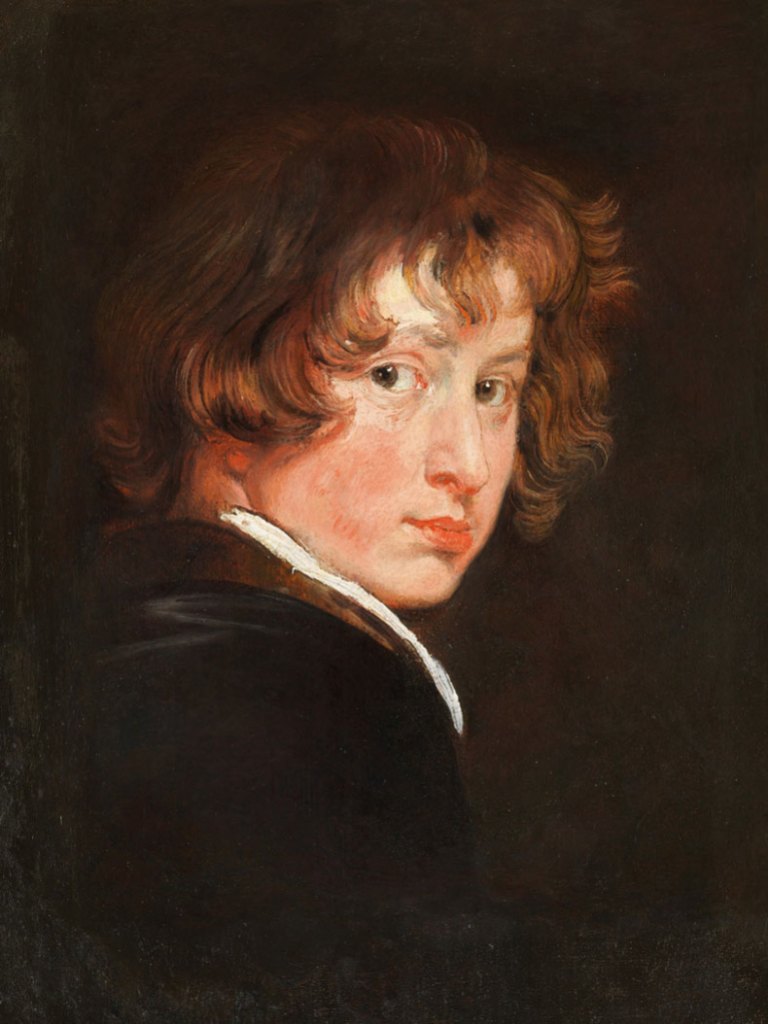
Van Dyck had the luck to launch his career at the start of one of the most astonishing and concentrated artistic flowerings in human history, as innovations in the art market and political upheaval birthed new schools of painting in both the southern and northern Netherlands. While Antwerp lost its status as a centre of trade, its painters refashioned the city as a cultural capital with a bold new style of painting that fused the devotional intensity of the Counter-Reformation, the meticulous craftsmanship of Flemish tradition and the theatrical innovations of the latest Italian art. Van Dyck, one of the greatest artistic prodigies ever born, contributed to this revival from the very start of his career. Unlike Rubens, whose studio he would soon join as an assistant, Van Dyck left behind no halting novice works or artistic awkward phase. His earliest surviving self-portrait (c. 1614) is astonishing in its confidence and painterly bravura. Still sporting the plump cheeks of adolescence, the young artist looks out at the beholder, framed by a mop of russet-colored hair. A slash of white paint, the merest suggestion of a collar, runs below his jawline. While a chilly smoothness characterises Van Dyck’s later work, this early calling card revels in the showiness of impasto. The painter’s hands may be invisible, but every brushstroke calls attention to their preternatural skill.
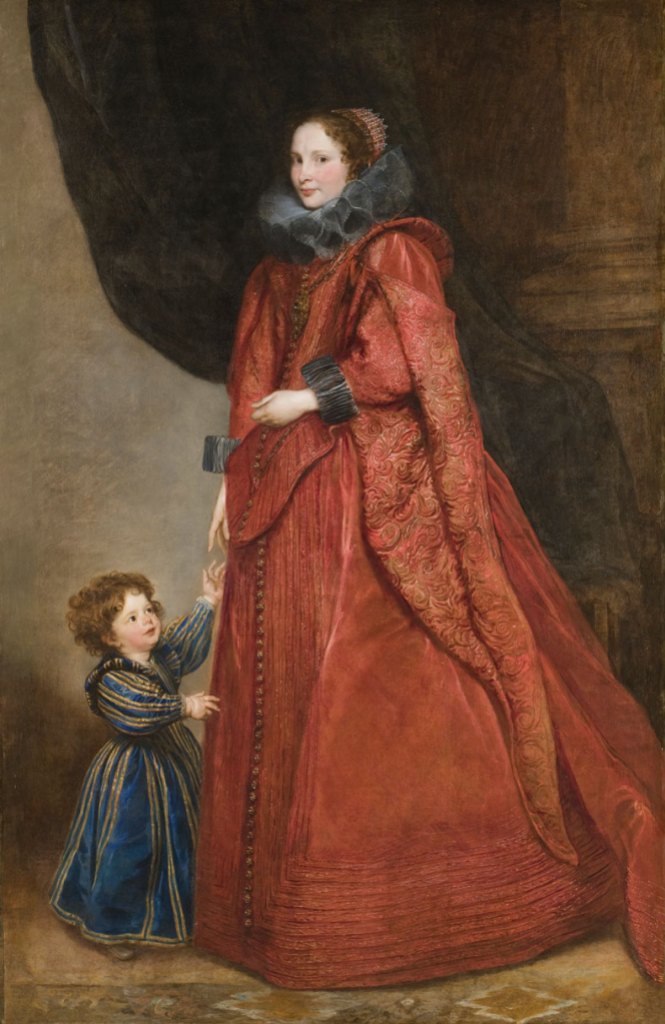
Van Dyck left Antwerp in late 1621 and spent six years traversing Italy, from Venice to Palermo, but Genoa drew him back again and again, making the city an ideal location for the upcoming exhibition. Like Antwerp, Genoa was a port city shaped by artistically inclined merchant-princes, whose pride and grandeur lent it the enduring nickname La superba. Unlike most northern European artists who spent journeymen years in Italy (Rubens being a prime example), Van Dyck didn’t devote himself to the study of classical antiquity and the monuments of Rome. Instead, he drew inspiration from the 16th-century Venetian painting, Titian above all, and from the lavish fashions and dashing confidence of the urban elites. Ancestral portraits by Van Dyck still hang on the walls of Genoese private palaces, as they have for 400 years. The Palazzo Ducale exhibition will complement these holdings by bringing home to Genoa numerous portraits that were eagerly acquired by British and American collectors of the Gilded Age, who saw their own aspirations affirmed by the glamorous patricians of a bygone era.
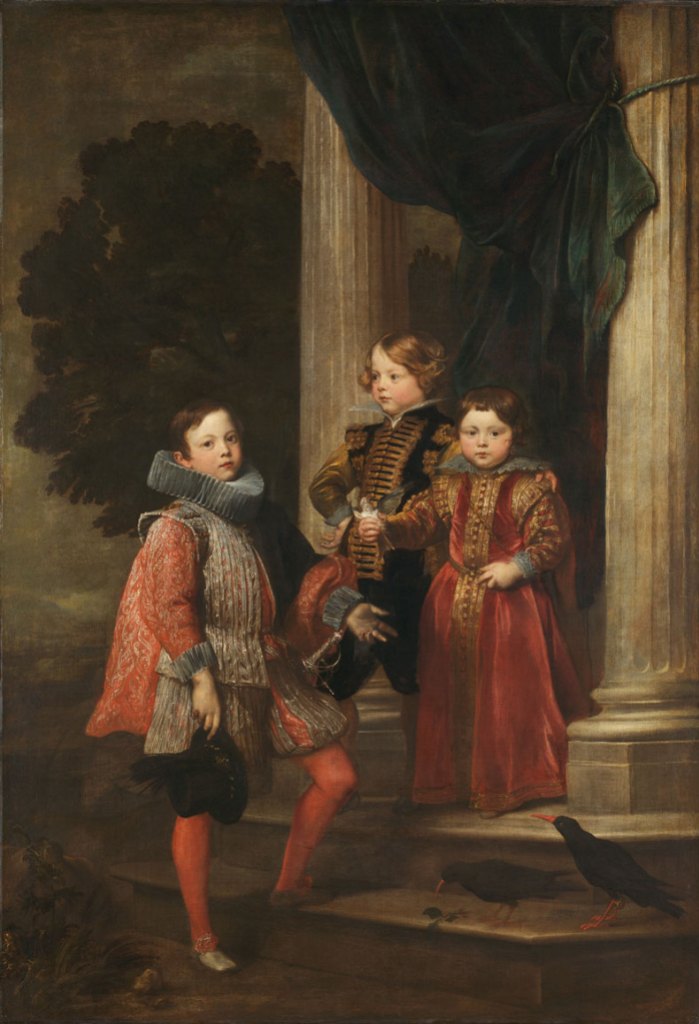
In one glorious example, a loan from the National Gallery in London, three young boys, recently identified as members of the Giustiniani Longo family, stand on the steps of a pillared building. The brothers occupy a classic Van Dyckian transitional space, half indoor and half outdoor, that feels more like a stage set than architecture. Van Dyck is one of European art’s most sympathetic portraitists of children and this image of three brothers of different ages carefully maps the way in which boys learn to carry themselves as men, as chubby cheeks hollow out and masterfulness replaces the shy sweetness of early childhood. The sitters, the youngest not yet breeched, are decked out in satin and velvet, lace and gold thread, but there’s no question that they’re still children and not miniaturised adults. At the dead centre of the panel, the youngest boy clutches a little white bird, its desperately flapping wings and parted beak puncturing the fiction of self-control demanded by the conventions of portraiture.
Ever since his earliest biographies, written within decades of his death in 1641, Van Dyck’s critics have scratched their heads over his decision to focus primarily on portraiture as opposed to narrative painting. The 17th-century Roman theorist Giovanni Pietro Bellori, for example, wrote that Van Dyck ‘achieved the highest esteem for his portraits, in which he was peerless […] In histories, however, he did not show himself to be competent and secure in design, nor did he carry out his work according to a perfect idea.’ Surely, Bellori and others have argued, Van Dyck’s career path must reflect some intellectual deficit or weakness of character. Why else would he have chosen to spend his time facing off with a demanding and vain clientele instead of grappling with classical and biblical stories in the heroic mould of Rubens or Poussin? Yet this argument falls apart in the face of the paintings themselves, which include devotional works of melting tenderness and narrative scenes with a psychological subtlety far removed from the overripe theatrics of Rubens.
In one important early series of paintings, represented in Genoa by a loan from the Scottish National Gallery in Edinburgh, Van Dyck depicted the martyrdom of Saint Sebastian, capturing both the resigned anguish of the saint and the chilling professionalism of his torturers. Whereas most other painters, Rubens included, chose to paint Sebastian already pierced with the arrows that failed to kill him, Van Dyck focused on an earlier moment in the narrative, with a group of tormentors binding the beautiful young saint to a tree. In the Edinburgh version, probably painted just before Van Dyck’s departure for Italy, the saint’s nude body glows with an almost lunar pallor, offset by the rich reds and blues worn by the henchmen. One older man, his broad back a study in muscle gone to seed, ties a rope around the martyr’s ankles. Another, his arm around Sebastian’s shoulders, reaches for his hand with a curious delicacy, much like an artist adjusting a model’s pose. This is a painting about men enacting dominance and submission and a forensic examination of the male body as it changes from youth to old age. On the far left margin, a Black man holding a bow breaks the fourth wall of the painting to meet our gaze. He is an important reminder that Antwerp had one of the largest populations of African descent in early modern Europe.

The title of the Genoa exhibition, ‘Van Dyck, the European’, is a conscious choice to emphasise the artist’s cosmopolitan wanderings. Van Dyck has always made an awkward fit with the nationalist narratives that were so important to art history as it emerged as an academic discipline in the 19th century. This has been particularly the case in his native Flanders, where a lack of political independence has made cultural self-assertion feel all the more urgent. Nothing could be further from the beer-swilling world of Adriaen Brouwer’s peasants and scoundrels than Van Dyck’s hyper-refined aristocrats and languorous saints (though the two painters appear to have been friendly and Van Dyck made an elegant portrait of his colleague). Van Dyck was multilingual, switching between Flemish, French and Italian in the surviving documents, and his paintings similarly distil different visual idioms ranging from Venetian eroticism to English court portraiture. In this regard, Van Dyck fashioned himself in the image of Rubens, who served as a diplomat, traversed Europe and built a Genoese-style palazzo back home in Antwerp. But Van Dyck never made a permanent home for himself. He got married only at the very end of his life, to the daughter of a Scottish earl, and died just eight days after the birth of his daughter Justina.
Van Dyck was perceived by contemporaries as both a ladies’ man and an effeminate fop. Art history is still enthralled in many quarters by swaggering masculinity and, here again, his reputation has always suffered. As I argue in my book Van Dyck and the Making of English Portraiture, modern responses to Van Dyck reflect an anachronistic romanticism that misunderstands courtly careers, preferring artists to be virile and bohemian in equal measure. In the 17th century, however, almost everyone who had the option aspired to join the aristocracy and gain the favour and resources of the court. By the measure of his own time, Van Dyck was the ultimate success story. Yet more recent critics have judged him severely for catering to the market (and particularly to female patrons). In one representative example, from an essay published in 1950, the curator Wilhelm Valentiner dismissed Van Dyck as ‘little more than a man of wealth, pampered by courts and women’.
The ambivalent response to Van Dyck, simultaneously admiring his skill and deriding his commercial success, has been particularly marked in England, where he made his home for most of the last decade of his life. No one would deny Van Dyck’s transformative effect on English painting. Again, he was fortunate in his timing, his career overlapping with the reign of Charles I, the greatest collector and connoisseur ever to sit on the English throne. Charles loved Venetian painting and saw in Van Dyck the opportunity to employ a modern-day Titian. Charles’s queen, Henrietta Maria, shared Van Dyck’s Catholicism, and his portraits immortalised the glamour of the royal couple, their children and their court.
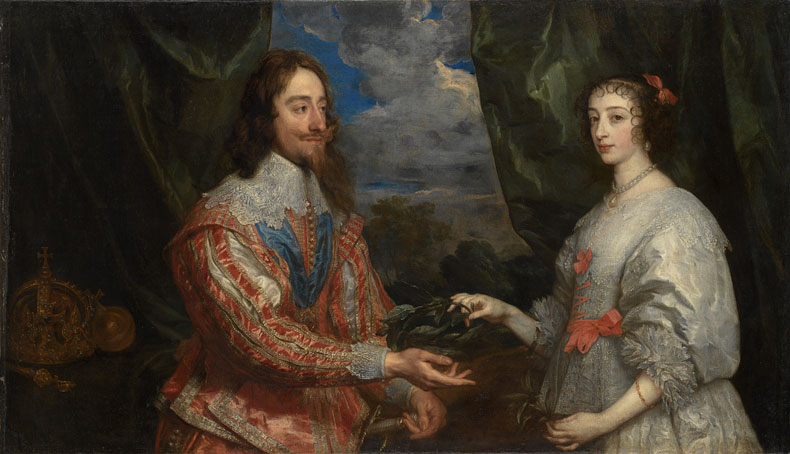
The long history of portraiture in England, stretching from Lely and Gainsborough to Lawrence and Sargent, is unthinkable without Van Dyck. Time and again, portraitists drew from the well of his paintings, their gestures and textures a seemingly inexhaustible source for the representation of successive generations of the British elite. The large dynastic portraits of the Dukes of Marlborough at Bleinheim by Reynolds and Sargent, for example, seem impossible without Van Dyck’s precedent. At the same time, British artists and writers have never lost sight of his essential foreignness. Hogarth shamelessly cribbed from Van Dyck’s portraits but repudiated him in his critical writings. It is Hogarth, the London-born, vociferously xenophobic dealer in painterly home truths, who has come to figure as the founding father of a truly English school of painting, and not Van Dyck, with his elegance, apparent flattery and excessive attention to clothes.
In our own age of nationalist boors and testosterone-addled loudmouths, the exhibition in Genoa may come as a welcome tonic. Van Dyck has often been reduced to a caricature, his art elegant but rarely more than skin-deep. The opportunity to view the full international panorama of his career, from Antwerp wunderkind to seasoned chronicler of royal intimacy, will hopefully serve as something of a historical corrective. Not all artists embrace the margins; they certainly didn’t in the 17th century. Van Dyck wanted to be rich and famous, and he was. But he also left behind a pictorial legacy of a profound and still troubling complexity, waiting to be rediscovered by those willing to look.
‘Van Dyck, the European’ is at the Palazzo Ducale, Genoa, from 20 March–19 July.
From the March 2026 issue of Apollo.