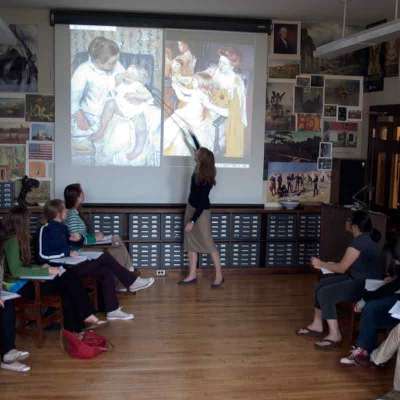
To those certain of its value, defending art history can seem unnecessary, if not absurd. Art, architecture and objects left behind by people who lived before are elemental; they are the history of us. When I first studied the subject – compulsory in the A level art curriculum at my Welsh comprehensive in the late 1980s – it seemed vital. How did the Medicis manipulate portraiture for status and control? Why did Picasso explode scale and perspective in Guernica? If rarity drove high prices, why did Warhol’s multiple Marilyns never seem to lose value? The answers brought me closer to history, politics, business and what it means to be human.
Yet as an academic discipline, art history faces ‘constant scepticism even among those who claim to love learning’, as Joan Kee, director of New York University’s Institute of Fine Arts, argues in her recent essay for the Irving Sandler series.
In the UK the subject is endangered at A level. Just 80 institutions offer it – a fall of 34 per cent in a decade, according to new research commissioned by the Courtauld. Teenagers studying art history are likely to be privileged and southern. Less than one per cent of state schools offer the subject; most institutions that do are fee-paying and in south-east England. Art history is not offered as a Scottish Higher; it was discontinued in Northern Ireland in recent years and there are now no courses in Wales.
Institutions may be closing A level courses for reasons beyond budget constraints, says Gregory Perry, chief executive of the Association for Art History (AFAH), which led the research. Anecdotally, the association has observed schools encouraging students to study fewer A levels, and ‘art history is a subject that’s usually taken as a fourth’.

Options are dwindling, too, for students to study at undergraduate level. Many parents see little value in the subject. Students with limited means may hesitate to enrol when the cost of university is a substantial investment. Universities are cutting humanities departments to combat rising costs, capped tuition fees and falling student numbers. The University of Kent axed its art history degree last year.
All this art-history scepticism is at odds with our age. The act of looking has become commodified as technology companies ‘mine and sell our attention like coal’, as Kee writes. Letting art history become endangered and drift further into elite status is not only unfair, it’s also perilous. ‘Art history gives you tools to interpret the visual world and makes you more of a critical viewer of political messages, advertising and a barrage of social media images,’ says Perry. ‘It’s dangerous if you can’t examine these things critically.’
The commercial case is obvious. Art historians are lucky: an industry is built around their subject. The UK had the second-biggest commercial art market in the world in the first half of 2025 and it needs curators, registrars, communications experts and marketeers. Museums and galleries – central to tourism, which contributed £240bn to the UK’s GDP in 2023 – require expertise in logistics, visitor engagement, education, fundraising, management and more. A strong culture makes us all richer – though if museums want to recruit young people they might consider improving pay. Strikes at the Tate do little to persuade students already sceptical about the value of an art history degree.
What else can be done to save art history? Schools could introduce the subject earlier in the curriculum, says Perry. ‘Younger students look at things without baggage and they’re inquisitive. One of the key times to reach anybody to become a lifelong appreciator of art is at primary school.’
Another force worth backing is Art History Link-Up, a charity that teaches the A level for free to state-school students. More than 600 students have used its services. According to Rose Aidin, its chief executive, half are from minority backgrounds. Among its alumni are arts journalists and employees at Christie’s and Phillips auction houses.
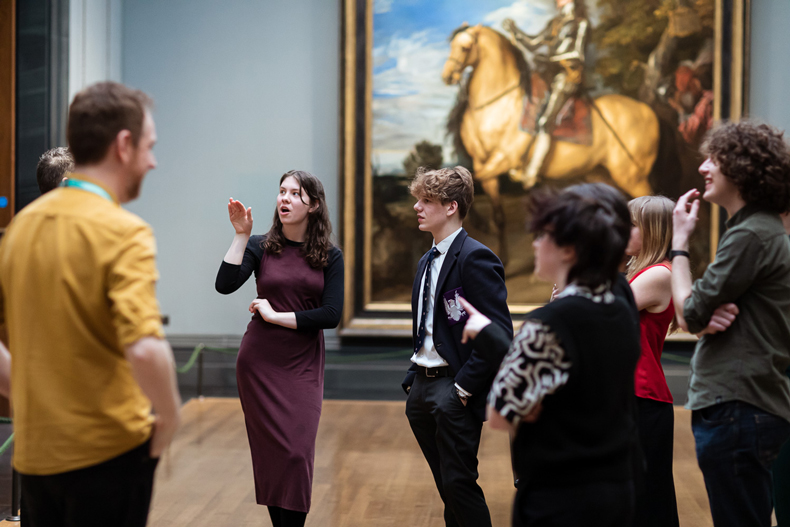
Elitism is detrimental to everyone. If art history is a subject only for the wealthy, most people won’t care if it dies, as Meg Molloy, founder of Working Arts Club, a networking group for people from lower socioeconomic backgrounds working in the UK art industry, points out: ‘Ensuring that the sector is not monopolised by the few but accessible to many would support a more resilient and dynamic industry.’
The Courtauld seems to recognise this. It has announced a fund to boost scholarships and bursaries and an ‘access and participation plan’ to increase applications from underrepresented groups including state-school pupils, though details of both are scarce.
Despite the odds, demand to study art history is constant. The number of students taking the A level in 2025 is virtually the same as it was in 2016, and has risen every year since 2019, according to the AFAH research. Entrants to undergraduate degrees remain roughly the same since 2019.
At university, I was astounded when art history was mocked as posh and irrelevant. To me, it seemed universal, but those perceptions are still around. They’re wrong: in a new age of media saturation, it’s essential we think critically about the images we see. A revitalised art history could even position itself at the centre of a radical push for visual literacy, rather than begging to be spared.