From the January 2026 issue of Apollo. Preview and subscribe here.
The long-anticipated opening of the first exhibition at the Museum of West African Art (MOWAA) in Benin City, in Edo State, southern Nigeria, should have been a significant moment for African culture. ‘Nigeria Imaginary: Homecoming’ is a selection of contemporary art, much of it first shown at the Venice Biennale in 2024. But what happened at a preview event on 9 November was, in the words of MOWAA’s director Phillip Ihenacho, ‘terrible and embarrassing’. Some 40 protestors – who sang their allegiance to Benin’s traditional king, or Oba, Ewuare II – stormed into the MOWAA complex. They robbed and beat up merchandise sellers, threw tables and chairs around and shouted abuse at the guests, who included artists, donors and ambassadors. Most of the guests were ushered into a more secure room, but the British Museum director, Nicholas Cullinan, on what would prove an eventful first trip to West Africa, was somehow stranded outside the museum with the protestors and threatened by a man wielding a drill. The police, conspicuously passive up to this point, eventually escorted MOWAA’s guests through a back door to their hotel. One guest described the events to me as ‘clearly orchestrated, shameful and hugely disappointing’.
Two days before the aborted viewing, Oba Ewuare II visited his ally Monday Okpebholo, the governor of Edo State. ‘Please stop the opening of the MOWAA,’ the Oba asked the governor, for it was ‘fraught with greed, deceit, mischief and lack of transparency’. The Oba’s grievances are connected to the Benin Bronzes, the thousands of brass, bronze and ivory sculptures that were looted from his great-great-grandfather’s palace by British soldiers and sailors in 1897. Today the Benin Bronzes are mostly scattered across museums in Europe and North America. Highly charged symbols of colonial dispossession, they are admired in the West as works of art, but to the Oba and his people they are the spiritual manifestation of an ancient civilisation.
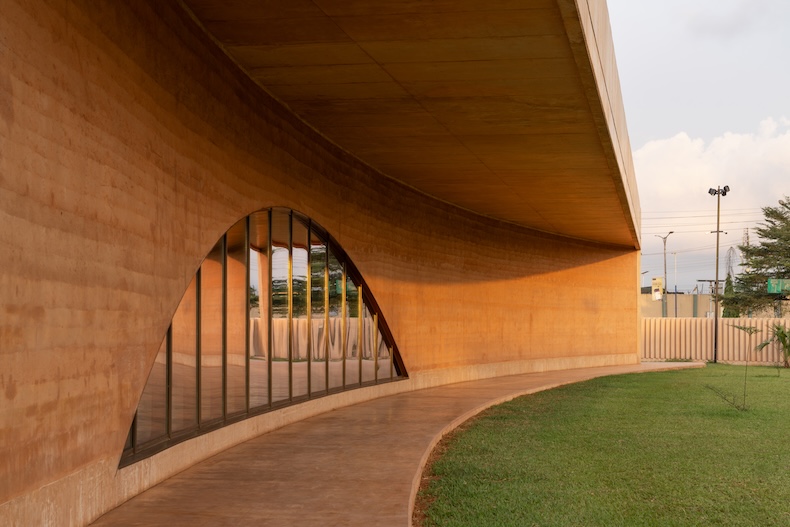
Although successive Obas had pleaded for decades for the return of the Benin Bronzes, Western museums began to engage seriously with the issue only in the late 2010s, when the previous Edo governor, Godwin Obaseki, threw his political weight behind the process. In recent years several museums – in Germany, the Netherlands, the UK and the United States – have returned all or parts of their collections of Benin Bronzes to Nigeria, citing a desire to address past injustices, in what has become a much-celebrated process of restitution.
In 2018, there was a consensus between Obaseki, the Oba and European museums that the returned Bronzes would go to a new Benin Royal Museum, the very name of which recognised the Oba’s moral authority in the process. But even at this early stage the danger signs were there, because enmity between the Oba’s and Obaseki’s families stretches back generations. This rivalry carried risks, especially in the context of Nigerian politics, which is often defined by a struggle for resources and patronage, and given the cultural significance and commercial hype surrounding the Bronzes. Between 2007 and 2016 two Benin cast heads and an ivory mask each sold for several millions of pounds in New York and London.
As plans for the new museum began to take shape, Obaseki brought in Ihenacho, a wealthy and well-connected friend from out of state, to raise money. Ihenacho in turn brought in his friend, the Anglo-Ghanaian architect David Adjaye. In late 2020 they gave the museum a new name: the Edo Museum of West African Art (it subsequently dropped the ‘Edo’). The new name, Ihenacho says, reflected the fact that it was born out of a ‘broader vision’ and was always meant to include contemporary art. This vision, it seems, was not shared by everybody. The museum would be run by an independent trust and not be under the sclerotic control of the Nigerian government’s National Commission for Museums and Monuments (NCMM). This reassured European institutions but, to the Oba and his supporters, it suggested they were losing control of the process. By March 2021, the Oba was expressing his unhappiness and in the following months any veneer of unity was shattered when he denounced the management of the museum as ‘an artificial group’ seeking to ‘divert’ the return of his ancestor’s artefacts. The ‘right and only legitimate destination’ for the Bronzes was the originally conceived Royal Museum, he said.
Foreign donors could have been forgiven – at least initially – for thinking that the Oba supported the project, because his eldest son and presumed heir, Ezelekhae Ewuare, sat on its board. ‘We believed everyone was working together and we never made a decision without the palace’s representatives,’ says a museum director in Germany. The Oba recalls this history differently. His beloved son, ‘poor child […] didn’t understand the implications of what he was getting himself into’. He was ‘dragged […] into a conspiracy against his own heritage’, the Oba says. ‘Perhaps we were a bit naive,’ reflects Andreas Görgen, the German civil servant who played a key role in Germany’s donation of millions of euros to EMOWAA, as it was then, as well as its startling declaration that its museums would return some 1,000 Benin Bronzes to Nigeria, ‘to think our connections with the royal court and crown prince meant everything would go smoothly.’
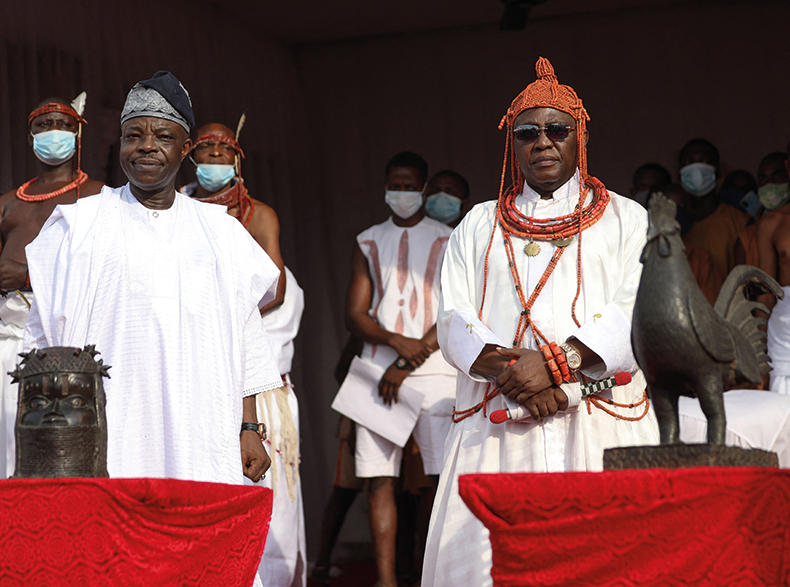
In March 2023, Nigeria’s then president, Muhammadu Buhari, made a declaration recognising the Oba as the owner of the Benin Bronzes and handed him responsibility for the management of all places where repatriated items were kept. This came as a surprise even to the NCMM, the institution through which most Western museums had been negotiating their returns. It wasn’t until February 2025 that the NCMM signed an agreement with the Oba, giving it the authority to retrieve from abroad and subsequently display Benin Bronzes. Encouraged by the belated appearance of Nigerian unity, the Dutch government announced the return of more than 100 Bronzes, which took place in June 2025.
Why, after this tortured history, from which the Oba has emerged victorious, does he still harbour such enmity towards MOWAA? After all, even his arch-enemy Obaseki has departed the scene, replaced in 2024 by Okpebholo. The Oba says it’s because those behind MOWAA have sought to profit from their ‘evil plan’, raising money from foreign donors under false pretences. ‘They saw it as a money-spinning opportunity, they acquired land illegally, and they deceived the Europeans,’ one of his closest relatives claimed to me. (MOWAA denies any illegality in land acquisition.) The Oba’s circle are convinced that MOWAA has effectively sucked up whatever donor funds might have been available for a new museum dedicated to the Bronzes alone. In November the Oba asked Okpebholo to ‘remind’ Nigeria’s new president, Bola Tinubu, to ‘make good his promise to assist in bringing our proposed Benin Royal Museum to fruition’.
Amid all this rancour, the return of Benin Bronzes from Western museums has carried on. On the same day that MOWAA’s shaken guests were flying out of Benin City, Beatrice von Bormann, director of the Museum de Fundatie in Zwolle in the Netherlands, was in the city to sign documents with the NCMM, transferring ownership of a magnificent 18th-century plaque depicting a fish, presumed to have been looted by the British in 1897. ‘Definitely, we did the right thing,’ she says. ‘The plaque belongs to the palace. This is an unconditional restitution so what they do next is their business.’ Since then, Nigeria has also received a plaque and cast head that were deaccessioned by the Museum of Fine Arts, Boston. Nigeria’s culture ministry says it expects more returns soon. These are unlikely to come from the British Museum, however, which has the world’s largest collection of Benin Bronzes but is currently prevented by law from making permanent returns.
MOWAA’s future in Benin City, meanwhile, is far from clear. It carries on with research and archaeology, but is closed to the public indefinitely. ‘You can’t work anywhere in Nigeria without local leadership on your side,’ says a supporter, ‘and international money won’t protect you from that.’ When governor Okpebholo received the Oba two days before the protest, he told him, to rapturous applause, ‘the issue of MOWAA is over’. Nigerian media reported that the governor had revoked its title, so the land could be returned to its prior use as a hospital, only for Okpebholo to later tell Germany’s ambassador to Nigeria that this information was a ‘social media scam’ and nothing had in fact been revoked.
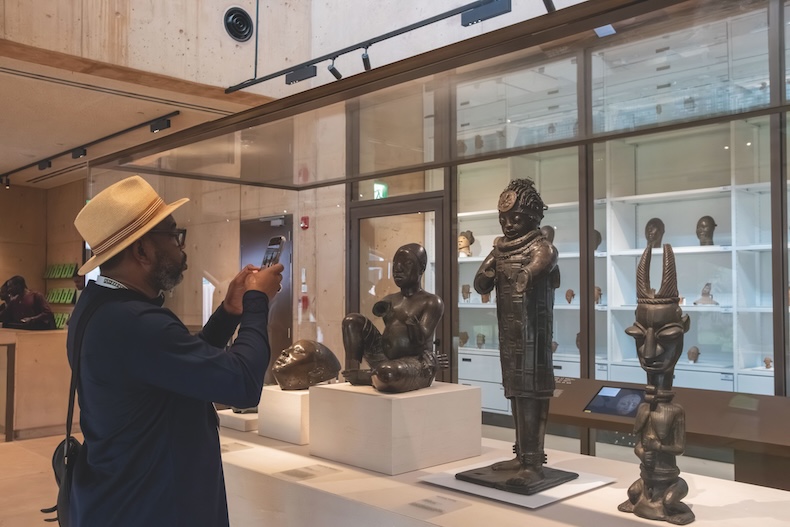
Germany, despite the claims of the Oba’s supporters that it was duped into handing over its money, still seems committed to MOWAA. Other donors were impressed by what they saw during the brief viewing before the protest. ‘The building is great, the objects are displayed wonderfully, the labels are thoughtful,’ says a curator from a leading museum. All this, regrettably, is in contrast to the NCMM’s long-standing and cash-strapped National Museum in Benin City, which has just hosted an exhibition, ‘Restitution in Motion’, of some recently returned Bronzes. Ancient plaques were crudely attached to walls; a precious ivory mask, returned from Germany, sat in a Perspex case beneath a precariously detached lid. ‘Heartbreaking,’ says one Nigerian artist. ‘Not ideal,’ admits a European museum director who is in favour of restitution.
Much now depends on Nigeria’s federal government in Abuja and the extent to which it wishes to get involved in Edo’s politics. After the protest in Benin City, culture minister Hannatu Musawa reassured ‘the MOWAA community and cultural stakeholders across the world’ of her government’s support for ‘a treasured cultural asset’. President Tinubu announced the formation of a committee, chaired by the minister, comprised of the many Nigerian stakeholders but also French and German diplomats, to provide recommendations on MOWAA’s future. Tinubu may feel Nigeria’s international reputation is at stake. But in recent weeks his government has suffered grievous setbacks as it struggles to restore security in the country. Donald Trump is threatening to step in, ‘guns-a-blazing’. Tinubu could be forgiven for thinking he has more important issues to solve than the management of a museum.
All of which would be a shame for Benin City itself. Whatever the controversy over its origins, MOWAA has already brought new opportunities for Nigerian artists, curators and archaeologists, and raised the bar for its museums. ‘The quality of young people we met was impressive, and it would be tragic to see them let down,’ says one visitor. An NCMM official described the dispute over MOWAA as ‘a clash between tradition and modernity’. But the benefits of such a large investment – it has attracted more than $25m in total – are less abstract. ‘Sources of livelihood,’ says Ihenacho, ‘is what it is about in Nigeria, and we are overwhelmed by people saying please continue.’ He sketches the outline of a possible solution. ‘We are supporting a cultural complex, and it ought to be possible that there is a building within it that the palace feels is theirs, a distinct and important attraction.’ An artist bemoans the fact that in Benin City ‘you are either on one side or the other’. MOWAA asked him to work with them, but he declined out of loyalty to the Oba. ‘I just hope this issue is resolved soon, because I want to work with them,’ he says, ‘the MOWAA initiative is a good one.’
From the January 2026 issue of Apollo. Preview and subscribe here.