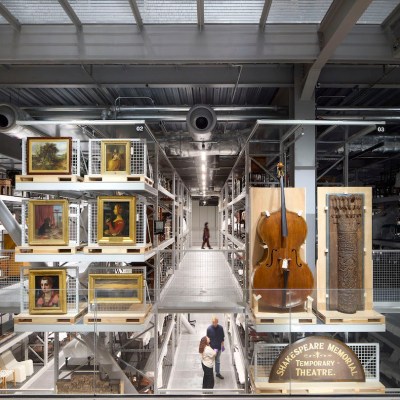
The London museum scene was dominated in 2025 by the culmination of the National Gallery’s bicentenary and its much-anticipated unveiling of the new-look Sainsbury Wing. The Victoria and Albert Museum did a decent job of competing, opening the V&A East Storehouse, the latest development on the former Olympic park in Stratford, to wide acclaim. The V&A will hope that it can continue its success when the Storehouse’s sister building, V&A East Museum, opens in an angular building designed by O’Donnell & Tuomey on 18 April. The collection will be split into thematic galleries over two floors, with everything from Italian Renaissance paintings to vintage jewellery and clothing rubbing shoulders with works of modern art, fashion and design, while a huge sculpture by Thomas J. Price will welcome visitors at the entrance to the building. The first exhibition at V&A East is ‘The Music Is Black: A British Story’, in which visitors will be able to see photographs by artists such as Jennie Baptiste and Dennis Morris, and items including an outfit worn by Little Simz and a guitar once owned by Joan Armatrading. The original V&A, in South Kensington, is not having quite as busy a time as its east London offshoot, but it will, in March, reopen its expanded galleries dedicated to the exquisite collection of objets d’art assembled by Rosalinde and Arthur Gilbert and on long-term loan to the museum since 2008.

A few miles down the road, and a few months on, the London Museum (which has ditched its former name, the Museum of London, for a snappier one) will finally open in its new site at West Smithfield, having shuttered its London Wall building in 2022. Its new home, designed by a consortium of architects – Stanton Williams, Asif Khan and conservation specialists Julian Harrap – and initially scheduled for 2021, has been delayed several times. The permanent galleries, housing one of the largest collections of urban history in the world, will open in the Victorian general market in the second half of this year, while the museum’s temporary exhibition spaces – in the old poultry market on the same site – are lower down in the pecking order and will not open until 2028.
The United States had a big year for museum openings last year, with the Frick, the Studio Museum, the Yale Center for British Art, Princeton University and the Met’s Rockefeller Wing all unveiling major transformations. In 2026, cultural institutions may be focusing their attention more on the country’s semiquincentennial, but there are still significant institutions due to open. In early 2026, the New Museum – New York’s preeminent museum dedicated to contemporary art – will unveil a major expansion by OMA’s Shohei Shigematsu and Rem Koolhaas of its distinctive, Jenga-like Lower East Side building, doubling its exhibition space and providing more room for artist residencies. In April, the Los Angeles County Museum of Art (LACMA) is opening a new building on its campus. Named after the film producer David Geffen, who donated $150m to the museum, these galleries are housed in a vast, curving concrete structure designed by Peter Zumthor that provides more gallery space, a 300-seat theatre, restaurants and more.
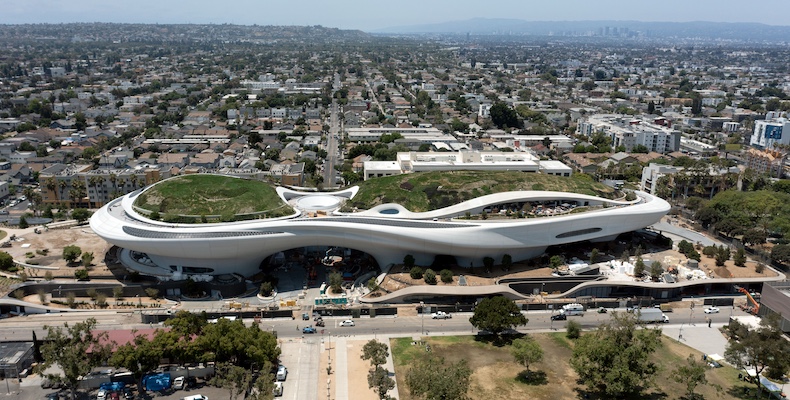
LACMA’s expansion, however impressive, may however be outshone (in terms of media attention, at least) by a brand new museum on the other side of Los Angeles. The Lucas Museum of Narrative Art, the brainchild of George Lucas and his wife, Mellody Hobson, will finally open in Exposition Park this autumn, its futuristic building designed by Ma Yansong of MAD. If its raison d’être seems hazy, we do have some details about what’s on show: comics, book illustrations, film posters, as well as artworks by artists ranging from Norman Rockwell to Frida Kahlo and Henri Cartier-Bresson to Dorothea Lange, all of which are bound by the theme of storytelling and narration. Up to now the museum has had a bumpier ride than an X-wing starfighter pilot trying to fly into the Death Star exhaust port, with delays to the building, redundancies and the resignation of both the director and the chief curator in 2025. Now, though, the museum’s website now has a countdown timer – measured to the second – so the opening date of 22 September should be set in stone.
In Lisbon, two major institutions are making a comeback this year. The Calouste Gulbenkian Museum, which holds its founder’s collection of objects ranging from Ancient Egyptian artefacts to Chinese bronzes and French decorative art to medieval Islamic manuscripts, has been closed since March 2025. The works consist mostly of technical changes, to air conditioning, cloak rooms and so on, rather than major architectural or curatorial changes, but the spruced-up building is due to reopen in the summer. The National Museum of Ancient Art, closed since September 2025, should also be back in business at some point this year, though an exact date is yet to be firmed up. Founded in 1884 as a home for the collections of the Portuguese royal family and of the National Academy of Fine Arts, the museum has a significant collection of decorative arts from the medieval period onwards, as well as works by Old Masters including Bosch, Durer, Raphael and Zurbarán.
The Museo Dolores Olmedo, founded by a philanthropist and friend of Diego Rivera, in a 16th-century hacienda in Mexico City in 1994, was intended to display Olmedo’s collection, which contains the largest single groups of work by Rivera and Frida Kahlo (140 works by the former and 25 by the latter). Now run by Olmedo’s granddaughter, Dolores Phillips, the museum has been the subject of major controversies that include a plan to move the collection on long-term loan to a site in the city’s Chapultepec Park. The building has been shut since 2020 because of the pandemic, but will reopen this year – though exactly what will be on display, and how, is yet to be seen.

The Musée de la Vie Romantique in Paris has been shut since September 2024 for major works. The home of the 19th-century painter Ary Scheffer and the venue for salons attended by cultural figures including Chopin, Liszt, Dickens and Delacroix, the house today is a museum dedicated to Romanticism, and specifically to the possessions of the writer George Sand (who also made appearances at these salons). During the renovations, much of the collection has been on public display elsewhere, including at the Chopin Museum in Warsaw, but soon Parisians will be able to see it back in situ. The grand unveiling is scheduled for 14 February, so there’s no excuse not to have Valentine’s Day plans this year.