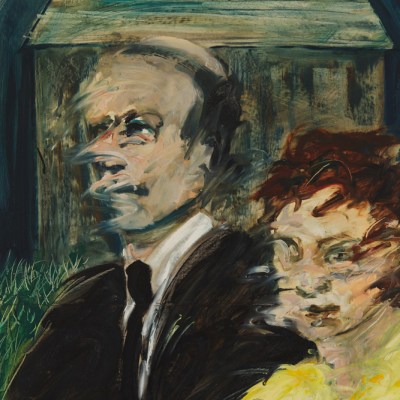
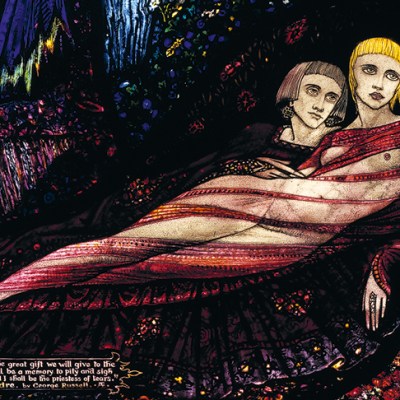
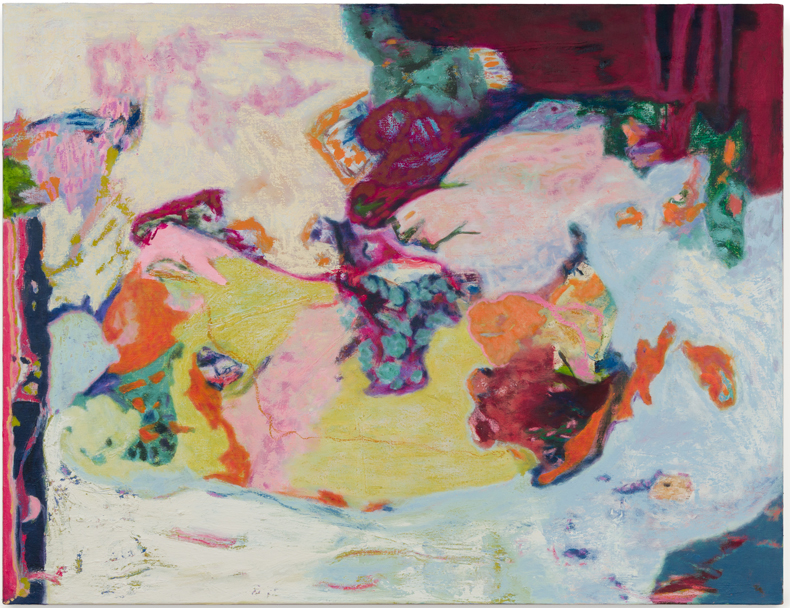
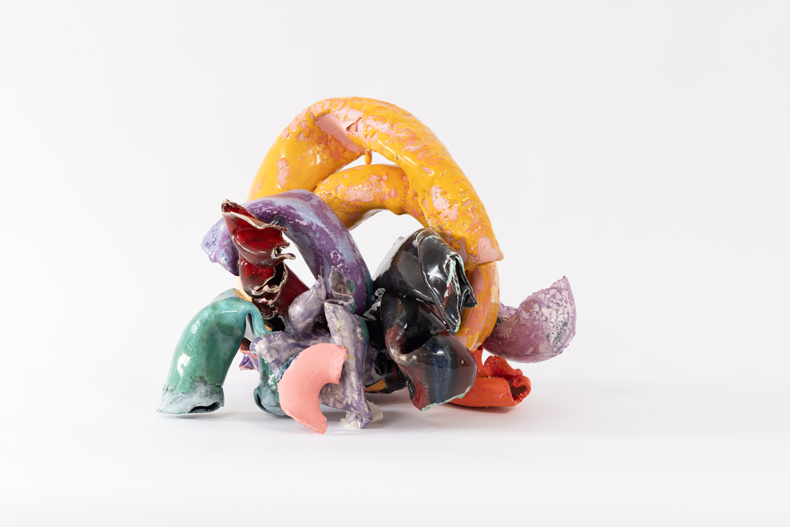
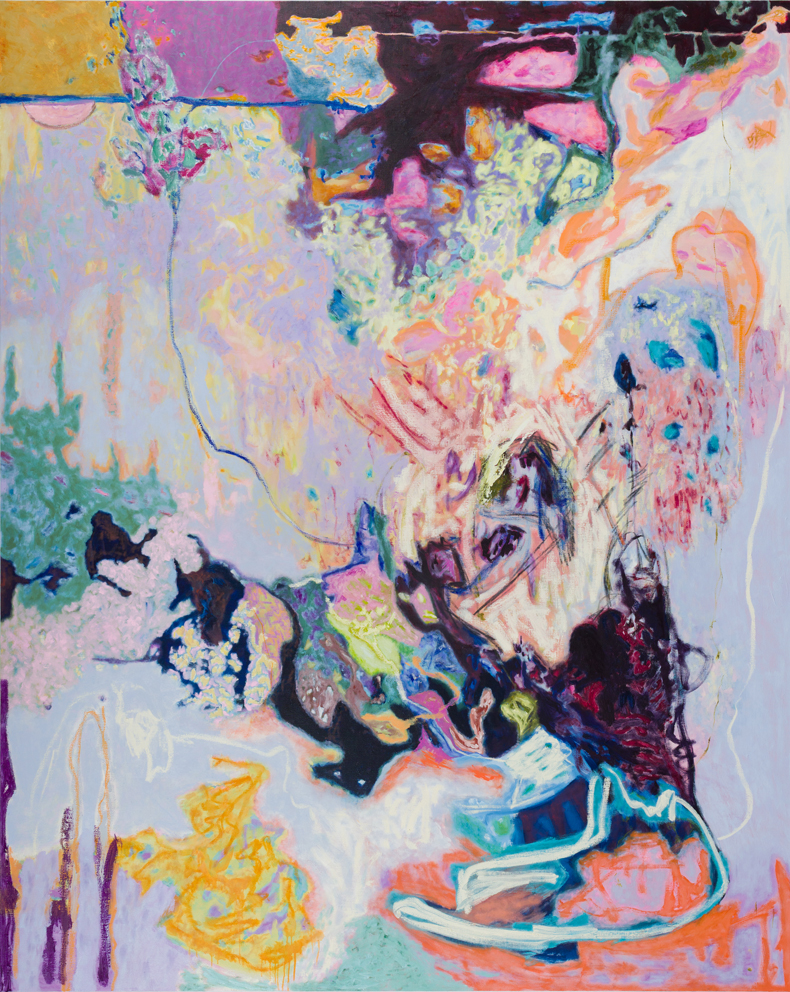
The Irish painter, sculptor and printmaker Sarah Dwyer began her career as an artist in her late twenties. After studying politics, philosophy and economics at university, Dwyer completed a Master’s in painting at the University of Staffordshire, before undertaking a second Master’s at the Royal College of Art in London. Over the past two decades Dwyer has developed a unique practice in which swirling, brightly coloured forms take shape in both paintings and ceramics: see, for example, the neon-hued abstraction Ruff and Tumble (2025) or the contorted tubular sculpture Tight Rope (2025). She has exhibited across Europe, the United States and Asia. Her first institutional exhibition, ‘Penti Menti’, is at the West Cork Arts Centre until 27 January.
Where is your studio?
I’ve just moved from the studio that I’d been in for five years to a new space in the Hanwell Community Centre in north-west London. It’s an enormous converted Victorian workhouse from the mid 1800s; Charlie Chaplin went to school here for a few years. The building is owned by Ealing Council and is fully intact, as it is listed by Historic England. It’s a beautiful building and my new studio looks out on to a big rugby field and pitch, playing fields and gardens.
There are four badminton courts beneath my studio, a gymnasium and, right by me, a boxing studio. It all feels very serendipitous, as my father was a boxer who used to train the Irish boxing team – I like to think he manifested it for me.
How would you describe the atmosphere in your studio?
Supposedly this place is haunted, but I haven’t witnessed it yet, so let’s see… Tom, an 85-year-old artist [and former teacher at the Slade School of Fine Art] who let me use his third-floor studio space as my own, says he’s seen things moving by themselves, but I suspect he’s trying to wind me up. I can’t help but feel the atmosphere is positive. How many studios are there in London that have views like this?
I have to come up a spiral staircase to get to the studio, so there are compromises, but the natural light is worth it. We’re currently fitting out the studio, building white walls for hanging works and adding in extra storage space. It’s the simplest things in life that artists get excited about. Most importantly, it’s a 10- to 15-minute cycle to my house from here, and only a 15-minute cycle to my daughter’s school.
What is your studio routine?
I’m here six or seven days a week – I arrive at 9.15am and I leave at 6pm. On Thursdays I do my ceramics in the basement and on Fridays I go to galleries and museums and do a bit of drawing. Sundays are meant to be my day of rest, but because of my upcoming shows and moving studios I’ve been working seven days a week. But I love it: I’m only leaving this place one way, and that’s in a box.
Do you work with anyone in your studio?
I have one or two studio assistants in four days a week. For 20 years, interns who are studying at Central Saint Martins, the Royal College of Art and Chelsea College of Art have come one day a week. I give them academic and professional practice support and teach them all the traditional processes of making paint, how to stretch a canvas and prepare it – everything they’re not learning enough about on their degree or Master’s courses. In exchange, they give me their physical bodies for lifting, moving, stretching, packing. Previous interns always come back – these are long-term relationships and it’s always so nice to feel like you’re building a community.
Who is the most interesting or unusual visitor you’ve had at your studio?
My dentist. I bartered a tooth implant for a painting when I was a student, just after I’d graduated from the Royal College. It was around £4,000, because the NHS wouldn’t cover it and I didn’t have enough money to pay. My usual dentist rang her friend, who was a top dentist in town, and said, ‘I’ve got a really good painter in my seat,’ so he came to the studio, picked a painting and said he’d see me in the chair on Monday.
Do you listen to anything while you work?
I listen to audiobooks and background radio noise. I’d like to listen to more classical music, but my studio assistants don’t want to: they keep saying that’s the music people listen to before they go out to murder someone. I don’t know what they grew up watching.
When I was young my family listened to a lot of opera, so if there are no studio assistants I’ll listen to that, but if there are we’ll listen to audiobooks. We’ve been listening to Art and Fear [by David Bayles and Ted Orland] and Rest [by Alex Soojung-Kim Pang ]. I’m not a very restful person, so that’s great for reminding me to take care of myself.
What is the most unusual object in your studio?
I make these ceramic sculpture mounts that get screwed on to the wall; they’re basically door-stoppers that are coated with jesmonite. My studio assistants have given them a very suggestive nickname because of their shape… so I think, for now, that’s the most unusual thing in my studio.
What is your most well-thumbed book?
It’s a book of Philip Guston’s drawings – I’m a mad Guston fan. When I first met my husband, I hadn’t been able to go to the Philip Guston drawing show that was held across Europe in 2007, and he tracked down the catalogue in English through a rare bookseller for my birthday. A few years later I went to the Louisiana Museum of Modern Art, one of the museums where the show had been, and bought the display copy of the book for €10 – and then the other four copies they found in the back. I felt a bit guilty, because I think the one my husband bought me set him back £250.

As told to Lucy Waterson.
‘Sarah Dwyer: Penti Menti’ is at the West Cork Arts Centre until 27 January. It will travel to Highlanes Gallery in Drogheda (7 February–18 March) and the Limerick City Gallery of Art (18 April–13 June) before travelling to the UK.