From the February 2026 issue of Apollo. Preview and subscribe here.
Jade has been prized in China for millennia. The Chinese character for jade dates back to an oracle bone script from the 11th century BC – long before the first-century scholar Hsu Shen defined jade as being endowed with five virtues: charity, rectitude, wisdom, courage and equity. Today it refers both to the mineral nephrite, a hard stone which comes in many shades of white, green, grey and brown and which has held religious and cultural significance since the Neolithic period, and to jadeite, a chemically distinct material that has been imported from Burma since the 18th century and comes in an even greater range of colours.
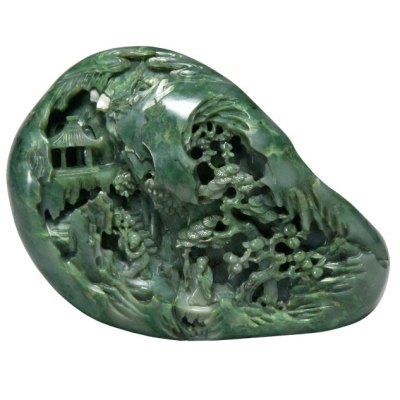
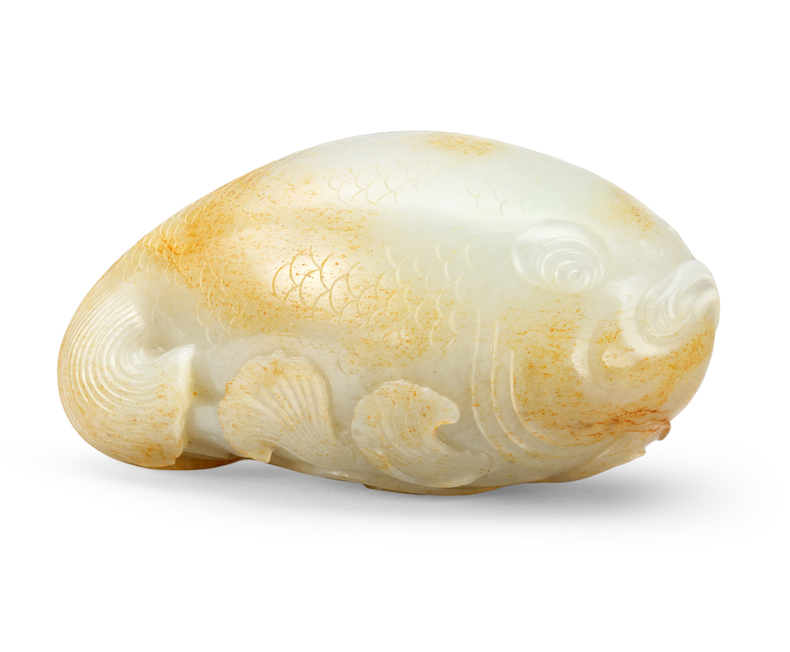
For most of Chinese history the most highly valued type was ‘mutton fat’ jade – pale white to pale green nephrite, with a pure and milky surface – and its use was largely restricted to the Imperial families, though the Qing emperor Qianlong’s fondness for emerald-green jadeite has given it a high status since the 18th century.
From pre-history jade was used to create a wide range of objects, from decorative and functional objects to ritual weapons and sculptures of animals and mythological creatures, as well as ceremonial objects, of which the most renowned types are the Six Ritual Jades. During the period of Buddhist fervour in the Tang dynasty (618–907), ritual use of jade declined but a revival of interest among Song-dynasty scholars in the next few centuries was followed by a wave of new production during the Ming dynasty (1368–1644). A more elevated status for artisans, with some jade carvers even signing their names, encouraged ever higher standards of craftsmanship, while the production of decorative objects reflecting courtly life flourished.
On the whole, European collectors showed little interest in Chinese jade until the early 20th century. From the First Opium War in 1839–42, however, to the looting of the Summer Palace in Beijing by the British and French in 1860, significant pieces began to appear in Western collections in Europe and the United States. One contributor was the collector Heber R. Bishop, who amassed more than a thousand fine examples of 18th- and 19th-century Chinese jades, which he bequeathed to the Metropolitan Museum of Art in 1902. Many of the pieces Westerners encountered had been seized from tombs after the fall of the Qing Dynasty and so were undocumented; this was exacerbated by Western museums throwing away the wooden stands, made in Imperial workshops and often integral to the objects’ display, thereby destroying vital historical evidence. The first excavation to offer reliable archaeological evidence was conducted at Anyang, the historic capital of the Shang dynasty, by the Academia Sinica from 1928 to 1937. But chronologies and object types established earlier on the basis of comparison with archaic bronzes and other artefacts have mostly held up through later research. Significant institutional exhibitions in London, New York and Hong Kong during the last decades of the 20th century maintained public and collector interest.
Asaph Hyman, global head of Chinese ceramics and works of art at Bonhams, says that ‘while the market was largely dominated by Western buyers, private and institutional, mainly from the United States and Europe, throughout the 20th century, this has changed materially since around 2004, with the entry of mainland Chinese buyers, eager to acquire Chinese antiques, able to travel and with overwhelming financial power.’ At first these buyers were less interested in the unusually coloured or exquisitely carved pieces favoured outside China and were drawn more to Qing dynasty jade carvings, particularly those with a white tone, with Imperial connections. Now, Hyman says, ‘there is greater interest in jades from the Ming dynasty and earlier, which typically are of less pure tones, as the best quality jades were simply not as available at the time to craftsmen.’ In March 2023 a large Neolithic mottled grey cong (a tube-like form that is one of the Six Ritual Objects), dating to the Liangzhu culture (c. 3300–2250 BC), sold at Bonhams New York for $1.5m including premium – 50 times its low estimate of $30,000. Zheng Ma, senior specialist in the Asian department in Christie’s Paris, also points to a shift, suggesting that today ‘the most sought-after pieces at auction are typically from China’s earliest historical periods, from the Neolithic era up to the end of the Shang dynasty (c. 5000–1046 BC)’. She adds that ‘Ming and Qing jades are experiencing a market slowdown, though exceptional pieces continue to be highly prized’. She cites an Imperial inscribed white-jade ‘Luohan Cudapanthaka’ boulder from the Qianlong–Jiaqing period (c. 1736–1820), which sold over estimate in October last year in Hong Kong for HK$2.5m (roughly £250,000). Moreover, in November 2024 a Han-dynasty jade bi (disc), dating from c. 89–144 AD, fetched HK$25.2m (£2.5m) in Hong Kong – 10 times the upper estimate of HK$2m.
Christie’s requires pre-2000 documentation for all its lots. Furthermore, Zheng Ma says, ‘it has become difficult, or sometimes impossible, to transact archaic [pre-Tang] jade without clear and well-documented provenance’. Even with later pieces, those with ‘well-documented histories and publications can significantly impact price’. Undoubtedly part of the allure behind the Qianlong-period ram-head teapot, made from white jade and cloisonné enamel, that achieved the world-record price for a jade carving at Sotheby’s Hong Kong in October 2017, was the fact that it came from the collection of the socialite and designer Millicent Rogers. It made HK$75.5m (about £7.3m) against an estimate of HK$30–50m.
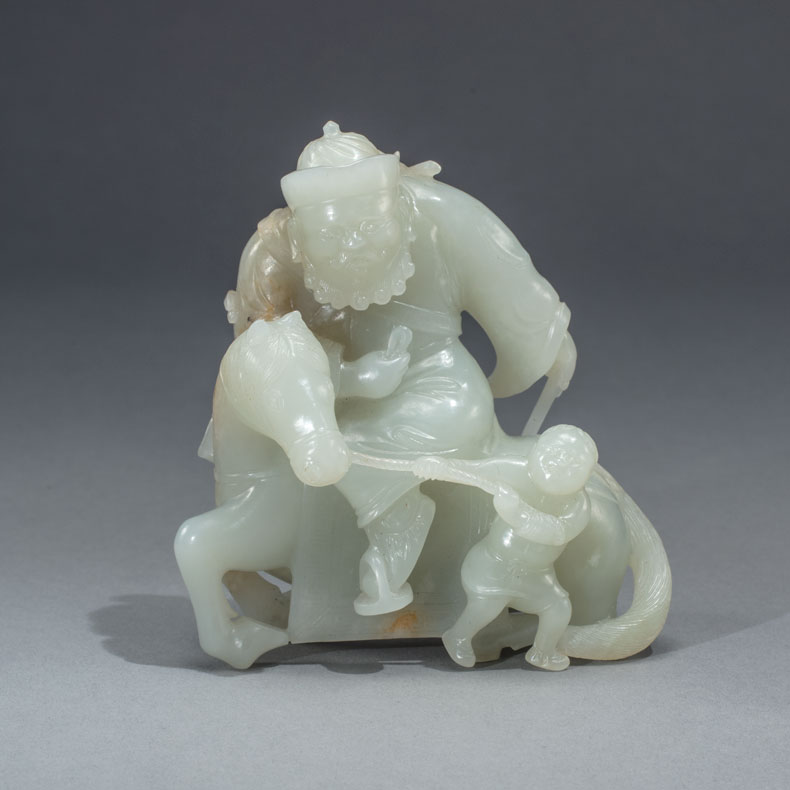
Robert Bradlow of Robert Bradlow Fine Art says: ‘With regard to later jades, the market for Imperial Ming- and Qing-dynasty seals has been one of the strongest areas of growth in the last 20 years. This again has mirrored mainland Chinese taste for significant items of Chinese imperial history.’ An outstanding example is the Qianlong-period inscribed white jade ‘Ji’entang’ seal, dating to 1766, which sold at Sotheby’s Hong Kong in 2021 for HK$145.7 (£13.5m) – the record price for a jade seal. Bradlow notes that for 20 years the market in jades was boosted by one major collector: Robert Chang. A leading figure in the Hong Kong trade after the Second World War, in his later years Chang began collecting some of the best pieces of jade on the market. ‘His taste was very much for imperial quality pieces of white, spinach and Khotan green jade,’ Bradlow says. Since his death in November 2024, ‘the market has softened somewhat’.
Julian King, head of Chinese works of art at Sotheby’s, takes an even more pessimistic view. ‘Whereas overall Chinese art has been very resilient in the market, Chinese jade has absolutely plummeted.’ He notes that when Xi Jinping became president in 2013 he put in place restrictions on luxury goods and gift-giving in order to further austerity and reduce corruption; this has resulted in a huge oversupply of mediocre jade items. But between 2010 and 2016, he reports, dealers continued to come regularly to sales in the UK, United States and Europe, feeding the Chinese market, keeping up prices and demand: ‘It was more like a commodity, like jewellery, with lots of speculative buying. As soon as the market dropped, they stopped coming. No one wants to buy when prices are low.’ Things have declined further since the pandemic. Consequently, collectors are keeping hold of their pieces, reluctant to put them on the market. He says that one resilient part of the market is archaic jade. In the Chinese Art sale at Sotheby’s London on 5 November 2025, a rare yellow jade turtle pendant from the Shang dynasty was chased to £57,150 from a £8,000–£15,000 estimate. ‘A piece such as Millicent Rogers’s teapot,’ on the other hand, ‘would only make a million pounds today.’
London-based dealer and expert Anthony Carter, who has documented jade pieces available from 2500 BC to 1700 AD, confirms the dramatic downturn in values at auction but suggests that this makes it an ideal time to buy. He advises that rather than fret about attribution, enthusiasts should pursue great craftsmanship.
From the February 2026 issue of Apollo. Preview and subscribe here.