This review of Murder in the Rue Marat: A Case of Art in Revolution by Thomas Crow appears in the February 2026 issue of Apollo. Preview and subscribe here.
‘For at least eight days, I was in love with Charlotte Corday.’ This passion first seized Pierre Notelet as Corday was progressing to the guillotine in July 1793. She wore a red chemise, the mandatory costume of traitors. Four days earlier, the 24-year-old had killed journalist and self-proclaimed ‘friend to the people’ Jean-Paul Marat. After seeking him first in the Palais Royal and then at the Convention, she discovered that he was suffering a flare-up of a chronic skin complaint. Marat was working from home, on a makeshift desk slung over a kaolin-infused bath, the only thing that eased his symptoms. Corday’s letter promising the names of ‘enemies of the people’ secured her an audience at his bathside. In life, many had dubbed Marat ‘the blood drinker’. With a kitchen knife bought from a nearby cutler, Corday stabbed him in the chest and severed his carotid artery. ‘By the time [the] officials arrived,’ writes Thomas Crow, ‘the flow had spread to the adjacent antechamber.’
The death of Marat is one of the better remembered episodes from the French Revolution, partly for its obvious dramatic appeal and partly because it was immediately commemorated in paint by Marat’s friend and ally, Jacques-Louis David. Produced in David’s official capacity as ‘Pageant-Master of the Revolution’ (a year before he, too, was accused of treachery and arrested), Marat at his Last Breath (1793) is the subject of this short yet masterly monograph, which, among other things, makes it clear that the painting arose from a period of ‘exceptional contestation over the meaning of the Revolution’. Even David’s title adopts and attempts to fix a phrase that had been conspicuous in the writings and pronouncements of both actors in the drama. Corday was convinced that the death of Marat would stem the flow of violence she considered him to have endorsed, if not initiated, with the September Massacres of 1792. ‘I want my last breath,’ she wrote, ‘to be a service to my fellow citizens.’ Marat, on the other hand, had promised to make his last gasp an indictment of his political enemies, publicly turning a pistol on himself in the Convention.
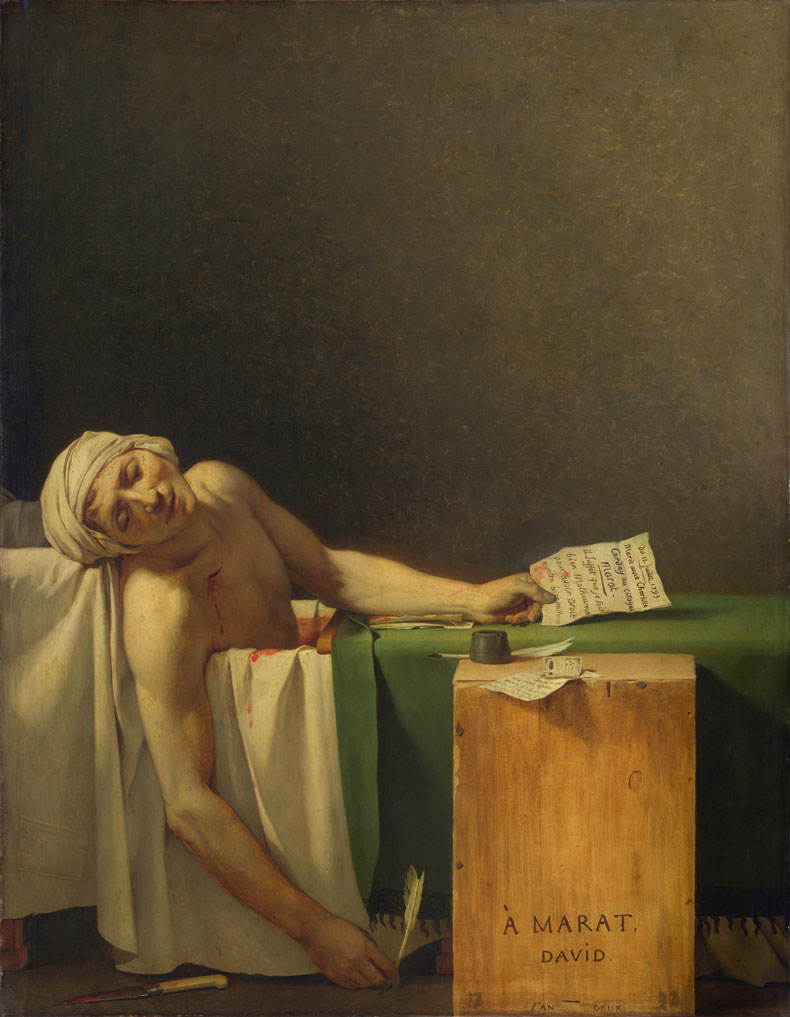
Marat’s actual last breath was a gush of blood; a cry; the panicked incursion of his household and a violent flurry that culminated with his longtime companion, Simone Evrard, seizing Corday by the hair. From the confusion of reality, Marat at his Last Breath emerges as a picture of monumental stillness and economy. Even the incriminating blood appears, Crow writes, only ‘by virtue of the things it has delicately touched’, staining the neatly patched linen and colouring the bathwater as it trickles from an unfeasibly modest incision just below Marat’s clavicle. In his capacity as Pageant-Master, David had already road-tested this composition for Marat’s spectacular funeral procession when, borne on a bier through the streets of Paris, the martyr’s hopelessly dangling right arm had testified to the magnitude of the people’s loss. Yet, as Crow writes, the final painting comprises an ‘inspired synthesis of monumental funerary portraiture with an interlocked constellation of accessory objects that conjure the offstage assassin’. Corday’s kitchen knife lies abandoned on the floor and Marat’s fingertips – already turning blue – are still curled around the fraudulent letter that bears her name. Meanwhile, Marat’s tireless work on behalf of the Republic is highlighted by a second painted letter, a virtuous double of Corday’s, casually placed on the crate, but pointedly jutting out from the picture plane: Marat’s written instruction to deliver the attached paper assignat to a widowed ‘mother of 5 children’.
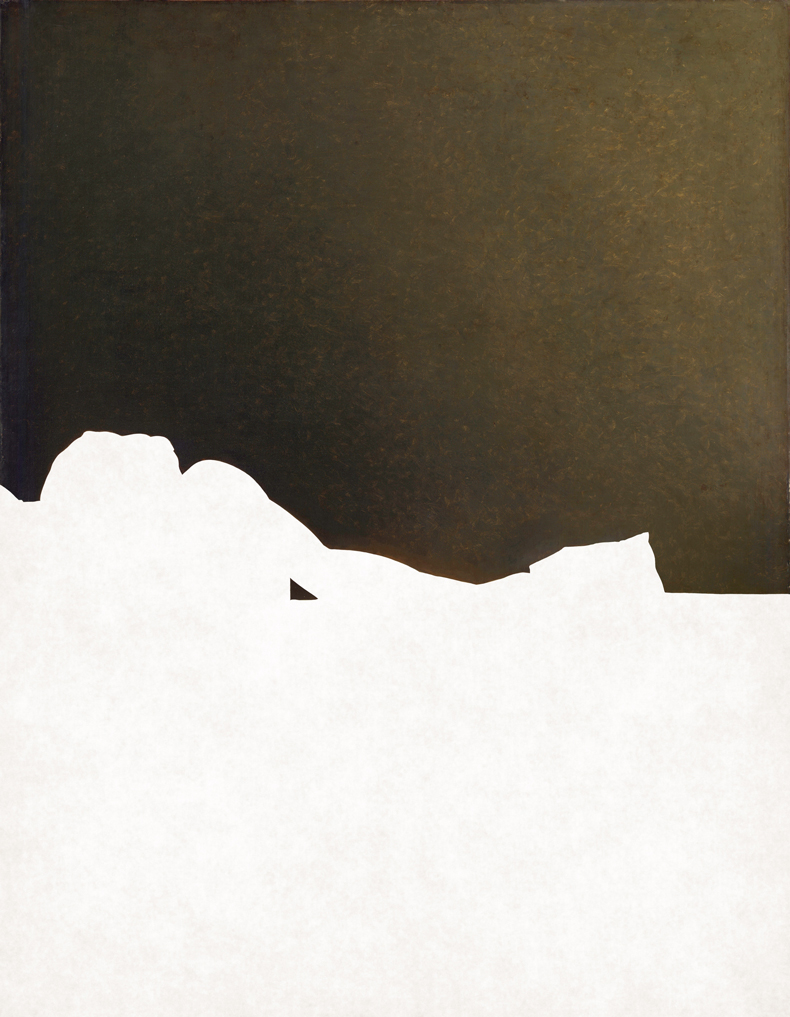
The union of these humble objects in the service of monumentality lends itself well to Crow’s approach to the painting, which is declaredly structuralist, focusing less on its context than its ‘internal symbolic dialogue’. Readers hoping for a detailed account of Corday’s upbringing and motivations must look elsewhere; the index cites Barthes and Balzac more than Marie Antoinette. Instead, its chapters are devoted to the boundary (‘like a crack in the ice’) between the picture’s top and bottom halves; to the androgyny of the central figure – an acknowledgment, Crow argues, of Corday’s grip on the public imagination – and, perhaps most provocatively, the ‘field of repetitive, translucent, non-mimetic touches of paint’ that comprise the picture’s extraordinarily stark background. His analysis is supported by beautifully rendered image manipulations by Dominika Ivanická, which effectively create five alternative versions of Marat at his Last Breath – ‘many partial works in one’ – the last of them just a dark void, which occupies half the canvas; its gentle luminescence the result of thin paint smeared over a lighter ground.
Though Crow’s scholarly interests have recently extended into modern and contemporary art, he has never ceded the territory of his groundbreaking first book, Painters and Public Life in Eighteenth-Century Paris (1985) and the later Emulation: Making Artists for Revolutionary France (1995). In a fitting counterpart to the doublings and reversals he traces throughout Marat at his Last Breath, Crow’s latest publication is also arguably his first: it opens with an account of his abandoned graduate proposal, at UCLA, to use David’s painting to create a visual counterpart to Barthes’s literary structuralism. What this project might have become is an intriguing counterfactual, though it would certainly have sat easily alongside the popular percolation of Peter Weiss’s play The Persecution and Assassination of Jean-Paul Marat as Performed by the Inmates of the Asylum of Charenton under the Direction of the Marquis de Sade (1964, commonly known as Marat/Sade) and the events surrounding the Paris uprisings of May 1968, both of which are discussed here. Conversely, in the present day, Crow feels he must rescue structuralism’s reputation ‘from the condescension and amnesia of present-day intellectual fashion’. He argues anew for the significance of the ‘charged repositories of experience’ encapsulated in paintings such as David’s. The political struggle of the 1960s, he writes, was ‘nourished […] on the past’ – but what sustains revolution today? Maybe the time has come for Marat to breathe again.
Murder in the Rue Marat: A Case of Art in Revolution by Thomas Crow is published by Princeton University Press.
From the February 2026 issue of Apollo. Preview and subscribe here.