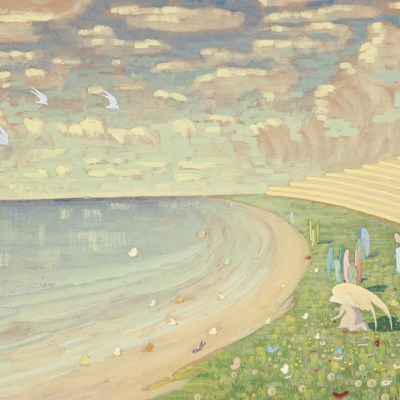
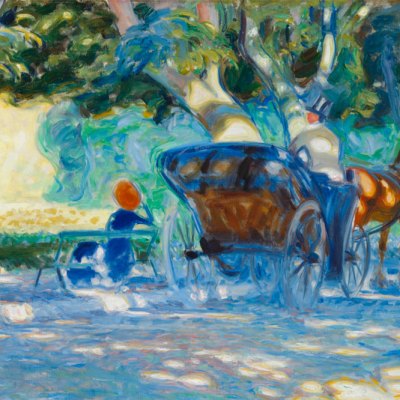
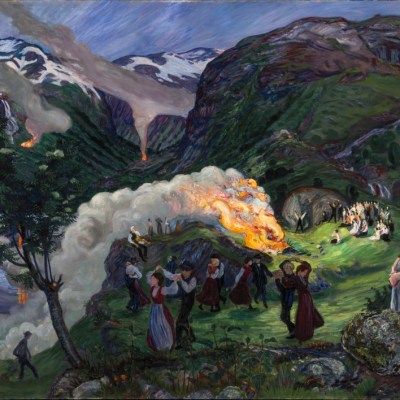
From the February 2026 issue of Apollo. Preview and subscribe here.
Somewhere in the Gulf of Finland, buried beneath the seabed, are a number of paintings by Konrad Mägi (1878–1925), one of Estonia’s pre-eminent artists. We may never know how many; of the 400 or so works he is thought to have painted, some 100 remain unidentified and untraced. What we do know is that in the autumn of 1944, as the Red Army swept north through the Baltic states, 75,000 Estonians – around one in 12 citizens – fled their homeland, haunted by memories of the Soviet occupation of 1940–41. Most of them set off in small boats for Finland, Sweden and Germany; amid stormy weather and crowded onto vessels intended only for coastal fishing, thousands drowned. Some of the refugees carried with them paintings by Mägi. The works that survived ended up scattered around the world – not only in Scandinavia but as far away as Australia and the United States, where they reside largely in private collections.
Known today primarily for his visionary landscapes, Mägi himself never crossed the Atlantic, but like many other budding Eastern European modernists he caught the Continental travel bug at the turn of the 20th century. Though his career would be characterised by rapid artistic evolution, he got off to a stuttering start. Having enrolled at the Stieglitz Art Academy in St Petersburg in 1903 at the relatively ripe age of 24 – before that, his art education consisted of drawing lessons aimed at factory workers – he left after the Russian Revolution of 1905, dreaming of Paris but installing himself instead on Finland’s Åland Islands, where he began to paint under the influence of a younger compatriot, Nikolai Triik. Mägi finally made it to Paris in 1907, but the city never quite suited this country boy. ‘There are many interesting parks in Paris,’ he wrote, ‘but I don’t like the nature there as a whole.’
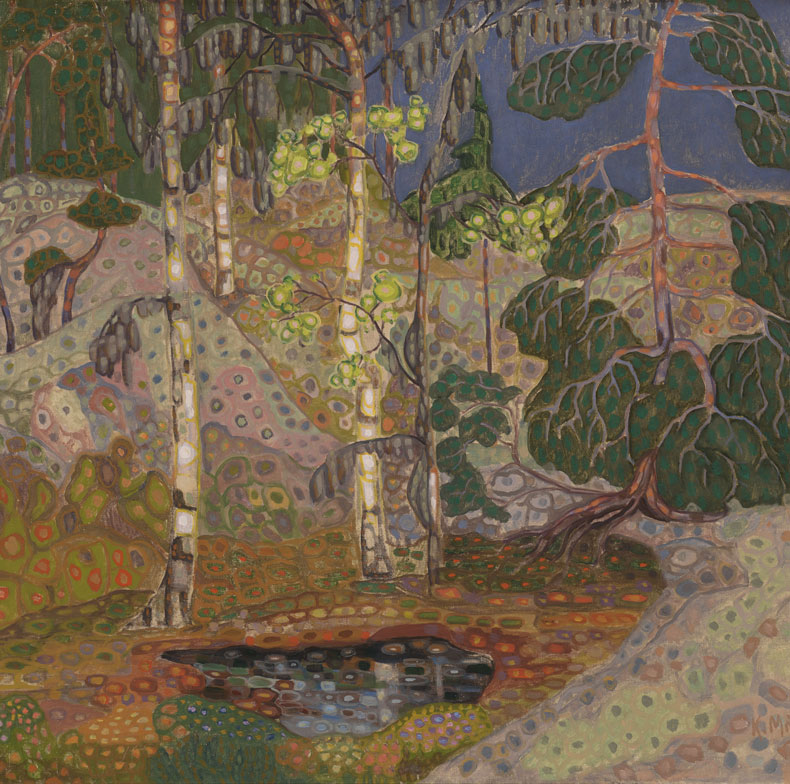
It was not until a two-year stint in Norway in 1908–10 that Mägi began to succeed as a painter. The landscapes he made there were among the smallest of his career – oddly, given the vastness of Norway’s vistas – but reveal a facility for full-bodied cumulus clouds and trees that seem, with their fine vertical brushstrokes, to be straining for the heavens. Many works from this period show him engaging with wider artistic developments in compelling ways: the Klimtian Norwegian Landscape. Bog Landscape (1908–10) is an arboreal scene turned inside-out, the bog resembling so many organelles suspended in cytoplasm.
Over the next 10 years, spent mostly in Estonia, Mägi experimented with skies, incorporating dazzling vermilion shades and stark Symbolist stylings that seem to reflect the clinical depression from which he suffered; looking at some of his landscapes, it’s hard not to think of Van Gogh. But his attention to flora distinguished him from his contemporaries in Estonia and abroad. Beginning during a stay on the Estonian island of Saaremaa, Mägi developed a pointillistic style that reached its apogee in his best-known painting, Sea Kale (1913–14), in which bright coastal vegetation composed from hundreds of brushstrokes flourishes under a narrow strip of wan grey sky.

It’s not hard to see why Estonia loves Mägi so much. His work makes the country’s landscapes seem much more colourful than they actually are. There is something of Mägi’s fierce individualism in how Estonia sees itself – a product, perhaps, of having spent much of the last 500 years occupied by other countries: Sweden, Germany, the Soviet Union. Estonia is often grouped with Latvia and Lithuania as one of the Baltic states, but most Estonians identify more closely with Finland, thanks to linguistic affinities and geography (the capital, Tallinn, is closer to Helsinki than to anywhere in Latvia). In any case the country has followed its own path, punching above its weight in digital technology, motor sports – and museums. The Estonian National Museum in Tartu, redesigned in 2016 by DGT Architects, resembles a sleek 355-metre-long spacecraft beamed in from the future on to a former Soviet airfield; visitors enter through a gaping glass maw and can walk down the length of the building as it recedes into the landscape. It is for the most part an ethnographic museum, but a number of Mägi works are stored in its cavernous cellars.
More of his paintings are on display at the Art Museum of Estonia, known as Kumu, in Tallinn – another glassy edifice, curvilinear where its larger sibling in Tartu is straight-edged. Kumu tells a story of Estonian art from the 18th century to the present day and is a good place to see Mägi’s art in context; many of the artists in the permanent collection were, like Mägi, clearly influenced by art movements fermenting in the West, from German Romanticism to Pop art. Kumu holds more Mägi works than any other institution or collector, but it’s given a run for its money by Enn Kunila, a neat, attentive 75-year-old industrialist who owns more than 30 paintings by the artist. Together with his wife, Maris, he has done much to spread Mägi’s name throughout Europe, lending works for exhibitions in Florence, Turin, Copenhagen and elsewhere, and offering to pay for the restoration of Mägi paintings in private hands.
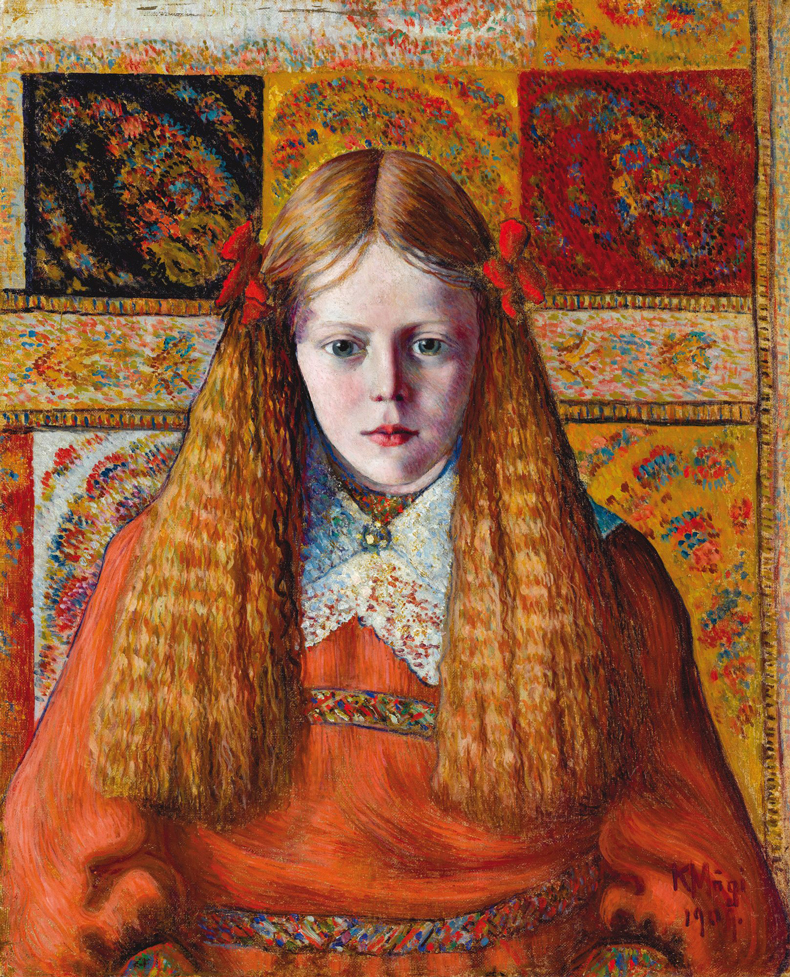
Kunila’s proselytising has been effective – helped, perhaps, by the continuing trend of artists from the former Soviet Union being integrated into European art-historical narratives. Mägi was the subject of a solo survey at the Galleria Nazionale d’Arte Moderna in Rome in 2017–18, and later in 2018 some of his paintings were included in a show on Baltic Symbolism at the Musée d’Orsay in Paris. In March, Dulwich Picture Gallery will continue its run of Baltic and Nordic exhibitions with a survey of Mägi’s landscapes and vivid portraits. What will have to be matter for another show is Mägi’s period in Rome, Venice, Naples and Capri in the 1920s, when his skies turned ultramarine and his increasingly vertiginous urban vistas began to include more people and buildings.
Despite recent fillips to his reputation, Mägi is not especially sought after by international museums or collectors and has never fetched more than €302,000 at auction, but perhaps this is a blessing for Estonia: its museums and collectors have only each other to compete with when persuading art-lovers abroad to part with their Mägis. The main challenge will be what it has always been: tracking the paintings down.
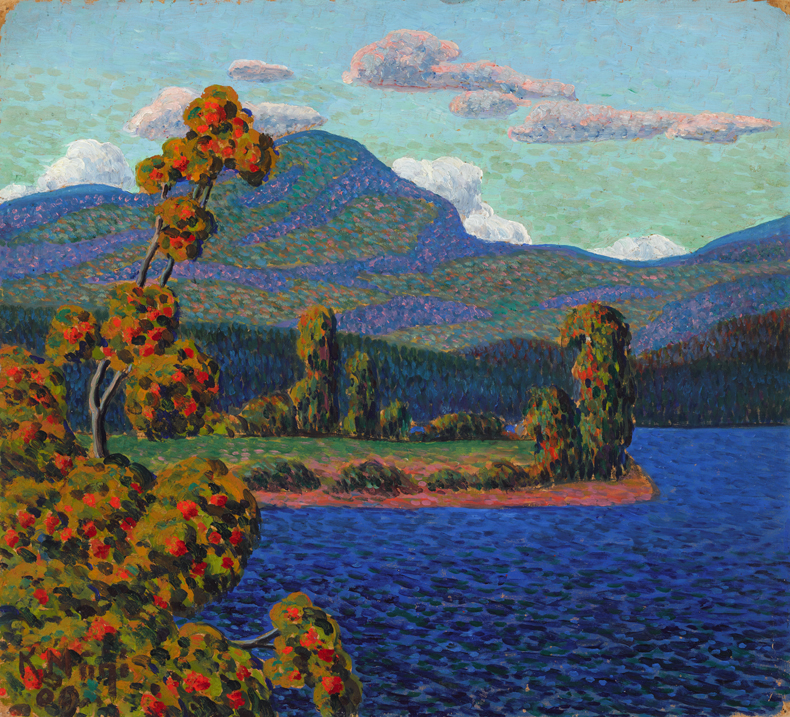
‘Konrad Mägi’ is at the Dulwich Picture Gallery, London, from 24 March–12 July.
From the February 2026 issue of Apollo. Preview and subscribe here.