From the February 2026 issue of Apollo. Preview and subscribe here.
The integration of the natural landscape and its beauty is part and parcel of wine farming in the Western Cape. Franschhoek (Afrikaans for ‘French Corner’) in the Western Cape owes its name to nine Huguenot families who arrived in the new Dutch colonies from the late 17th century. Though the area produces only two per cent of South Africa’s wines, it has a distinguished tradition – one of the oldest vineyards, La Motte, has been operating since since 1709, when Pierre Joubert named it after his home village in Provence, La Motte-d’Aigues.
In 1970, the businessman Anton Rupert acquired the farm and began a thorough redevelopment and restoration of the historic buildings, replanting parcels of noble varietals, including Sauvignon Blanc, Cabernet Sauvignon, Viognier and Sémillon. La Motte represents a sliver of the country’s wine volume, but its significance is larger than that suggests, thanks to the Rupert family art collection, which is anchored by a significant body of work by one of South Africa’s most recognised – and most controversial – artists from the first half of the 20th century: the landscape painter Jacob Hendrik Pierneef (1886–1957), usually referred to simply as Pierneef.
Rupert was motivated by a desire to preserve South African art and share it with the nation – a responsibility he passed to his daughter Hanneli Rupert-Koegelenberg, along with the wine estate. The works owned by the family include Pierneef’s most significant public commission, the Johannesburg Station Panels, executed between 1929 and 1932, some of which are now displayed in the family’s private gallery in nearby Stellenbosch. The panels were originally hung in the concourse of Johannesburg’s newly constructed railway station as an enticement to travellers to explore what was then the Union of South Africa.
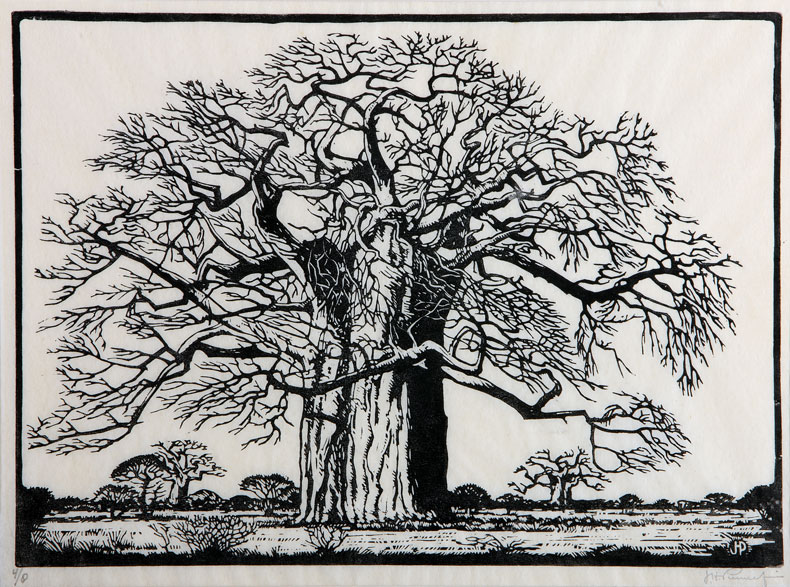
Tasked with depicting ‘places of scenic beauty or historical interest’, Pierneef travelled throughout South Africa, sketching and painting with watercolours. Undeterred by conventions of representation and scale, the artist moved mountains and shifted plains, reshaping clouds and reformatting trees to fit his idea of form. Pierneef was devoted to the graphic line: clouds and the trees of the Karoo become fluid lines, technical and representational on one level, but veering into musical fantasy.
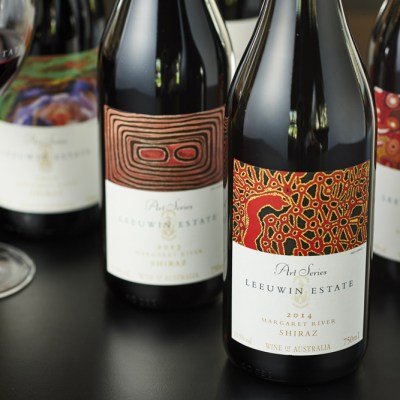
The winery honours him with a series of linocuts of the landscape and trees on their premium Pierneef Collection wines. The labels are small, monochrome, subtle and elegant, so as not to detract attention from the wine, but the associations blur the painter’s landscapes into the winemaker’s terroir. The Sauvignon Blanc is blended with Sémillon sourced from some of the most southerly vineyards in Africa, around Elim, in the new appellation of Cape South Coast; the label uses Pierneef’s linocut of a tree, Baobab, Northern Transvaal (1916). The Pierneef Atelier Red is predominantly Shiraz – also from Elim – blended with Viognier from Franschhoek. The image on the label, Cape Dutch House, Krom River (1916), is a tribute to the distinctive Dutch Cape architecture.
Pierneef learned his art from established artists, including European masters – in his teens, during the Second Boer War, his family went into exile in the Netherlands and he studied art in Rotterdam. In the 1910s and ’20s he made a living in South Africa as a commercial artist and teaching and lecturing. His more experimental paintings were criticised for his adoption of abstraction and modernism – a review of 1928 slated him as ‘a Futurist’. In 1958, though, Matthys Bokhorst, who went on to become director of the South African National Gallery, called Pierneef the ‘Cézanne of South Africa’.
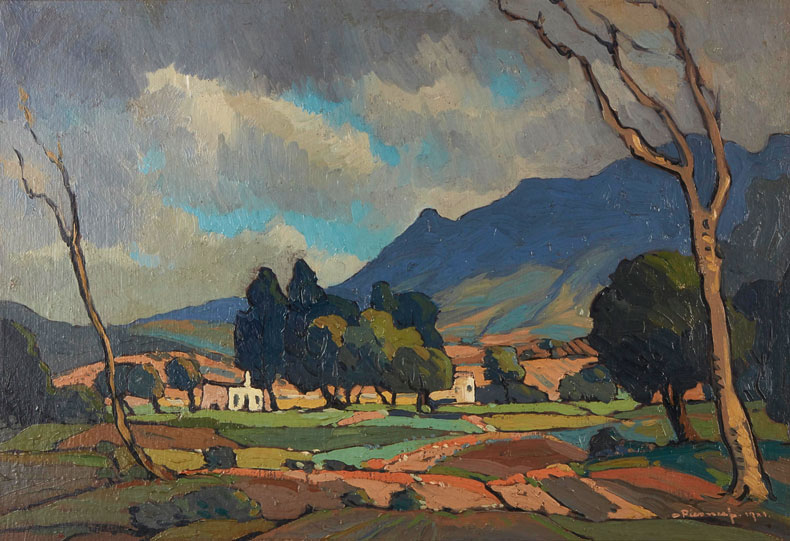
The artist’s legacy has been problematic in post-apartheid South Africa. In the 1920s, Pierneef resigned from his teaching posts in protest at an education system based too much on the English art-historical tradition; he advocated a peculiarly South African style of exploration. He was also, for a period, a member of a secret nationalist Afrikaner brotherhood.
His pieces still sell at auction, though: in 2017, Farm Jonkershoek with Twin Peaks Beyond, Stellenbosch (1928) fetched R20.5m (approximately £1.25m at 2017 rates) – not just his own auction record but, at the time, the second highest amount ever paid for a work by a South African artist. And South African artists today do not deny his influence. The ceramicist Michael Chandler, who in 2025 was commissioned by La Motte to create sculptural grape bunch garlands, hand-modelling every berry using soil from the terroir, says: ‘Pierneef’s works were made to delight the eye […] I admire the way Pierneef could take a landscape and project it on to a canvas; his work feels like a facsimile of the land at times.’
Pierneef’s paintings, displayed here among the landscapes he depicted, allow us to understand and debate how his legacy has shifted over time. As Chandler says, ‘I’m not sure you can discuss landscape painting in South Africa without mentioning him.’
From the February 2026 issue of Apollo. Preview and subscribe here.