From the February 2026 issue of Apollo. Preview and subscribe here.
One of the great artistic colonies of the Victorian era was in Kensington, then a village on London’s periphery, where wealthy painters including Frederic Leighton and Val Prinsep built magnificent, architect-designed studio homes on the old Holland estate. Leighton, who moved into No.12 Holland Park Road in 1866, was easily the most famous of that loose group and is more often than not the one credited with turning the area into a honeypot, but actually he discovered it by dint of the lively Sunday salons that Val’s mother, Sara, established at Little Holland House as early as 1850.
Sara’s other guests included Edward Burne-Jones, Alfred Tennyson, William Makepeace Thackeray, Charles Hallé, John Herschel and Charles Darwin. Not forgetting the artist G.F. Watts, who trumped the unanimous and unwavering devotion of those figures by coming to stay with the Prinseps for three days and leaving 24 years later.
Before she became Mrs Thoby Prinsep, Sara was a Pattle – one of seven Anglo-Indian sisters whose combined arsenal of breezy bohemianism, artistic talent, beauty, idiosyncratic dress and facility for making connections and conversation had a significant influence on 19th-century British culture. You will, I think, be familiar with her elder sister, the photographer Julia Margaret Cameron, and with certain descendants of her younger sisters Mia (Virginia Woolf and Vanessa Bell) and Sophia (the historian William Dalrymple) but history has otherwise been largely blind to the Pattles. Hence the importance of this small but engagingly conceived exhibition at the Watts Gallery in Surrey – the first to consider them in septuplicate.
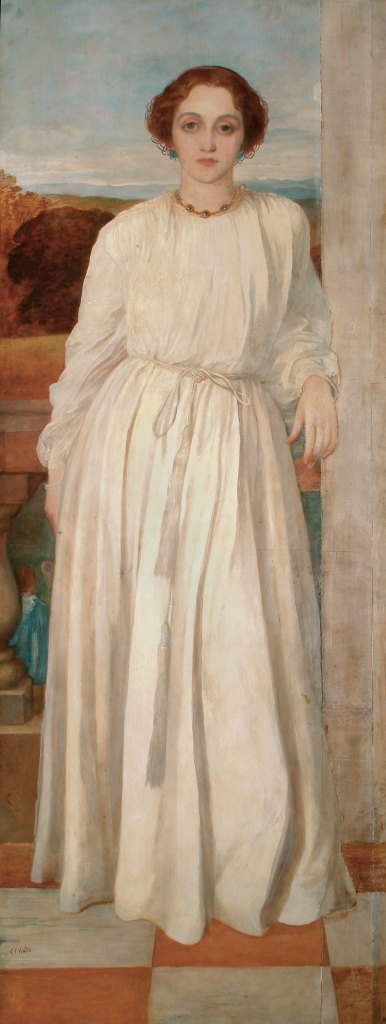
In order, they were Adeline, Julia, Sara, Mia, Louisa, Virginia and Sophia; the daughters of James Pattle, a British civil servant of the East India Company, and Adeline Maria De l’Etang, who was of French-Indian heritage. All but Mia were born in Calcutta and all seven were educated in Paris, while living with their grandmother at Versailles. (According to family lore, the grandfather had been exiled from that court for his close relationship with Marie Antoinette.)
Sara was the first of the sisters to settle in London, in 1843. On the death of her parents two years later, she brought the as-yet-unmarried Virginia and Sophia to join her in Mayfair. Her new friends were delighted: to John Ruskin the girls seemed ‘Elgin marbles with dark eyes’, while Thackeray wrote that when Virginia came into the room, ‘it is like a beautiful air of Mozart breaking on you’. Louisa and her husband also moved to Britain that year; Julia and Mia and their husbands in 1848 (Adeline died at sea in 1836).
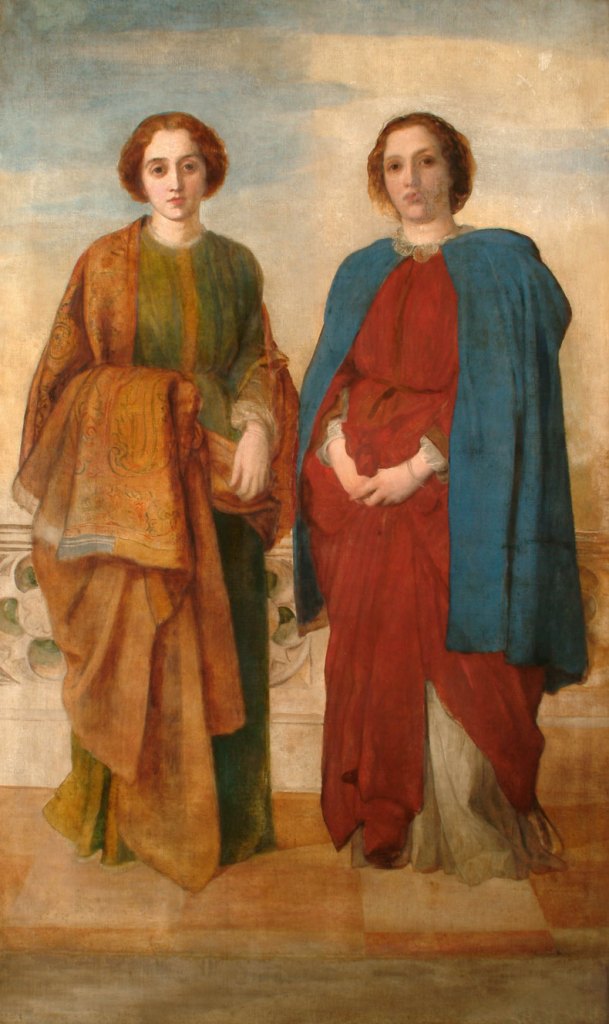
The Prinseps moved to Kensington in 1850 and Watts later the same year. Little Holland House was the dower house to the Jacobean Cope Castle, the terrace of which can be seen in several of Watts’s portraits of the Pattles, including The Sisters, which opens the exhibition. It shows Sophia – by now married – and Sara in the free-flowing, tunic-style dresses of Indian silk and muslin they favoured. They also wear rakhi bracelets, which symbolise the love between siblings, and Sophia a sumptuously embroidered Kashmiri shawl. Indeed, the Pattles made a point of emphasising their Indian background: at Little Holland House guests sat on Indian rugs spread on the lawn and were served lobster curry. Sara and her sisters were also apt to chatter to each other in Hindustani, ‘the language best suited to express their superabundant vitality’, noted one observer.
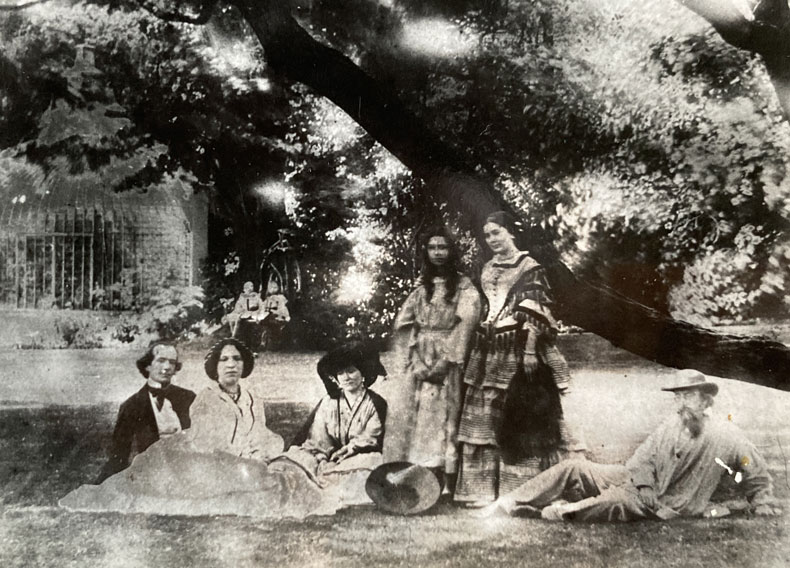
As quasi artist-in-residence, Watts painted the sisters repeatedly. Their distinctive features – particularly Sophia’s – are also visible in certain of his historic, literary and allegorical works. They were especially close: she nicknamed him Signor and he called her Sorella – ‘sister’. Watts’s style of painting rather calcifies the vitality for which the Pattles were renowned, but it is copiously present in his drawings, of which there are a happy number on display: a coloured chalk, for instance, of the Versailles grandmother Thérèse Josèphe Blin de Grincourt and studies of Sara and her niece Julia Jackson (daughter of Maria) in close-up.
Cameron’s role in early photography grants her a starring role here. One of only two albums she created and inscribed – in a gorgeous looping hand – for Virginia and Mia in 1863 is on display, along with her portraits of Watts, Tennyson and May Prinsep, Sara’s niece, who later married Tennyson’s son and whose painted portrait by Val Prinsep is a highlight of the show.
Watts was a great friend to Cameron – an exhibited letter from Little Holland House in 1872 praises her recent work; her approach matched his opinion that a portrait should be ‘a summary of the life of the person, not a record of accidental position or arrangement of light and shadow’. Her gold-flushed prints, which prioritise emotional depth over the consistency of focus that her era believed was photography’s sine qua non, outshine him here.
It was Virginia Woolf – Mia’s granddaughter – who produced the first serious study of Cameron’s work, Victorian Photographs of Famous Men and Fair Women (1926). Three years earlier, she also wrote a comic play, Freshwater, satirising her great-aunt’s life on the Isle of Wight, where Cameron had moved in 1860 following the example of her great friend Tennyson. Watts acquired a bolthole in the same village in 1871 and the pages of Woolf’s script displayed here have him deliberating over a painting. Beside it is Vanessa Bell’s memo book containing her costume and cue notes for the play. Her daughter Angelica played the actor Ellen Terry, Watts’s first wife. It was Sara who had introduced them and Terry joined Watts to live with the Prinseps until she and he separated after a mere 10 months.
Watts met his second wife at Little Holland House too, in 1870. Mary Seton Fraser Tytler was also born in India and her two elder sisters had been photographed by Cameron in 1864–65. Four years later she herself appears in The Rosebud Garden of Girls, a photograph Cameron made in tribute to Tennyson’s poem Maud.
The catalogue reminds us that Hermione Lee, in her landmark biography of Woolf, named Little Holland House the ‘spiritual ancestor’ of Bloomsbury; useful though that is in terms of granting the Pattles’ a kind of canonical status, it is the women themselves that the show brings most exuberantly into relief.
‘Women of Influence: The Pattle Sisters’ is at Watts Gallery, Surrey, until 4 May.
From the February 2026 issue of Apollo. Preview and subscribe here.