From the February 2026 issue of Apollo. Preview and subscribe here.
When Luca Signorelli’s ‘much beloved son, who was extremely handsome in face and figure, was killed in Cortona’, according to Giorgio Vasari’s Lives of the Artists, ‘even as he grieved, Luca had the body stripped, and with the greatest constancy of heart, without crying or shedding a tear, he drew his portrait so that he could always see whenever he desired, through the work of his own hands, what Nature had given him and inimical Fortune had taken away.’
The drawing doesn’t survive, if it ever existed, but Vasari’s account inspired the tradition that the figure of Jesus in Signorelli’s Lamentation over the Dead Christ (1502), painted for the church of Santa Margherita in Cortona and now in the city’s Diocesan Museum, is based on the portrait of his dead son.
Another reason for the legend, as Maud Cruttwell put it in her 1899 life of the painter, is that ‘the realism and pathos of this dead Christ are so convincing’. And one reason for that is the contrast between the horizontal corpse and the vertical figures crowding the panel: Christ looks so very dead – almost as if carved out of wood – in part because so much of the rest of the painting is so very full of life.
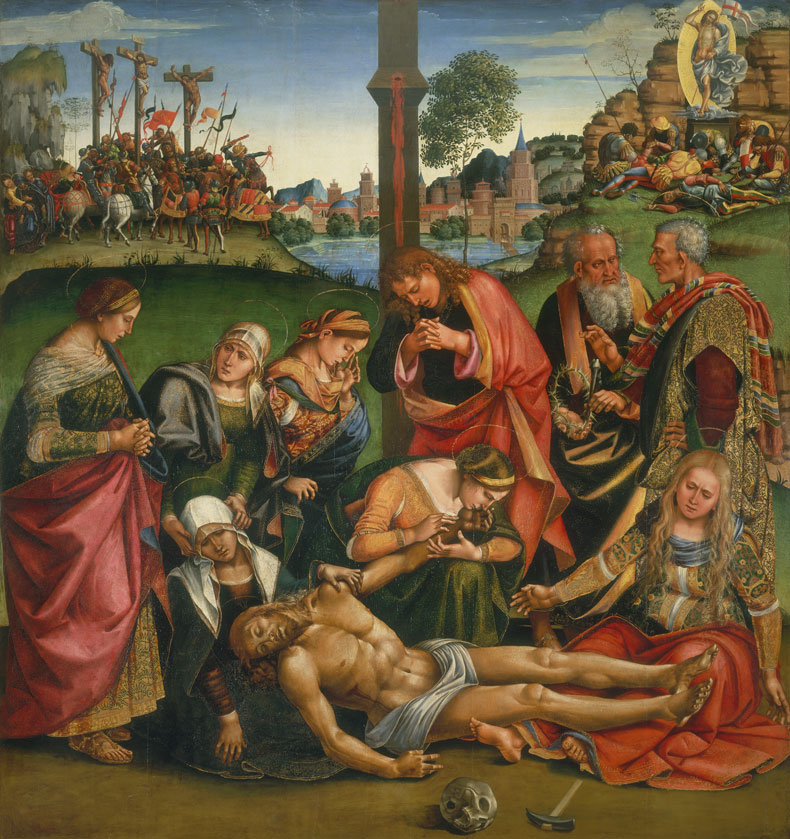
Two of the mourning women and all three of the men are easy to identify: Jesus’s mother is nursing his head and his outstretched calves are resting on Mary Magdalene’s foreshortened shins; the men are John the Evangelist, Joseph of Arimathea and Nicodemus. The other women mentioned in the gospels are Mary the wife of Cleophas, Mary the mother of James and Joseph, the mother of Zebedee’s children, and Salome. The last three are often taken to be different ways of referring to the same person – but if so, who are the other two women in Signorelli’s painting? The figures are all so distinctive – in their postures, expressions, jawlines, clothing, headdresses – that I want to know their names.
Signorelli was a master of contrasts and a master of crowds. There are hundreds of figures in his fresco cycle in Orvieto cathedral, painted shortly before the Lamentation, depicting the end of the world: a crowd gathers to hear the Antichrist; a panicked crowd tries to flee out of the painting from foreshortened demons; a crowd of resurrected skeletons climbs from the earth to be reclothed in flesh; a crowd of the blessed waits to be carried up to heaven; a crowd of the damned is manhandled by demons.
These days you can get from Orvieto to Cortona by train in under an hour, though the two cities were close enough in Signorelli’s time, too. Close enough for him to rush home in time to sketch his dead son’s body? Perhaps. Certainly close enough for the echoes between the paintings to resonate. Mary Magdalene looks very like the woman who appears at the centre of two of the scenes in the cathedral: standing next to the Antichrist with her hair down as a man presses a coin into her hand; riding on the back of a demon who bears her down to hell. And the trio of Jesus, his mother and the Mary who is holding his hand appear, in mirror image, on the cathedral wall below the resurrection of the body.
But the contrasts, too, are striking. Working in oils on panel, Signorelli had time to attend to details that would be impossible to achieve in fresco before the plaster dried: the intricacies of everyone’s hair, their clothing, their hands – there are 200 fingers in the foreground of this painting. You have to look closely to see the tears on the women’s faces.
And where for that matter is Mary Magdalene looking? At Jesus’s feet, or at the skull and the hammer that are front and centre of the painting? The skull, lying at an unconventional angle, the foramen magnum exposed, the lower jaw missing, yet another virtuoso experiment in foreshortening, is both a memento mori and a location tag (Golgotha means ‘the place of a skull’), and recalls the reanimated skeletons in Orvieto cathedral. The hammer is an instrument of torture, used to nail Jesus to the cross (and to make the cross in the first place), though also to remove the nails, which Joseph is holding, and allow the body to be taken down.
A similar hammer might have been used in the manufacture of the panel to which Signorelli has applied his oils: a workman’s tool, in other words, like a palette knife or a paintbrush.
From the February 2026 issue of Apollo. Preview and subscribe here.