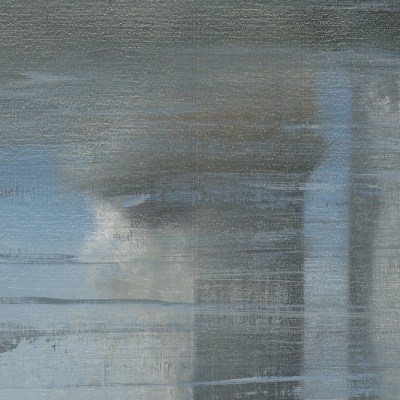
Untitled (2016; detail), Wolfgang Hollegha. Museum Liaunig, Neuhaus. © Wolfgang Hollegha Estate
When suggesting how viewers might best approach his work, the Austrian painter Wolfgang Hollegha (1929–2023) would often invoke a phrase associated with his compatriot Ludwig Wittgenstein: ‘Don’t think, look!’ This instruction is now the title of a survey of Hollegha’s work at the Museum Reinhard Ernst in Wiesbaden – the artist’s first solo museum show in Germany.
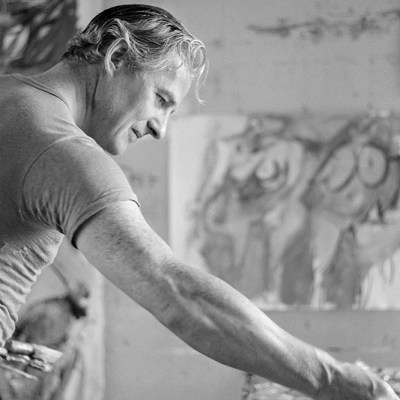
Born in Klagenfurt, Hollegha enrolled at the Academy of Fine Arts Vienna in 1947 and exhibited in Austria, Germany, France and Italy in the 1950s before finding success in the United States, where he drew inspiration from the Abstract Expressionists. In 1958, representing Austria, he won the Guggenheim International Award; he was the youngest winner among 23 laureates representing their respective countries, including Rothko (United States) and Giacometti (Switzerland). Hollegha’s gestural, intensely colourful large-scale paintings caught the eye of influential curators: in 1960 Clement Greenberg invited him to exhibit alongside other abstract painters in a group show in New York. But the city didn’t suit him. ‘New York was somehow a wilderness, a jungle – I liked that, but it wears you out,’ he would later say. ‘I thought to myself: I would rather go into the real forest now.’ Hollegha returned to Styria the following year and though he would continue to exhibit, taking part in the third edition of Documenta in Kassel in 1964, he returned to the Academy of Fine Arts Vienna in 1972, where he served as a professor until retiring in 1997. Over the decades, in a woodland studio he built himself, Hollegha created a body of work in which the joy he found in the process of constant discovery is clearly evident.

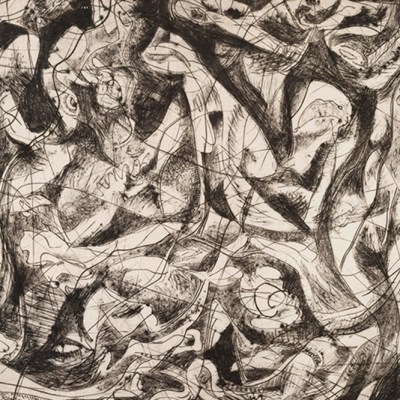
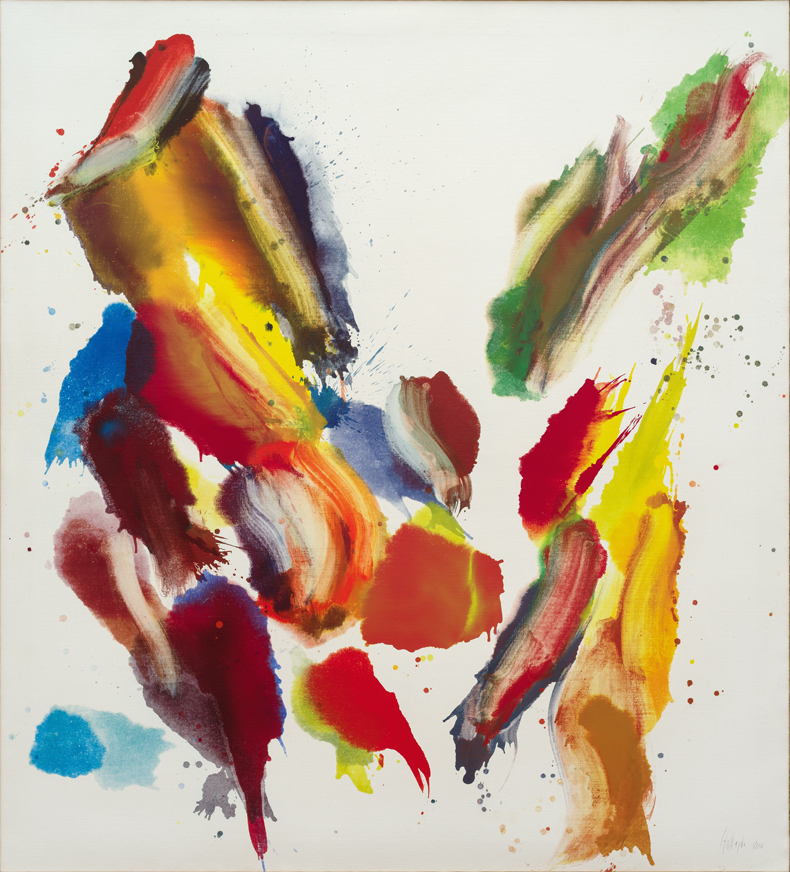
Organised in cooperation with the Neue Galerie Graz and the Universalmuseum Joanneum, ‘Don’t Think, Look!’ makes clear that Hollegha’s abstract paintings invite us not to analyse or contextualise but to look, to respond to the art immediately and instinctively. More complex than they seem at first, and based – unusually for an Abstract Expressionist – on drawings, Hollegha’s bursts of colour reward close looking and slow, patient observation. His paintings are hung alongside work by American contemporaries such as Jackson Pollock and Jules Olitski, who, alongside Hollegha and a handful of other painters, won the Carnegie Prize in 1961.
Since opening in 2024, the Museum Reinhard Ernst, which houses the substantial collection of abstract art built up by the industrialist who gave the museum its name, has shown work by painters including Helen Frankenthaler, Morris Louis, Atsuko Tanaka and Frank Stella. Its permanent collection galleries, designed specifically to accommodate large-scale paintings, allow visitors to appreciate the affinities and contrasts between Hollegha’s work and contemporaneous developments in Color Field painting in New York. The late Japanese architect Fumihiko Maki’s thoughtful design, with its clear sight-lines and abundance of natural light, shows off the paintings to best advantage while also allowing visitors to appreciate the leafy Wiesbaden setting.
Hollegha’s art gives us the freedom to lose ourself in form and colour. This is one of the chief perks of visiting the Museum Reinhard Ernst: it invites us to take things slowly, absorb an impressive range of abstract painting on its own terms, and leave with a renewed appreciation for mark-making, brushwork and compositions that may seem improvised but are in fact more carefully and skilfully conceived than we might imagine.
‘Wolfgang Hollegha. Don’t Think, Look!’ is at the Museum Reinhard Ernst, Wiesbaden, from 15 March–25 October. Tickets are available here.