
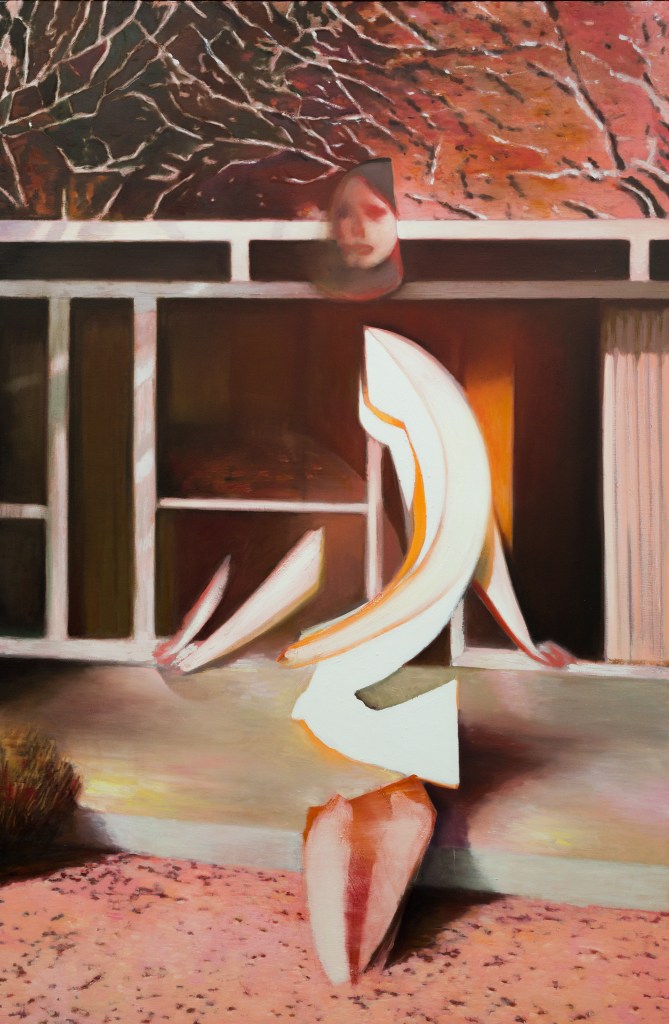
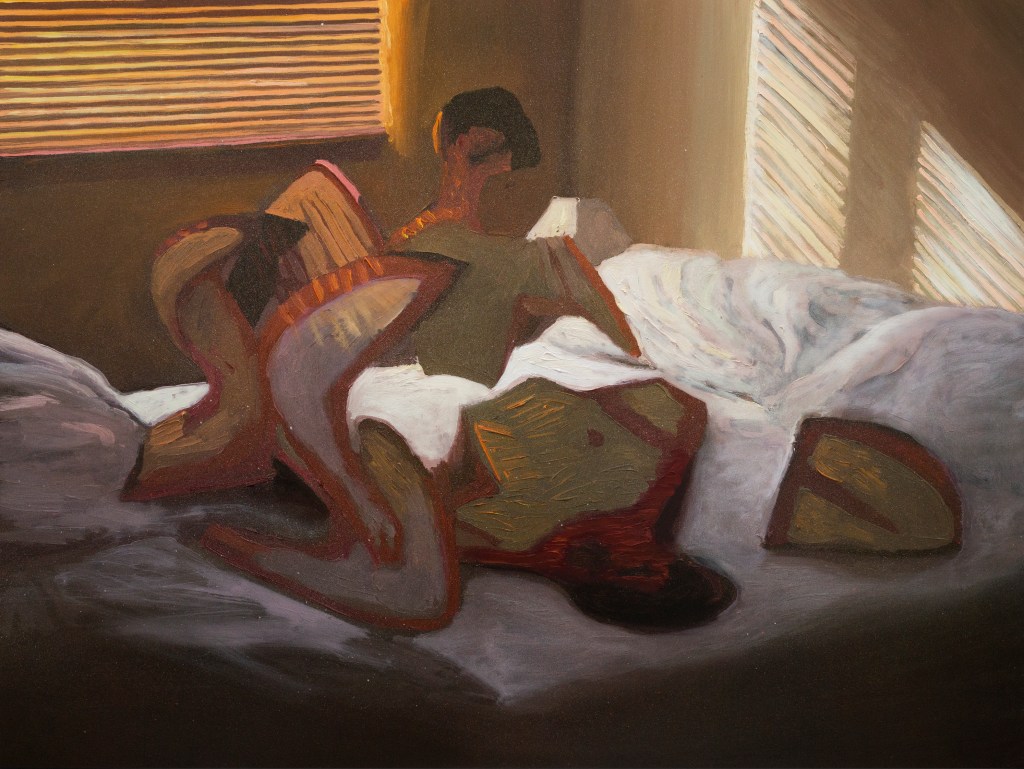
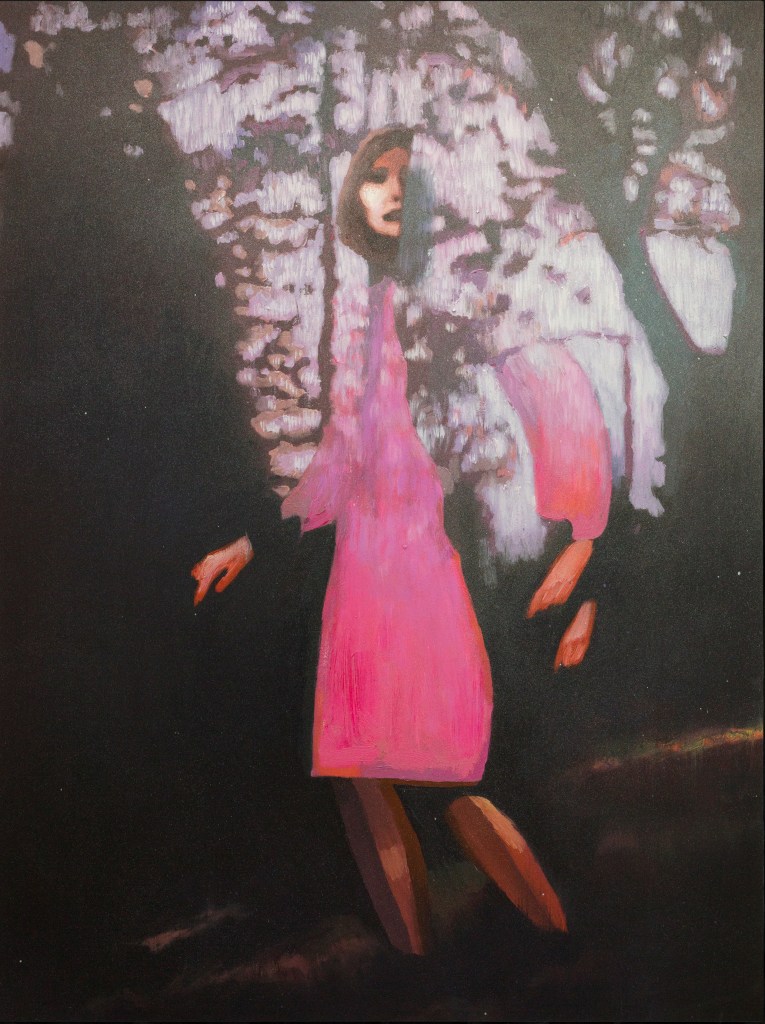
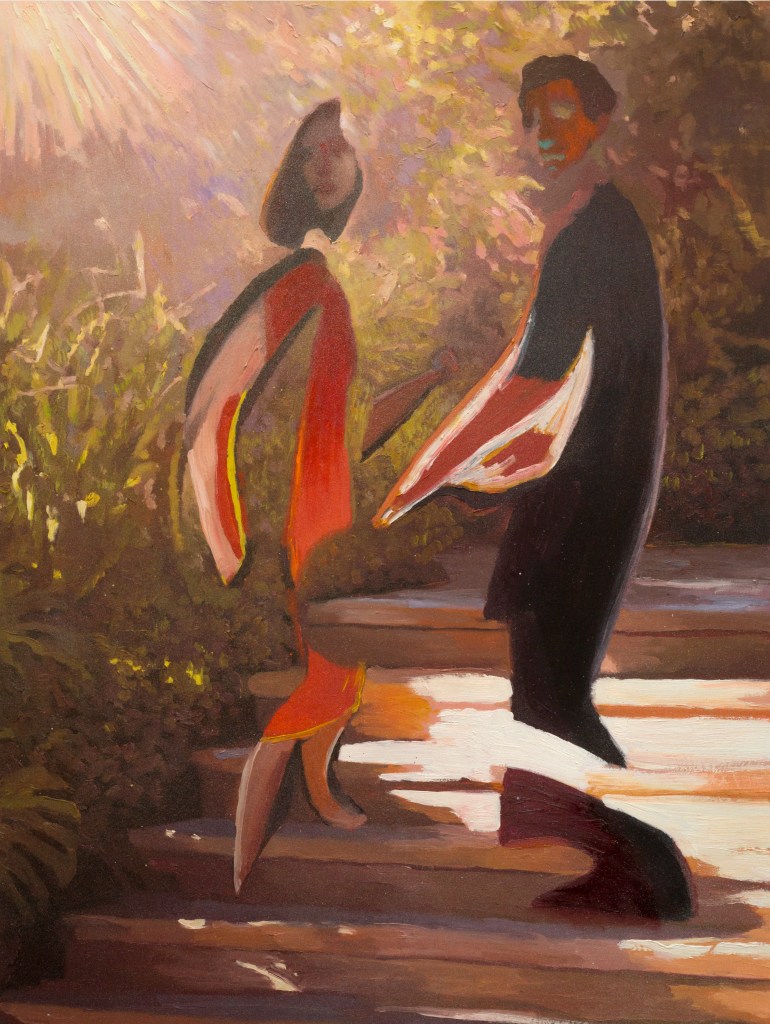
After a 14-year break from painting that began shortly after he graduated from the Glasgow School of Art in 1990, Lusaka-born artist Jonathan Wateridge returned to the medium, using elaborately staged sets as the source material for hyperreal paintings inspired by his love of film. Over the past decade Wateridge has adopted a more fluid approach, creating uncanny paintings of fragmented figures isolated in suburban settings: in Red Desert (2025), for example, a woman half-turned towards the viewer bears a startled expression, as though she’s been caught making a quick escape. Works including Red Desert and paintings on paper are presented in the artist’s first exhibition in Amsterdam, which is at GRIMM gallery from 12 February–28 March.
Where is your studio?
My studio is in south Norfolk just a few steps from my home. I lived in east London for more than 20 years but moved here with my family in 2017. Among other things it was an amazing opportunity to convert a 550 sqm agricultural unit into a studio and not have to pay unaffordable London rents for a similar-sized space. The fear of moving away from London is that you will be cut off, wither on the vine or lose that urban edge, but I found it liberating. I thought that if no one’s looking, who cares? Do what you want and take more risks.
How would you describe the atmosphere in your studio?
It’s very much a painting environment and because I’m so close to home there are no creature comforts – I don’t even have a chair or kettle. It’s just canvases, bits of paper and paint and, depending on what stage I’m at with a body of work, a fair amount of painterly detritus all over the floor. When I first arrived I was still making work that was realist enough to necessitate building sets for reference material, so I assumed I’d need a big space to build in. But once I moved here my work very quickly became more improvised and abstracted. So now I’m in the very lucky position of having a large messy studio to work in and an even larger clean ‘gallery’ space in which to curate paintings alongside each other as they develop towards a show. That has been a faintly ridiculous luxury but an invaluable one.
Is there anything you don’t like about your studio?
It’s too big to heat so it can be bitterly cold in winter but that’s a nice problem to have. My chilblained toes, however, scream in agony…
What is your studio routine?
If left to my own devices, I gravitate to working late into the night but parenthood has meant that I’ve kept more normal hours for a good few years now. I like to work most days and generally have at least a dozen paintings on the go at any one time, so I spend a bit of time first thing thinking through the most pressing options for the day. Sometimes that’s about technical execution and a case of just putting in the hours; other times it’s more open to play and following a scent and seeing where the work takes you. That’s always the best kind of day in the studio – even if it ends in failure, it always opens up unexpected choices.
Do you work with anyone in your studio?
Back in London, when still set-building, I worked with a wonderful assistant who was a construction dynamo, but when it comes to painting I’ve always worked alone. Painting with someone else in the room has always made me feel uncomfortable and self-aware, which I never want to feel when working.
Do you have many visitors to your studio?
Given where I’m based, no! But I’ve never particularly liked people coming into the studio when work is in progress. Either they say nothing and you immediately feel the urge to destroy it because it’s clearly terrible or, just as bad, they love it, which makes you fear you’ll mess it up. I have a handful of very dear artist friends whose opinion I trust enough to see things in their ‘ugly’ state, but otherwise the studio is quite a private, joyously solitary space.
Who is the most interesting or unusual visitor you’ve had?
I’ve had visits from a few of the great and the good of the art world but none were a patch on the timber delivery man I used to have in London. He was an amazing-looking British Caribbean guy who figuratively (and literally) wore rose-tinted spectacles. He’d been a musician in the ’60s and was relentlessly positive, curious and possessed the most soothing voice I’ve ever heard. I always hoped it was him delivering because he’d hang around for a chat and it was like ASMR before its time. He was the Bob Ross of delivery drivers.
Do you listen to anything while you work?
Ideally, no. I think that may be why I prefer the quiet solitude of the early hours. Listening to things marks time and generally I find the best sessions in the studio are ones where time becomes irrelevant and your focus is total. There’s a nearby road and farm that can get quite loud so I will listen to music or podcasts to drown it out. It very much depends on the task at the time, and any music needs to wash over you or simply provide a general feeling appropriate to your mood. Someone too interesting or arresting, such as Nick Cave, is really hard to work to because it demands too much of your attention. Classical is great to paint to, as is music that’s so familiar to you that it doesn’t distract. Northern soul is hard to beat in that regard.
What is the most unusual object in your studio?
That I would admit to publicly? Probably a chainsaw. I use it for cutting logs and the like, which are stored near the studio, but occasionally and tentatively I’ve started to use it for shaping the odd bit of wood into sculpture.
What is your most well-thumbed book?
Leaving aside fiction and non-fiction, I do crave art books and collect as many large monographs as I can. I don’t keep books in the studio but have shelves in the house and a particular table that always seems to have the books that I’m looking at on it. Matisse: Radical Invention 1913–1917 is often there, as are a couple of books on Picasso in the 1930s and ’40s, but at the moment it’s a monograph on Tal R, Francis Bacon: Human Presence and a glorious book on Rose Wylie. If I could be any living painter right now, she’d be very high on the list.
‘No Longer, Not Yet’ is at GRIMM gallery, Amsterdam from 12 February–28 March