Although she has been dead for some 400 years, Artemisia Gentileschi is having a very big month. On 4 February there were two major announcements: first, a small self-portrait painted in Florence in c. 1613–14, Self-Portrait as Saint Catherine of Alexandria, sold at Christie’s for $5.7m – a record for the artist. Second, the National Gallery of Art in Washington, D.C., announced that it had acquired Mary Magdalene in Ecstasy, likely painted in Rome in c. 1625. Unlike Old Masters whose fame has been consistent for centuries, Artemisia began to receive wide recognition only in the 1980s. Thus her oeuvre is still very much in flux, and each new discovery demands that we reconsider earlier assumptions. In the past decade in particular, many new works have begun to surface, with results that are sometimes confounding. But what’s remarkable about the paintings in question is that they are first-rate works of the most sought-after variety. Now seems like an opportune time to consider the paintings and Artemisia’s standing more broadly.
Self-Portrait as Saint Catherine of Alexandria
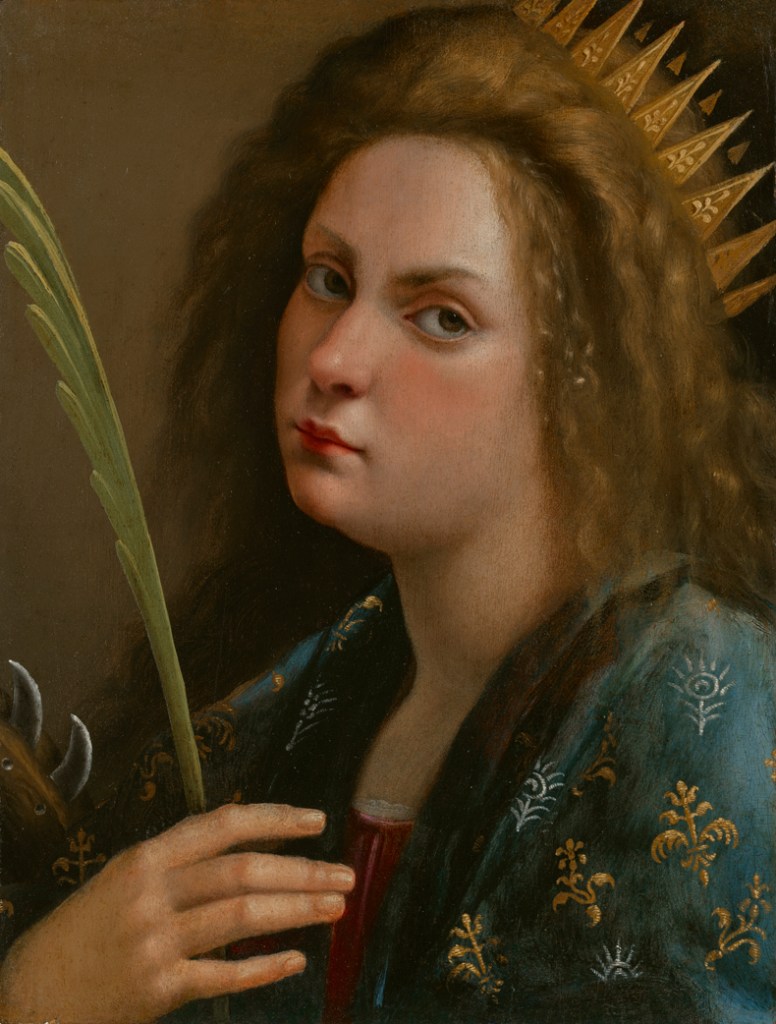
Painted in oil on panel and measuring just 32.3 by 24.6 cm, Self-Portrait as Saint Catherine of Alexandria portrays the artist gazing out at the viewer and dressed as Saint Catherine, with a crown, a palm, a spiked wheel and an embroidered blue cloak. The high quality of the work tends to get lost in reproduction, but in person it is luminous and finely finished in a way that would undoubtedly have appealed to Florentine patrons. The painting is closely related to a series of self-portraits that Artemisia painted after her arrival in Florence in c. 1613. So closely, in fact, that tracings and X-rays of the paintings have confirmed that they all originate from a common work that the artist must have traced or transferred through some other means. Despite deriving from a shared source, each of the Florentine self-portraits is distinct in mood, colouring and costume. In some, she dresses up as a female saint – often Saint Catherine, as seen here – while in the self-portrait held by the Wadsworth Atheneum in Hartford, Connecticut, she impersonates a lute-playing musician. In a lost painting mentioned in a Medici inventory of 1638, she is dressed as ‘an Amazon with a sword, shield, and helmet’. Such works seem to have been part of a deliberate strategy to promote herself in Florence and to step away from the legacy of her father, Orazio, and from her artistic godfather, Caravaggio.
Mary Magdalene in Ecstasy
The National Gallery of Art’s Mary Magdalene, on the other hand, is entirely different in tone and subject: dark, emotional, sensual and devout. It is also much larger, at 81 by 105 cm. The painting portrays Mary Magdalene at just over life-size and nearly pressed to the picture plane, her blonde hair loose, blouse slipping down over her shoulder, head thrown back in a state of religious ecstasy. Despite the deep black background, close inspection reveals that the Magdalene is in a leafy grotto, which places the scene at a later moment in the saint’s legend, when she has retreated to the wilderness to fast and pray. In its composition and stark chiaroscuro, the artist revisits her Caravaggesque roots, especially Caravaggio’s lost Mary Magdalene (best known through a copy by Louis Finson). But there is a fluidity, especially in the treatment of fabrics, and a depth of emotion that is distinctively her own.
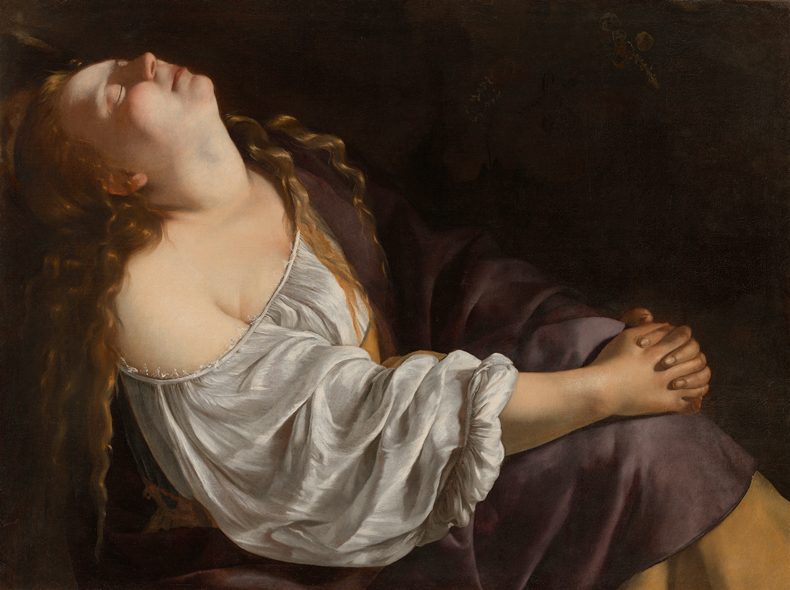
Eve Straussman-Pflanzer, head of Italian and Spanish paintings at the National Gallery of Art tells me that the reason for acquiring the painting now was simple: ‘This was the best work by Artemisia that we know of remaining in private hands.’ While Artemisia had already painted Mary Magdalenes, some of these works – such as the version in the Uffizi, with its shimmering satins and pearls and sparkling visual wit – seem to celebrate the very vanities that the Magdalene is supposed to be eschewing. But the National Gallery work is instead a profound exploration of the saint’s inner state, demonstrating what Straussman-Pflanzer calls an ‘embodied emotional tenor’ that forces us to ‘journey with her in a visceral, physical way’. In short, it has everything one hopes for in an Artemisia.
A Woman presenting her Child to Saint Blaise
An interesting contrast to these blockbuster acquisitions is A Woman presenting her Child to Saint Blaise, which was offered at Christie’s last December but did not initially sell. This very large (205.6 by 152.5 cm) altarpiece from her Neapolitan period portrays a woman kneeling and presenting a naked baby to Saint Blaise. The bearded bishop-saint, identifiable by the wool comb in the lower left-hand corner, sits on an elaborate carved and gilded throne and makes a gesture of blessing. Saint Blaise was the patron of throat ailments, and the painting appears to be an elaborate ex-voto from an unknown patron. Reminiscent of Italian Caravaggists such as Bartolomeo Cavarozzi, there are also dazzling passages of fabric and light that epitomises the best of Artemisia’s work.
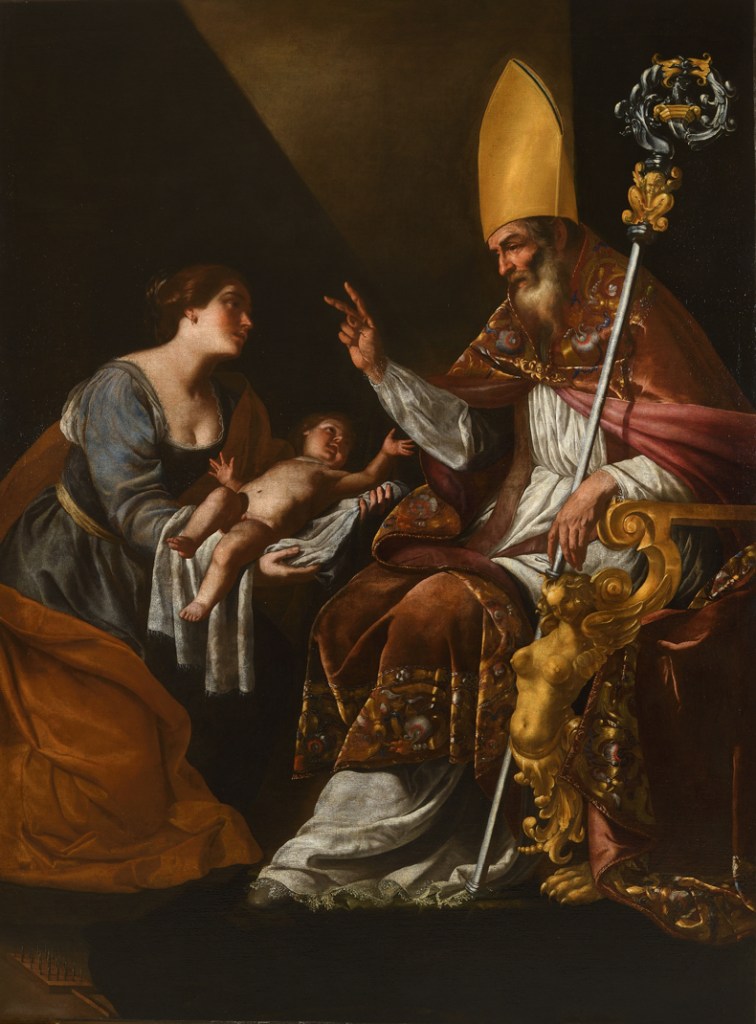
Saint Blaise was quietly acquired by FAMM, a private museum dedicated to women artists in the village of Mougins in south-east France, but the response has been muted. Why the disparity in interest? The enormous size – more than two metres high – makes it a daunting addition to any collection and there is some evident restoration in the figure of the mother that may have been a cause for concern. But, broadly speaking, the works from her later years in Naples, where self-representation takes a back seat to narrative or devotional concerns, are less sought after. Ironically, Artemisia was almost certainly paid many times more for Saint Blaise than she would have been for one of the small self-portraits, which she often gave as gifts to attract patrons. However, works such as this – large, traditional, expensive – do more to transform our understanding the artist and her career, even if they speak less directly to modern audiences. Given the broad revival of interest in the artist, new works are sure to emerge from dusty palazzi, museum storerooms and churches that require us yet again to reconsider what we know. I, for one, am eager to see that lost self-portrait of Artemisia dressed as an Amazon.