From the March 2026 issue of Apollo.
As an artist, Constantin Brâncuși divided opinion. Giacometti said he made ‘objects and only objects’ – a highbrow equivalent of the US customs official who in 1926 deemed Brâncuși’s sculpture Bird in Space to be ‘block matter’, classed it as ‘kitchen utensils and hospital supplies’ and tried to slap a 40 per cent tariff on it. But visitors to his studio on the impasse Ronsin in Paris were united in their admiration of his cooking. The painter Oscar Chelimsky, who took a neighbouring studio in the late 1940s, recalls ‘chicken, broiled in his forging oven, which we would wash down with Asti Spumante, or it might be a roast leg of lamb […] Everything he made was full of flavor, wholesome and thoroughly uncomplicated.’ Man Ray spoke of home-made pickles and shots of ţuică, a fierce Romanian plum brandy. Eugène Ionesco noted the smell of fermenting yogurt and the taste of ‘bitter’ raw cabbage and mămăligă, thick polenta made with sheep’s cheese and sour cream. Brâncuși himself said he bought ‘steaks by the yard’.
We tend to view the eating habits of the interwar avant-garde through the prism of a post-war aesthetic, intense and colourful but somehow composed, a series of illustrations by John Minton or Renato Guttuso, perhaps. Think of the whole sea bass, poached in a court bouillon, dressed with two kinds of mayonnaise, that Alice B. Toklas prepared for Picasso; the prix fixe at Brasserie Lipp; piperades and grands aïolis washed down with gallons of vin ordinaire on rickety tables overlooking the blue Mediterranean. Brâncuși’s simple, rustic Eastern European diet is a world away from that, but it formed a crucial facet of the artist’s mythology, along with his homespun clothes, ‘prophetic beard’ and ‘sly old peasant’s eyes’ (Ionesco again; at their first meeting the sculptor baited the playwright by saying he hated the theatre and proclaiming Hitler a ‘capital fellow’).
Brâncuși, born a century and a half ago this year, presented himself as, and to some extent was, a kind of holy innocent in Babylonian exile. (He left Romania in his late twenties but only took French citizenship at the end of his life, to facilitate the bequest of his studio to the state.) The stock anecdotes with which he regaled his dinner guests – walking all the way from Bucharest to Paris; renouncing Rodin as his sensei (he referred to the heroic figurative tradition in sculpture, typified by Rodin, as ‘beefsteak’) – suggest a certain detachment from worldly notions of convenience and self-advancement. His distillation of influences from Carpathian folk art, alongside the African and Oceanic sculptures his contemporaries were eagerly studying, gave his brand of primitivism a certain integrity, since the culture he was drawing on was at least in part his own.
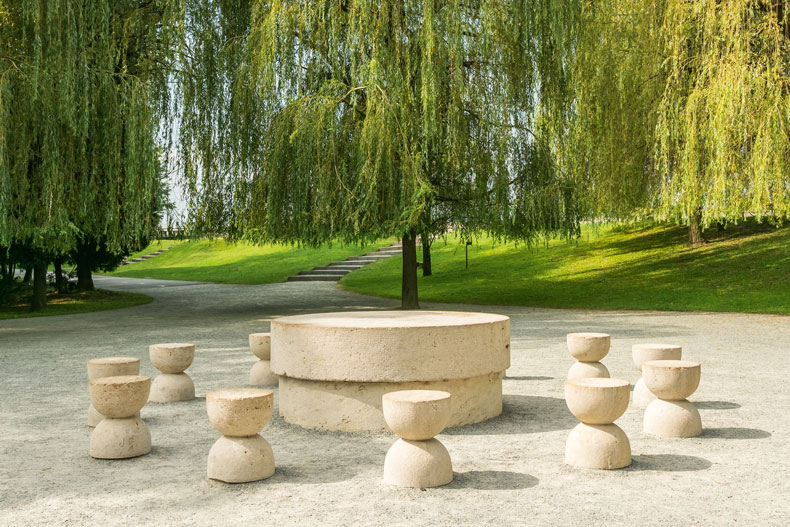
His gutsy, folksy cuisine clearly allowed him to retain a connection with Romania (though he seldom returned). But it also reflects aspects of his art: an elimination of the inessential, a preoccupation with things in themselves. ‘I’m not an abstract artist!’ he indignantly told James Joyce, who was surprised that a portrait sketch Brâncuși had made was so recognisable. Brâncuși then ‘made a few geometric scrawls on a paper, called it Portrait of James Joyce, and off he went, content’. The fact that a huge stone and plaster table – home-made, like the pickles and yogurt – could serve both as a plinth for displaying sculpture and a support for grilled chicken and Asti Spumante suggests a freewheeling dynamic between art and life. It is also an attractive point of difference from, say, the asceticism of Morandi, who slept and worked in the same room like a medieval monk, or the sheer squalor of the Giacomettis, who at one point shared their studio with a semi-feral fox and generally ate out.
In the 1930s, Brâncuși was commissioned to make a war memorial at Târgu Jiu in Romania. Along with an ‘endless column’ and a gateway derived from his decisively Rodin-sceptic early work The Kiss, he made a table surrounded by 12 stools: an enigmatic conceit, suggestive not just of the passion of Christ but also the Roman custom of offering and sharing food at the tombs of loved ones. After his own death, the studio he had come to see as the definitive statement of his artistic practice was crated up, then partially reconstructed, first at the Palais de Tokyo and subsequently the Pompidou. In the 1990s Renzo Piano designed an exquisite structure to enclose the latest and most faithful reconstruction of the studio, stove, table and all, as if it were the Holy House of Loreto. As part of the current renovation of the Pompidou, the studio will be ‘reintegrated into the Centre to give it greater visibility’, its press office tells me. In the meantime, Brâncuși must be content with a different accolade: like Alice B. Toklas, he’s had an upmarket modern European restaurant – hers in London, his in York – named after him.
‘Brancusi’ is at the Neue Nationalgalerie, Berlin, until 9 August.
From the March 2026 issue of Apollo.