It is 40 years since Janet and Allan Ahlberg’s The Jolly Postman, or Other People’s Letters first followed its eponymous postal carrier to the homes of the Three Bears, the Wicked Witch, Cinderella and The Big Bad Wolf (among others). Yet displayed as part of a celebratory exhibition at the Postal Museum in central London, Janet’s witty watercolours and Allan’s irreverent take on tradition feel as fresh as ever, even if the curators do now feel obliged to explain that letters were a pre-smartphone method to ‘keep in touch’ (and many may consider the story’s most fairytale element its depiction of a reliable local postal service).
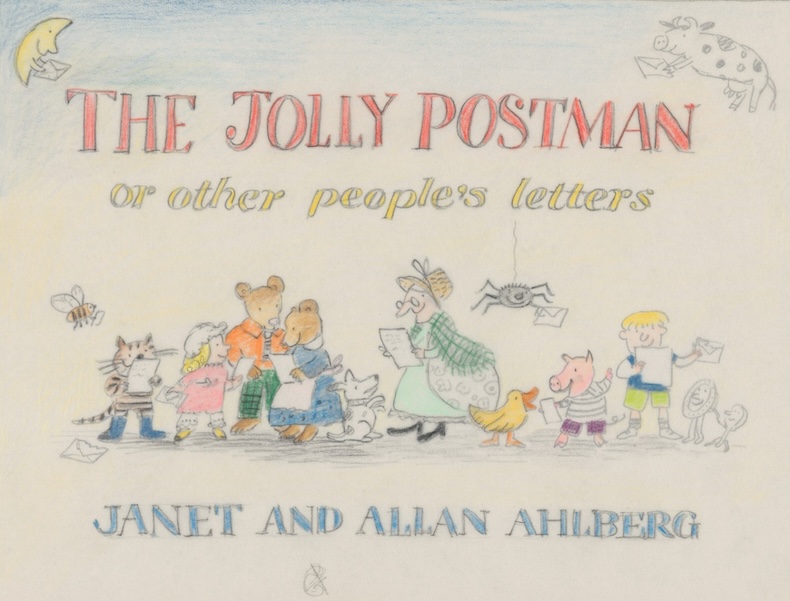
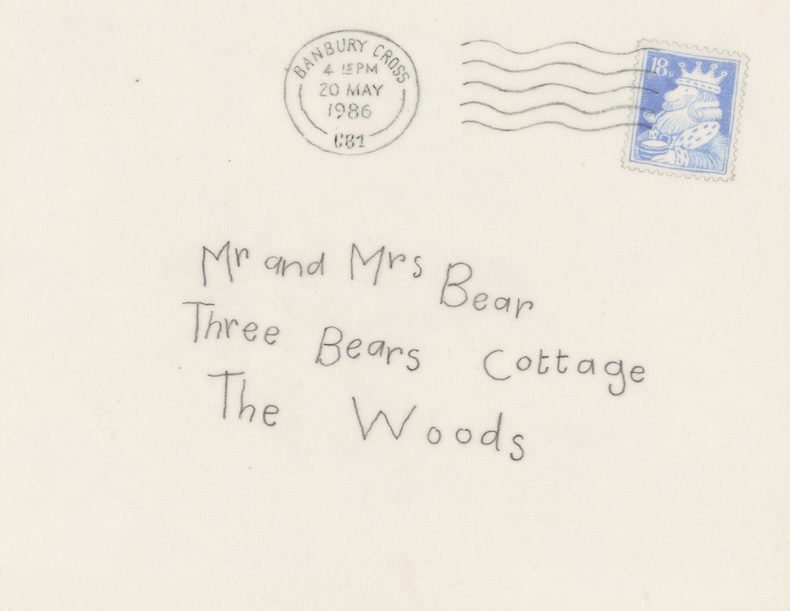
Letters are both the medium and the message of the Ahlbergs’ classic picture book, which offered the children of 1986 the spectacular gambit of six envelope-shaped pages that actually contained the cornucopia of paper deliveries described in the text. Short of the 19th-century peep-show and the 18th-century epistolary novel, it is hard to pinpoint a precedent to this device, which allegedly came to the authors as they watched their two-year-old’s fascination with the morning post (though the book’s parenthetical subtitle also slyly acknowledges a perennial fantasy of nosey adults). Over and above the childish joy of opening an envelope, the Ahlbergs recognised the excitement brought even to the pre-reader by the visual richness and variety of the textual material then daily dropping on the doormat. Some of Janet’s preparatory sketches show her studying the distinctive idiom of 1980s birthday cards, direct mail, and 1960s postcards in the planning for the final book, which includes an illustrated and misspelled apology from Goldilocks to the Three Bears; a birthday pound from the ‘Bank of Wonderland’; a product catalogue sent to the Wicked Witch (‘covens catered for’), and a typewritten cease-and-desist letter to the Big Bad Wolf from Meeny, Miny, Mo & Co., Solicitors ‘on behalf of our client, Miss Riding-Hood’. These are authenticated with commemorative stamps, tongue-in-cheek postmarks, and fussy instructions to handler and recipient. ‘Open up, don’t delay,’ Hobgoblin Supplies Ltd. quips in jaunty cursive. ‘This could be your lucky day!’
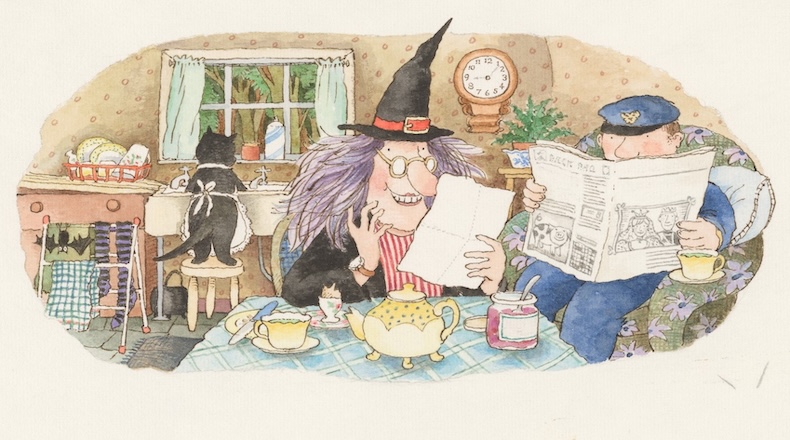
Allan Ahlberg, who died last year, once decreed that a successful children’s book was a ‘marriage of words and pictures’, and it is clear from the material displayed here that he and Janet were an incomparable personal and professional partnership. Arguably, he never scaled the same heights alone. She was an illustrator; he was a teacher. Between 1976 and Janet’s premature death in 1994, they co-created 37 children’s books, all of which root Allan’s sharp humour in Janet’s charming and instantly recognisable visual world. In The Jolly Postman, as in their breakthrough, Each Peach Pear Plum (1978), she creates a gently fantastical vision of the English countryside, the dreamy turrets of Cinderella’s castle offset by the church spire over the crest of the adjacent hill. Two cows are in the field; one is jumping over the moon. The scumbled blue sky is darkening, but apparently there is an Army & Navy around the corner, since Janet poured through their catalogue for source material, and subtly delineates her characters through teacups. The Three Bears favour sturdy white mugs with green stripes; the Wolf appropriates the classic Cornishware of Red Riding Hood’s Grandma, and the more fanciful Witch, with her purple hair in her bijou gingerbread cottage, serves an unappetising green concoction from a yellow, pot-bellied teapot with scalloped cups and matching saucer.
The richness of the Ahlbergs’ offering partly explains why a battered copy of The Jolly Postman is as much a fixture in my living room as it was in my parents’ (7 million copies sold). At the same time, the book came from a golden age of realism and complexity for younger readers. The Ahlbergs’ contemporaries included such writer-illustrators as Shirley Hughes and Jill Barklem, both of whom, like Ahlberg, exploited the subtlety of watercolour. This was a generation that invited children to spend time with their work – in Hughes’s words, ‘to learn how to look’. However, the combination of words, text and envelopes in The Jolly Postman additionally highlighted the reader’s own role in interpretation and meaning-making, recognising that a good book is always an interactive experience. With some honourable exceptions, children’s illustration since the 2000s has tended to move towards flatter, broader planes of colour and texture and simpler visuals often inspired by graphic and digital design. Conversely, the Ahlbergs’s ‘love letter to the post’ reminds us of the delights of staying analogue.
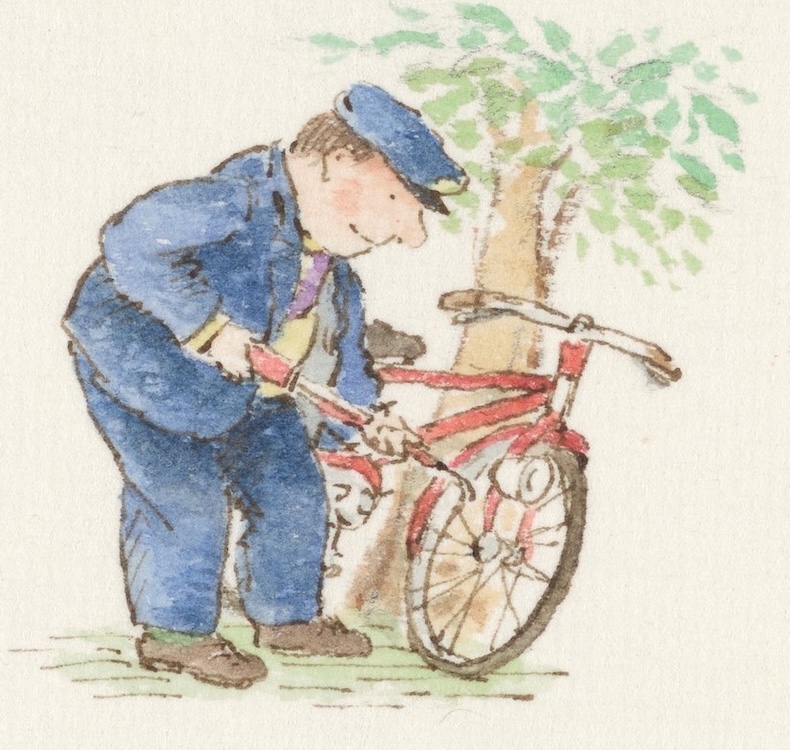
‘The Jolly Postman’ is at the Postal Museum, London, until January 2027.