From the March 2026 issue of Apollo.
Flemish baroque painting arose against a background of religious violence and political turmoil – the 80-year Dutch Revolt against Spanish rule which lasted from 1568–1648. The Peace of Westphalia resulted in Spain recognising the Protestant northern provinces as the independent Dutch Republic, while the Catholic southern part remained under Spanish rule until 1714. During this turbulent period, two distinct artistic traditions grew to maturity: the sober splendours of Dutch Golden Age art, led by Rembrandt and Vermeer, and the sensuous, dramatic and learned glories of the Flemish baroque, led by Rubens.
It was the synthesising genius of Peter Paul Rubens (1577–1640) that created a powerful and distinct artistic language in the southern Netherlands. This language drew on Italian forerunners and contemporaries as well as Flemish-born pioneers such as Pieter Bruegel the Elder and Roelant Savery. Under the patronage of courtiers, aristocrats and a Catholic church infused with Counter-Reformation zeal, monumental canvases on religious, mythological and historical themes, full of movement, emotion and contrasting light, were commissioned alongside smaller landscapes, portraits, genre paintings and still lifes. Despite a declining Flemish economy, the domestic art market thrived: to meet demand, Rubens’s studio became a teeming production house, one of several. After 1648, though, the fire went out of Flemish painting.
Three names dominate our conception of Flemish baroque painting: Rubens, who has always been valued as a symbol of Flemish identity as much as a painter, set the tone, drawing into his orbit other artists such as the animal painter Frans Snyders, the battle painter Pieter Snayers, Erasmus Quellinus the Younger, the portraitist Cornelis de Vos, printmaker and genre painter David Teniers the Younger and Jan Brueghel the Elder; his most gifted pupil, Anthony van Dyck (1599–1641), left for England in 1632, working as court painter to Charles I; after their deaths, Jacob Jordaens (1593–1678) became the leading Flemish painter.
Clementine Sinclair, head of Old Masters at Christie’s London, says, ‘Major works by the titans – Rubens and Van Dyck – come up rarely. The top prices go for works that represent what they are chiefly known for: religious works for Rubens, portraits for Van Dyck and, at a lower level, for Jordaens, a mix of mythological and religious subjects.’ The Rubens record was set at Sotheby’s London in 2002, when a long-miscatalogued version of The Massacre of the Innocents (c. 1610) was bought by the Canadian businessman Ken Thomson (aka Lord Thomson of Fleet) for £49.5m – at the time, the most expensive picture ever sold; it is now in the Art Gallery of Ontario. In 2016 Lot and His Daughters (c. 1613–14), which once hung in Blenheim Palace, came up for sale at Christie’s London, reaching a final price of £44.9m. Van Dyck’s auction record has stood since 2009, when his last self-portrait, executed shortly before his death in 1641, sold at Sotheby’s London for £8.3m against a £2m–£3m estimate. In December 2024 Christie’s sold a much earlier work, a stirring painting of an Andalusian stallion from 1621 that was a study for his first large-scale equestrian portrait, of Emperor Charles V, for £3.4m, around the top estimate of £3m.
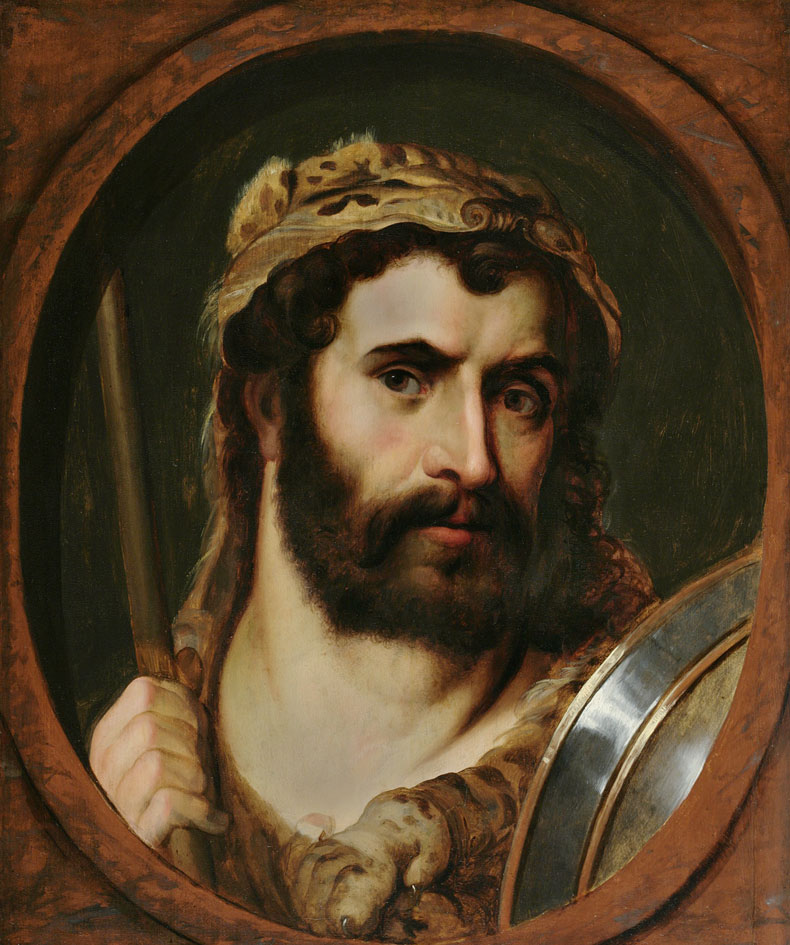
Sinclair points out that one advantage of the way these artists worked is that there remain many oil studies. However, attributions can be difficult, owing to the collaborative system in studios and, in the case of Rubens, the difficulty of authentication, thanks to a multiplicity of experts with conflicting opinions. At BRAFA, the Belgian dealer Klaas Muller unveiled an oil study on paper of an old man’s head (c. 1609), recently attributed to Rubens, asking price over €1m; while in February Sotheby’s withdrew a head study attributed to Rubens from the Master Paintings & Art Works Part 1 sale in New York. Meanwhile, at TEFAF Maastricht this month, Salomon Lilian Gallery will be offering a Rubens portrait of Hercules as a Gladiator, oil on panel, a possible show piece of his early talents, c. 1599–1600.
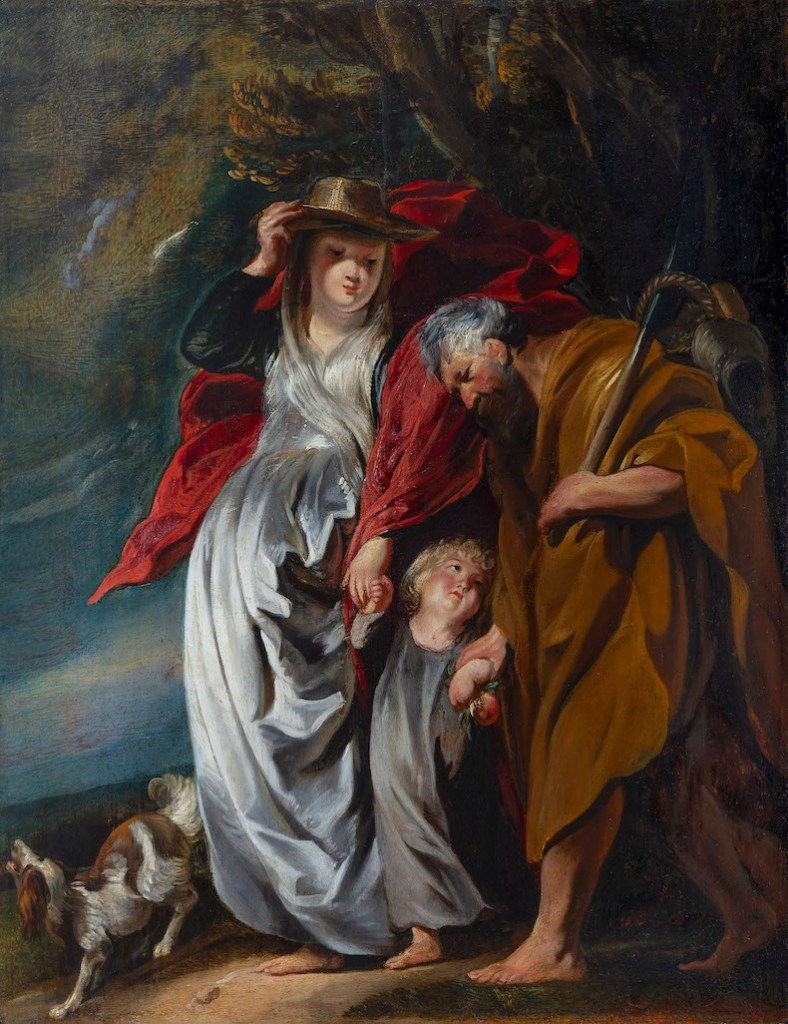
There remains strong interest in other well-known Flemish artists. At Christie’s Paris in June 2021, Jan Brueghel the Elder’s oil on copper Orpheus in the Underworld achieved €1.6m (estimate €400,000 – €600,000), while last December at Christie’s London, a Temptation of Saint Anthony by David Teniers the Younger – one of his favourite subjects – lured eight bidders to a final price of £101,600 against a £30,000–£50,000 estimate. At this year’s BRAFA Jan Muller sold a signed painting by Jordaens for over €200,000 to a private collector from Luxembourg. This month the Belgian dealer Cédric Pelgrims de Bigard will be taking to TEFAF a significant early painting by Jordaens of The Return of the Holy Family from Egypt, c. 1618, recently restituted to the family of Joseph Scheppers de Bergstein, a Belgian resistance fighter sent to Buchenwald. He reports that the market for Dutch pictures is ‘catastrophic’, but Flemish painters are still sought after. He recently sold a strong image by Franz Francken the Younger of the rare subject The Sword of Damocles and another of Death and the Miser (the purchaser ‘was not an Old Master collector. He was drawn by the image’).
Other less famous artists are gaining recognition, particularly Michiel Sweerts (1618–64), a highly accomplished and devout artist with a small documented oeuvre. In July 2023 Christie’s London sold the newly discovered The Artist’s Studio with a Seamstress (c. 1646/9) for £12.6m (estimate £2m–£3m). The following December, the much smaller picture within a picture tentatively labelled A portrait of the artist (?), presenting the Virgin in Prayer, c. 1654/6, made £1.7m (£400,000–£600,000 estimate). Bob Haboldt, based in Amsterdam, Paris and New York, will offer at TEFAF another rediscovery, a small Sweerts panel of the head of a boy, depicted as Jesus Admirabilis, c. 1655–60. Haboldt agrees with Pelgrims de Bigard that ‘The market has shifted decisively away from traditional Dutch pictures towards Flemish pictures, especially those with meticulously documented provenances’ – a shift he attributes to some active private buyers and determined bidding by the Phoebus Foundation, which have ‘opened the eyes of other buyers and institutions to the qualities of lesser-known artists’.
Philippe Henricot of Colnaghi in Brussels agrees, noting that as the number of available masterpieces by the best-known artists shrinks, collectors turn to works on paper and the best works of lesser-known names. Claudia Walendy of Antwerp based Arte-Fact Fine Art offers Louis de Caullery as an example – ‘An artist of remarkable quality who has long been overlooked,’ and about whom she is preparing a book: ‘The strong interest these works have generated reflects a broader trend in the market: collectors are increasingly receptive to rediscovered or under-appreciated artists when quality is high and the story is solid.’ Two key beneficiaries are the women artists Michaelina Wautier and Clara Peeters. In 2016 ‘The Art of Clara Peeters’ travelled from Antwerp’s Royal Museum of Fine Arts to the Prado in Madrid, and in December 2024 a still life by her was chased to £655,200 (against an upper estimate of £159,000) at Christie’s London. Henricot says that a Wautier exhibition held jointly at the Museum aas de Stroom and the Rubenshuis in Antwerp in 2018 ‘was a revelation for many collectors and scholars internationally’. Londoners will not have to wait long to find out what the fuss is about: a Wautier exhibition, organised in collaboration with the Kunsthistorisches Museum in Vienna, opens at the Royal Academy on 27 March.
From the March 2026 issue of Apollo.