From the March 2026 issue of Apollo.
It’s clear from the subtitle: this captivating exhibition does not only represent a ‘culture’, as a show from the British Museum’s department of Africa, Oceania and the Americas might once have done. It also explores a political formation that astonished the Europeans who first encountered it in the 18th century. And not just a kingdom on a grand scale, across an archipelago in the north Pacific, but one taking an active part in global diplomacy.
Tracking Hawaiian interactions with the West over the last 250 years, the exhibition reveals a magnificent artistic tradition, from the imposing sculpture of the akua (deity) Kū at the entrance to a spectacular array of red and yellow featherwork and a host of woven, carved and painted ancestral treasures, complemented by contemporary art and European images of Hawaiian islands and islanders. While the delicate feather forms are in vitrines, much else is on open display. But this is not the main reason why the mana, the spiritual power, of the treasures reverberates around the galleries.
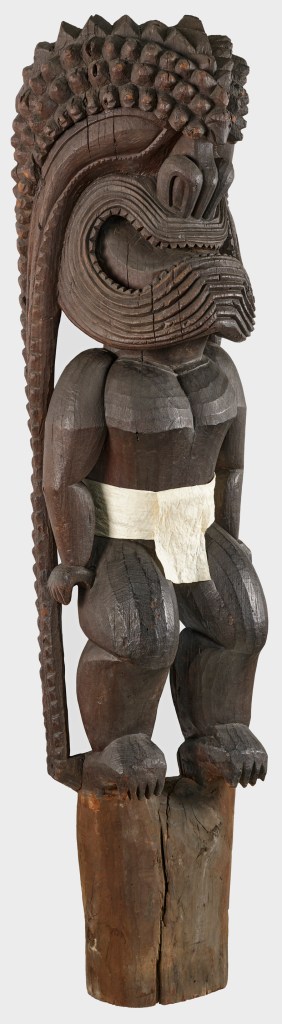
Over the last decade, British Museum exhibitions – with ‘Indigenous Australia: Enduring Civilisation’ in 2015 being an early example – have involved members of Indigenous communities, now a standard curatorial principle. ‘Hawai‘i’ takes the commitment further: the exhibition is curated and narrated by a group of native Hawaiian ‘co-stewards’; theirs are the authoritative voices. The catalogue, which includes a full inventory of the museum’s Hawaiian collection of some 950 works, opens with an evocation of Kū by Noelle M.K.Y. Kahanu, who has worked with museums across Europe and is a key advocate for the repatriation of human remains. ‘To stand before Kū is to be in the presence of the divine male principle and his hundreds of manifestations. Akua of governance, warfare and chiefly endeavours, he oversees procreation, medicine, healing, fishing and farming.’ Crucially, she adds, ‘To stand before Kū is to be seen through his eyes. To be subject to his gaze and ask of ourselves, where have we been and where are we going […] What is our trajectory as a people and a nation?’ This gathering of ancestral treasures is not just a celebration of historic cultural achievements and resilience, or a lament for what colonisation destroyed; it also asks how Hawaii might face the political and environmental challenges of the future.
After the first contact between Hawaiians and the British during the third voyage of Captain James Cook, commercial, political and ideological entanglements rapidly ensued as traders, settlers and missionaries sought alliances with Hawaiian ali’i (chiefs). By the early 19th century, Kamehameha I of Hawai‘i Island had established himself as king across the whole archipelago. Hawaiians had dealings with traders and navigators of many Western nations. Evangelical missionaries from New England brought Christianity and a quilting tradition that was soon locally adopted and that in due course became a vehicle for the representation of native royalty and the expression of sovereignty. But Hawaiians saw Britain, above other world powers, as a preferred ally.
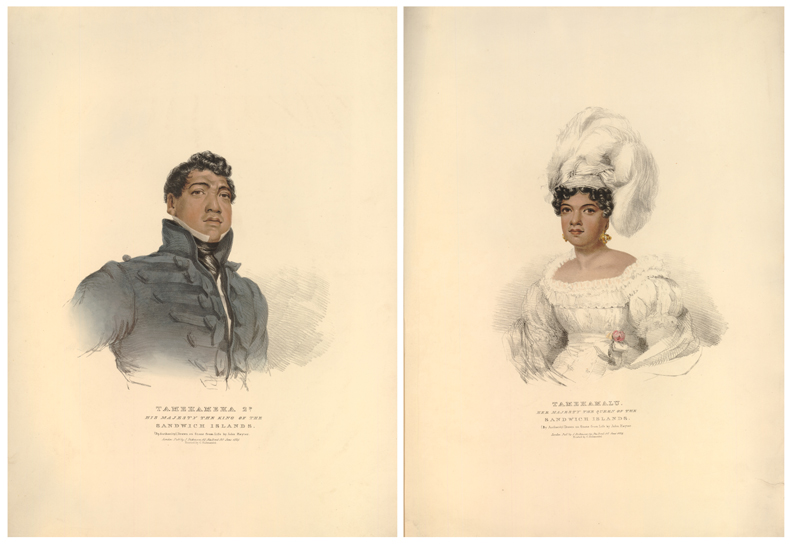
At the core of the exhibition is the story of a diplomatic voyage to the UK, undertaken in 1823 and 1824 by Liholiho (also known as Kamehameha II), the king, and Kamāmalu, the queen, together with other aristocrats and attendants. They hoped to meet with George IV, to consolidate the alliance and strengthen recognition of Hawaiian sovereignty. In London, the royal status of the delegation was acknowledged; they were depicted by artists, went to the theatre and even visited the British Museum, where they presumably saw sacred objects that had been presented to Cook less than 50 years earlier. Tragically, however, while waiting for their appointment, both king and queen fell ill with measles and died. The survivors were able to meet King George and presented him with an array of resplendent ‘ahu ‘ula (feather cloaks and capes), some of which remain in the Royal Collection. They received gifts in return and HMS Blonde was dispatched to take the bodies of the king and queen back to Hawaii. There, the crew seized an opportunity to take sacred artefacts from a temple site, exemplifying the at-best uneven nature of European diplomacy in Oceania. Yet the sustained Hawaiian effort paid off: in 1843 France and Britain formally recognised Hawaii’s independence. That rare acknowledgement of Indigenous sovereignty held for 50 years, until the kingdom was overthrown by primarily American settlers and the archipelago subsequently annexed by the United States.
For decades, curators of Indigenous collections have agonised over whether to foreground ‘artefacts’ or ‘art’. This exhibition offers both. It brings together virtuosic works made of strikingly varied materials – stone, fibre, fabric, bone, wood – and spanning centuries. The British Museum’s collection of Hawaiian ancestral treasures is the most important in the world and includes much more early historic material than the extensive collections in Hawaii itself. It is too rare a privilege to see so much on display.
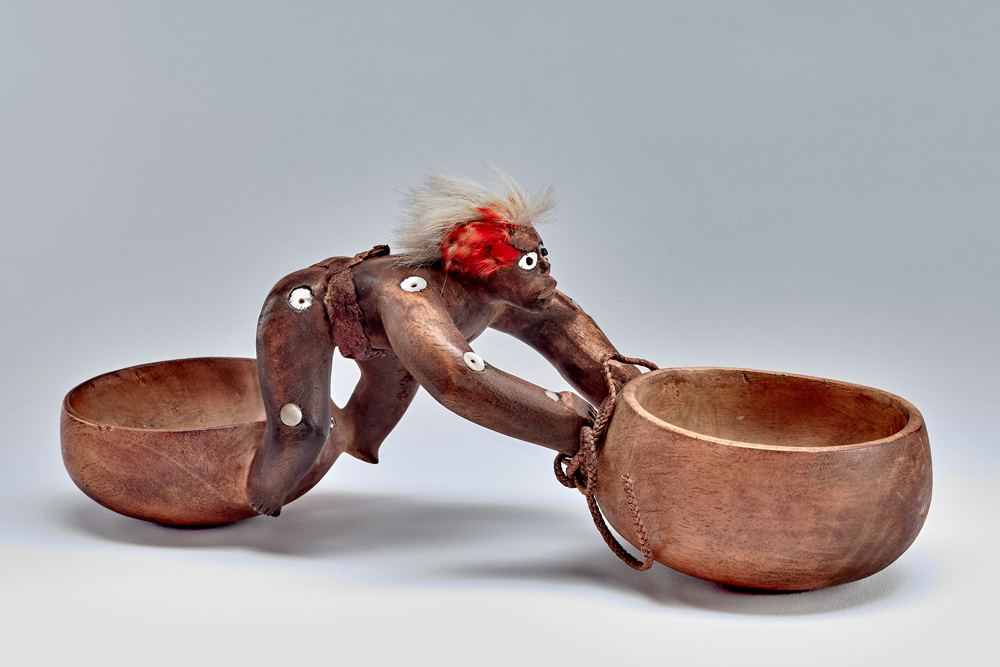
As it happens, ‘Hawai‘i’ has coincided with ‘Voces del Pacífico’, an exhibition touring Spanish venues that presents examples of the arts of Oceania from the collections of the British Museum. That show includes many wonderful but less well-known Oceanian works, including contemporary art. A decade ago, Antony Gormley, then an outgoing British Museum trustee, dedicated a BBC radio series to asking why arts from Oceania, Africa and the Americas – ‘missing continents’, as the title had it – were largely absent from the museum’s displays. These temporary shows are immensely impressive – examples of how rewarding real curatorial collaboration can be – but the collections are too important to be brought out from stores for just a few months. Now is the time for the continents and archipelagos to have a permanent presence on Great Russell Street.
ʻHawaiʻi: a kingdom crossing oceans’ is at the British Museum, London, until 25 May.
From the March 2026 issue of Apollo.