
Gianfranco Rosi’s new film, Pompei: Below the Clouds, could just as easily have been given the title Fire at Sea – if that hadn’t already been taken by his last Italy-based documentary a decade ago. Vesuvius looms over the Bay of Naples, a dozing dragon. Somewhere on the city’s outskirts, teenage boys have turned arsonists. Meanwhile, along the coast to the west of Naples, the Campi Flegrei – literally ‘burning fields’ – spew up hot gases. Not for nothing was this area believed to be the home of Vulcan, god of fire.
And then there are the Vigili del Fuoco – the fire brigade, whose call centre is one of Rosi’s main haunts. The vigili are, at least from the film’s perspective, the guardians of the city, with the mortals of Naples calling to them in supplication as if to the gods on Mount Olympus – only they are more benevolent, much. The patience and compassion of the staff manning the phones seems super-human, as they field calls from kids fooling around, or a drunk man locked out of his house, or another man who wants to know the time. This is the proverbial fire brigade that will rescue a cat up a tree – or in this case stuck in the grille of a storeroom. It speaks to the sense of old-fashioned community that Italy still, somehow, seems to possess, even across a metropolitan sprawl. ‘I was cooking a nice ragu,’ one woman caller, anxious about a possible earthquake, reports.
These supplicants are from the immediate and more distant suburbs of Naples – from Vomero, Fuorigrotta, Portici; the city centre, above ground at least, is emphatically absent. And, just as Rome’s ring road, the Grande Raccordo Anulare (GRA), gave Rosi his peripheral territory and structure in Sacro GRA (2013), so the Circumvesuviana, the rail system that circles the volcano and serves the towns around its foothills, plays a significant role here.
If familiar sites are absent in this film, so is the expected palette. The last time Rosi shot in black and white was for Boatman (1993), another instance in which he invites us to look beyond the dazzling colour spectrum of his subject, in that case Varanasi. As it happens, Paolo Sorrentino’s latest movie, La Grazia, also has its UK release this month. It’s set in Rome, in the enfilades of the presidential palace, but the coincidental timing invites comparison with his own Neapolitan films, The Hand of God (2021) and Parthenope (2024). Rosi’s spare, monochromatic study comes as a welcome counterpoint – palate-cleanser, even – to Sorrentino’s over-ripe, colour-soaked treatment of the Vesuvian city.
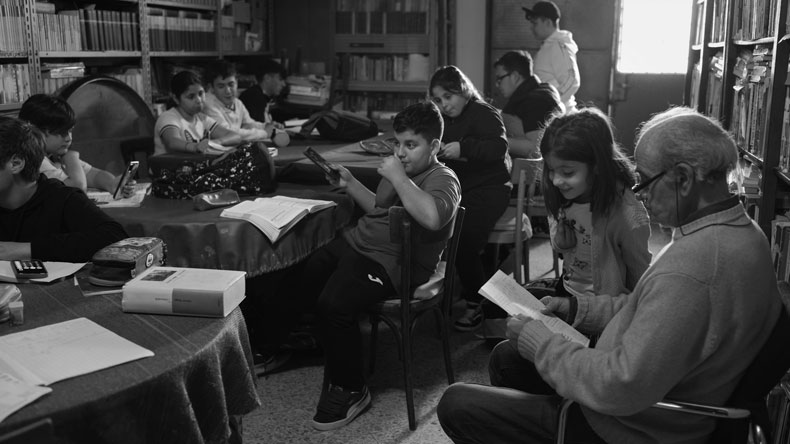
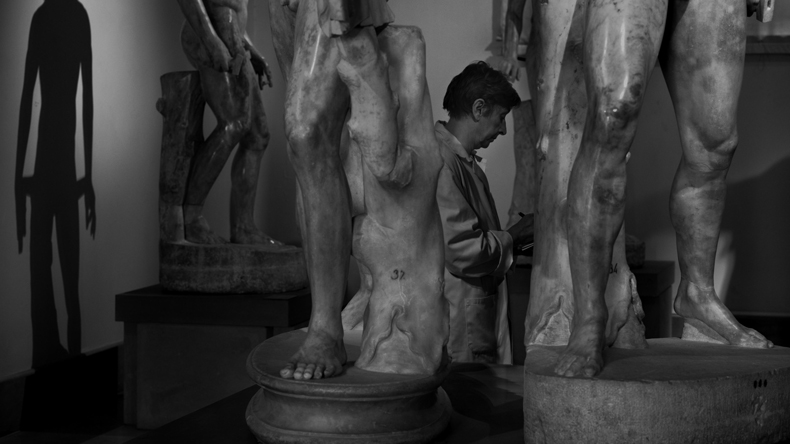
Rosi dislikes terms such as ‘documentary’ for his film-making: the presence of a camera, he argues, changes everything immediately anyway. The important thing, as he sees it, is not the difference between documentary and fiction, but between true and false. ‘I don’t know really what “observational” film making means,’ he has said recently. ‘For me the only word that exists is the word “cinema”.’ And Pompei: Below the Clouds is beautifully cinematic. Moreover, the director’s knack for finding ‘characters’ that seem to belong more to the realm of fiction than documentary – who could forget the garrulous nobleman fallen on hard times in Sacro GRA? – has offered up further delights. There’s Titti, the antique-dealing after-school teacher who reads his students the poetry of Marinetti; or Maria, a white-coated conservator who frequents the underworld of the Archaeological Museum in Naples, moving through the vast basement stores by torchlight (‘useful because we see far more detail than with diffused light’) and murmuring to her charges: classical busts, herms, a jumble of fragmented marble limbs – ‘like walking among so many ex-votos’.
This kind of access comes from Rosi’s immersion in his chosen locale for lengths of time. He spent nearly four years in Naples to make this film, shooting and editing as he went, working either alone or with one assistant. It’s that level of commitment, presumably, that gets you to a depth of nine metres underground with – who else? – the ubiquitous Vigili del Fuoco, whose duties extend to inspecting ancient electrical wiring installed by tunnelling robbers for a makeshift intercom. Though ‘ancient’ here, of course, is a relative term, and more properly applies to the buried Roman decorations and artefacts that these tombaroli seek out. Meanwhile up in those titular clouds – produced, like all the clouds of the world, according to Cocteau, by Vesuvius – a helicopter bearing the chief prosecutor of Torre Annunziata maps the 20 or so sites around Pompeii where significant illegal excavations have taken place. ‘[They] held out for 2,000 years,’ one of his colleagues says of the frescoed sites, ‘surviving the eruption of Vesuvius, numerous earthquakes, the passage of time; then all it took was for a few unscrupulous people, with no respect for history, to come here and carry everything off. And in doing so they obliterated our memory forever.’
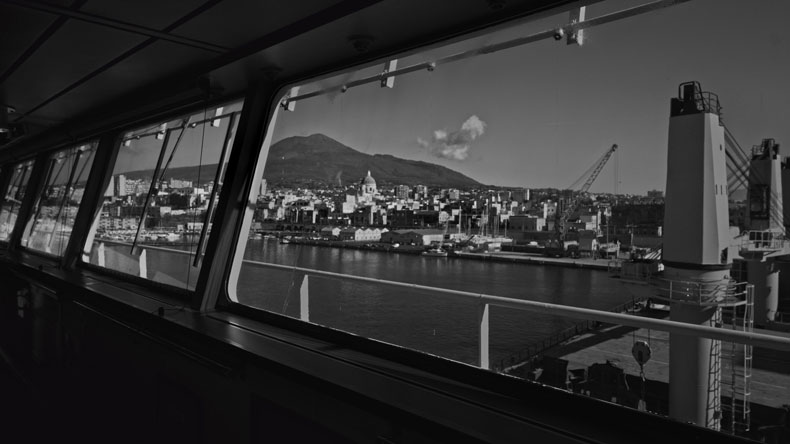
At the Villa Augustea, by contrast, that shared memory is painstakingly preserved by an archaeological team from the University of Tokyo. A lecture one of the mission delivers on trade and the movement of grain around the Roman empire yields a powerful link with another of the film’s narrative threads, an example of Rosi’s ability to expand and contract time and space, concertina-like. At the port of Naples, a ship is unloading 32,000 tonnes of Ukrainian grain, the mountain created and the cloud of dust rising from it inevitably recalling the volcano nearby. Footage of the grain being swept from the walls of the carrier’s vast container is mesmerising. But back in their cabins, the young Syrian men in charge of the vessel are hearing news of a Russian strike on Odesa, where they’re headed back to; some of their compatriots working on other grain ships have been killed. Aboud dreams of living in the mountains, drinking coffee and listening to Fairuz. ‘Enough of the sea,’ he says.
Vesuvius is, of course, the dominant entity here, its sulphurous gases and the territory’s tremors making themselves felt; the great destroyer and, as seen at Pompeii, Herculaneum and elsewhere, the great preserver. Many of the anxious calls that come in to the Vigili del Fuoco are connected to earthquakes or imagined earthquakes. ‘What’s going on, is it Vesuvius?’ And yet one of the most affecting moments of the film is a scene in which a member of the fire brigade keeps a woman terrified by her abusive partner on the phone while his colleagues make their way to her home. Vesuvius may rumble, yet in the shadow of this natural geological threat, the region’s denizens – like humans everywhere, throughout time – are busy making trouble for themselves.
Pompei: Below the Clouds is on MUBI from 27 March.