In Amélie (2001), at the exact moment the protagonist is conceived (‘September 3rd 1973, at 6.28pm and 32 seconds’, the narrator tells us), a fly lands on the streets of Montmartre and is crushed beneath the tyres of a passing car. A gust of wind makes two wine glasses appear to dance atop a tablecloth. As the narrator implies, this heroine arrives into a world filled with serendipity and whimsy.
Yet there’s an irony in the fact that all this is contrived. In Jean-Pierre Jeunet’s film, which is being re-released in UK cinemas to mark its 25th anniversary, visual effects are essential in orchestrating Amélie’s world. ‘Amélie has no boyfriend,’ the narrator informs us as he introduces the protagonist’s quirks. ‘Instead she cultivates a taste for small pleasures.’ One of her pastimes is skimming stones on the Canal Saint-Martin – a talent the film’s lead actor, Audrey Tautou, lacked. Like the pulverised bluebottle and the shimmying wine glasses, the skip and splash of the pebbles had to be added digitally with CGI.
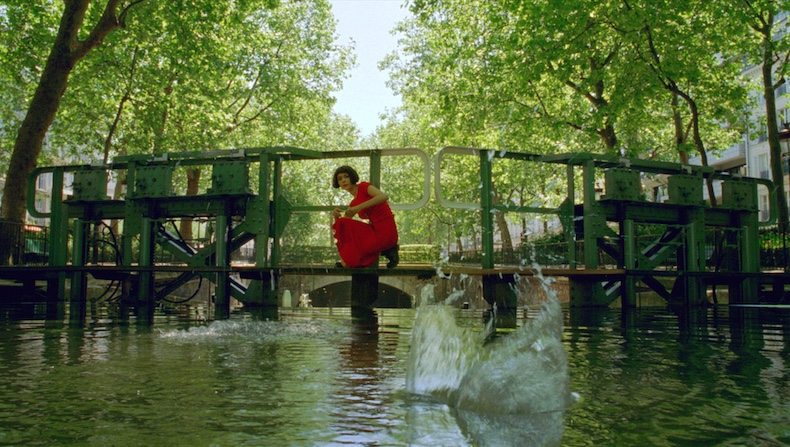
Jeunet’s airbrushed vision of Paris, with garbage cans, graffiti and grime removed, was a huge success, raking in $40m in France alone, and the film still drives thousands of tourists to flock to the streets of Montmartre and the Café des Deux Moulins to order a ‘crème brûlée d’Amélie’. The use of CGI was a bold choice for a film released at a time when the heavy use of visual effects was uncommon except in science fiction or fantasy films.
Jeunet’s penchant for painterly, non-naturalistic aesthetics stemmed from his cinematic upbringing. After working for a telephone company while dabbling in making animated short films in the 1970s, he met his long-term creative collaborator, Marc Caro, a comic book artist, at an animation festival in Annecy. They embarked on several short animation projects, such as the prison escape drama L’évasion (1978) and the carnivalesque Le Manège (1981), before turning to live action with the post-apocalyptic short The Bunker of the Last Gunshots (1981), which set the precedent for the mordant tone of their later work together. Delicatessen (1991) followed, a similarly dystopian satire featuring cannibalistic butchers and vigilante vegetarians. The duo continued in this fantastical vein, liberally drawing on animation techniques for the surreal settings of The City of Lost Children (1995). Meanwhile, Jeunet’s lacklustre venture into Hollywood, Alien Resurrection (1997), is notable only for its grotesque visual effects.
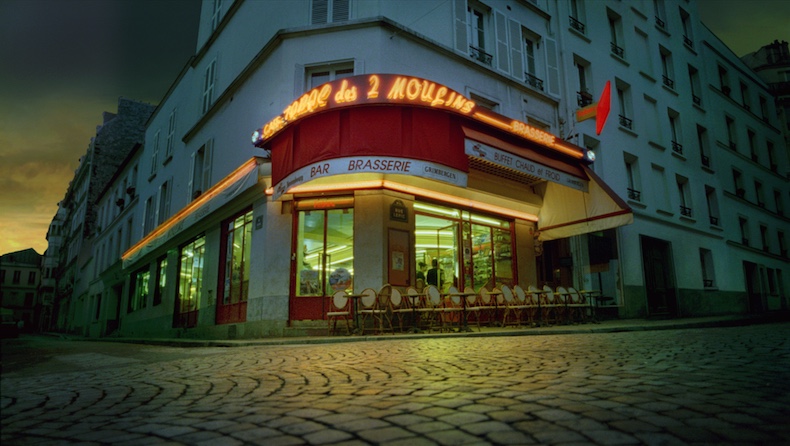
By contrast, Amélie – made by Jeunet alone – is a relatively mundane, breezy story: a cripplingly shy waitress discovers a time capsule stashed away in a nook in her Paris apartment, leading her to track down its original owner. The smallest details, often created using CGI, are crucial to its appeal. However, the style and aesthetics of Jeunet’s magnum opus are far from realist. Fish-eye lenses, rotoscoping and exaggerated colour grading make watching the film feel like stepping into a work of art. This drew ire from the French public, Jeunet said in an interview in 2010: ‘You should be able to take any single frame from the film and put it on the wall as a painting, and that’s what I’m aiming for. But that really winds people up in France, you know. Aestheticism really gets people’s goat, but ugliness and shock, not at all […] In London I only get compliments, but the French love realism.’
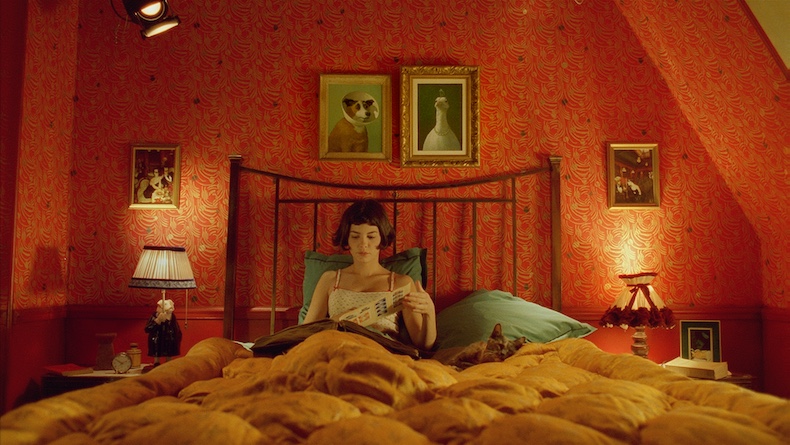
Guillaume Laurant’s screenplay and Aline Bonetto’s production design display the film’s artistic influences. Unsettling, green-hued pet portraits by the German artist Michael Sowa line the walls of Amélie’s apartment. The oddball protagonist comes to identify with the figure of the woman drinking a glass of water in Pierre-Auguste Renoir’s Luncheon of the Boating Party (1881), whom she sees as holding up a mirror to her own loneliness. (‘She’s a bit of a coward,’ her neighbour Dufayel, played by Serge Merlin, tells her.) The film’s very aesthetics were siphoned from the art world, the film’s colourist, Didier Le Fouest, inspired by the saturated, sepia-toned palettes of the Brazilian painter, sculptor and illustrator Juarez Machado. Jeunet and the artist had struck up a friendship in the late 1980s after Machado moved to Paris; the pair lived on the same street and attended each other’s exhibitions. Scaled-down copies of two of Machado’s works furnish Amélie’s flat.
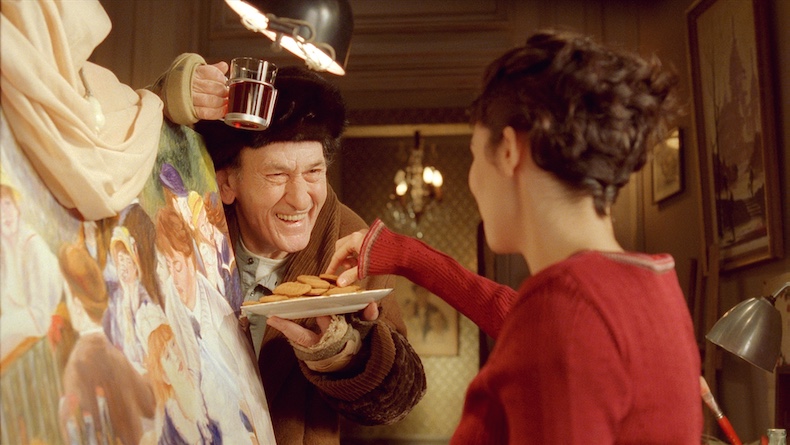
In tandem with the CGI implemented by Paris-based studio Duboi, cinematographer Bruno Delbonnel filmed with an 81EF filter to capture only a warm gamut of colours. Lenses, ranging from 14 to 27mm, were picked out according to each actor to deliberately warp their facial features – for Tautou, 25 and 27mm were selected. In post-production, colours were digitally processed to emphasise yellows, green and reds, while the film’s honey-hued skies were full of digitally added clouds. Before the widespread availability of filters, Jeunet’s Parisian romance is a precursor to the tinted, polished and ultimately distorted look that would soon define social media feeds.
Decades before the use of visual effects and CGI became common in film and television of all genres to embellish cityscapes, touch up small details and add gloss, the quietly revolutionary visual effects of Amélie heightened the quotidian. For the main character, reality is another kind of fantasy. ‘In general, special effects are for spaceships and monsters,’ the director said upon the film’s release, ‘but this time I wanted to use effects for a new kind of narration or poetry.’
Amélie (25th Anniversary rerelease) is in UK cinemas from 3 April.