From the April 2026 issue of Apollo.
Bernardo Bellotto made his name with city views painted in Venice and Dresden – but it was in Vienna that he produced some of his most innovative works, explains Mateusz Mayer of the Kunsthistorisches Museum.
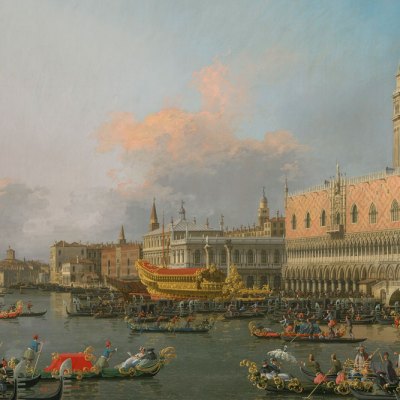
Shortly after Giovanni Antonio Canal, better known as Canaletto and celebrated for his shimmering views of Venice, arrived in London in 1746, a rumour began to spread. This painter, it was said, was an imposter. How could it be Canaletto when there was an artist still in Venice signing his works with that name – and making paintings in his inimitable style?
In 1749 the British antiquarian George Vertue cleared things up. In Venice, he said, there was a ‘young stripling’ – the son of Canaletto’s younger sister – who had been making great strides in the genre of city views, or vedute. ‘Well imitating his uncle’s manner of painting [he] became reputed and the name of Cannaletti was indifferently used by both uncle and nephew.’
This young man was Bernardo Bellotto (1722–80), who had trained at Canaletto’s workshop in Venice. By the early 1740s Canaletto was the most popular painter of vedute in Europe. It was a boom time for the genre: waves of predominantly English aristocrats in their twenties were undertaking the Grand Tour in Italy, travelling round the country purportedly for artistic edification. They would spend time in Rome to learn the language, study ancient monuments and marvel at the Old Masters. But they would head to Venice – the city of opera, carnival and courtesans – in search of a good time.
Canaletto and Bellotto were only too happy to furnish these tourists with souvenirs. But in 1740, when the Habsburg emperor Charles VI died, Prussia, France and Bavaria challenged Maria Theresa’s right to inherit the throne of Austria, and the War of the Austrian Succession broke out. Tourism in Venice ground to a halt as the travel routes from London became fraught with danger. For Canaletto and Bellotto, money was running out; they had to find another source of income.
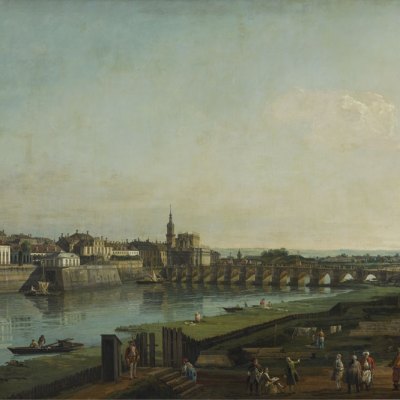
Uncle and nephew decided to take a tour of Italy. They began to broaden their style a little, making capricci – combinations of real views of cities with imagined architectural elements – in the hope that this would appeal to buyers. But this wasn’t enough to sustain them and in 1746 Canaletto travelled to London while Bellotto stayed behind in Venice. The following year Bellotto took up an invitation from the Dresden court to become a court painter there. He built up a formidable reputation for his views of the city – until 1756, when Prussian forces under Frederick the Great invaded Saxony. So began the Seven Years’ War, which eventually forced Bellotto to head for Vienna. He arrived in January 1759 and stayed until early 1761.
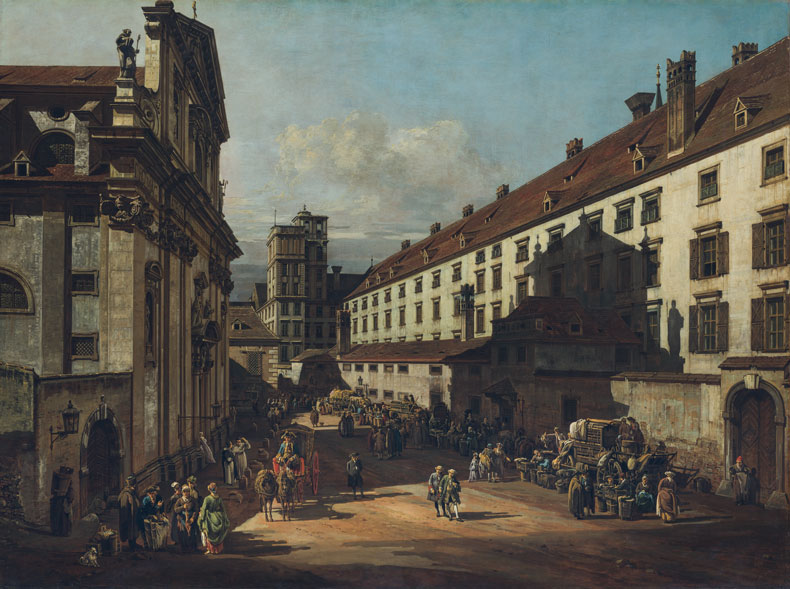
In his two years in Vienna, during which he introduced vedute to Central Europe and became the genre’s only significant practitioner in the region, he created a magnificent series of 16 large paintings of the city. One of the most impressive is The Dominican Church in Vienna (1759/60), which, as well as being striking on its own terms, also functions as a handy time capsule. Since 1683, when the Holy Roman Empire and the Polish-Lithuanian Commonwealth had joined forces to fend off the second and final Ottoman siege of Vienna, the Austrian city had developed a certain self-confidence. Palaces began springing up, particularly in the suburbs, and by the time Bellotto arrived Vienna had been transformed by a building boom that had lasted three quarters of a century.
As well as being a construction site, Vienna was also a science hub. The Jesuits were investing heavily in astronomy and higher education, and in 1733 erected an observatory tower – the first sign of institutional investment in astronomy in the city – that can be seen at the far end of the square in The Dominican Church in Vienna. In another of his views of Vienna, Bellotto captures the astronomy tower of the so-called Großer Federlhof – the former home of the philosopher and mathematician Gottfried Wilhelm Leibniz, who in his Monadology of 1714 used an analogy that chimes neatly with Bellotto’s Vienna paintings. Leibniz likened the many possible views of a town or city to views of a single universe – and to universes in themselves. Bellotto explores a similar idea: each of his paintings adopts a certain focus while the series as a whole provides an overview of commercial, social, religious and scientific life in Vienna.
The first thing you notice in The Dominican Church in Vienna is the architecture. Most imposing is the facade of the titular building, which had been built and decorated from 1631–75 to replace a crumbling gothic church. It’s typical of Viennese baroque architecture in its ornateness – in contrast to, say, the classical austerity of the French baroque. The church is squaring up to a Jesuit college – whitewashed, devoid of ornament and somewhat severe – that was established in the mid 16th century and subsumed by the University of Vienna in 1623.
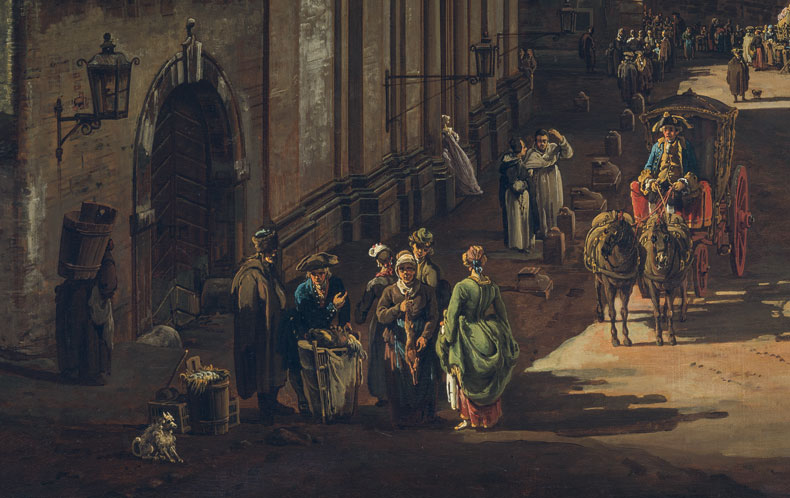
Between the two principal buildings is one of the few squares in the city able to claim a sense of grandeur. It is in this setting that Bellotto places an array of lively characters, turning what could have been a dry architectural painting into street theatre. Towards the left of the painting, a delightfully shaped dog crouches next to a seller of eggs and chickens, who seems all the more dishevelled next to the well-dressed figure – perhaps a soldier – leaning in and talking. A hare vendor tries to sell to a lady in green, who is probably from the burgher class. Behind two Dominicans having a confab, an aristocratic lady slips somewhat furtively into the church; the gold-trimmed carriage is probably hers, waiting for her to step back in.
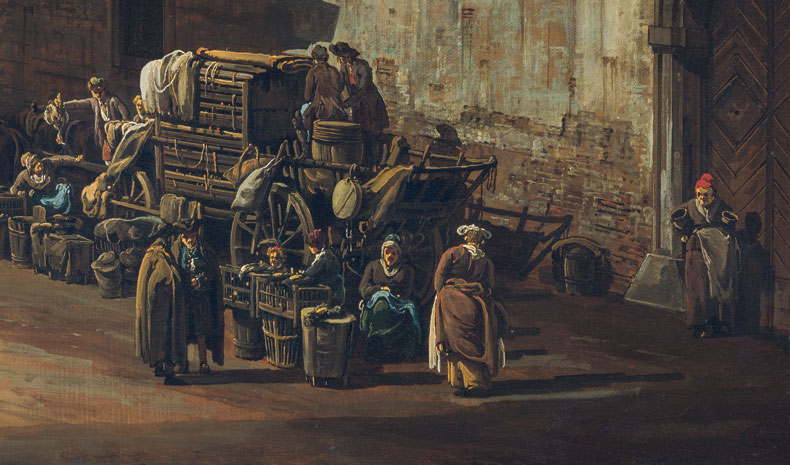
On one of the few sunlit patches of ground, a couple of courtiers walk and talk and assorted burghers stroll in the background. On the right are kitchen porters with woven baskets, who appear throughout Bellotto’s pictures. One man brandishes a dead turkey; in one of the hutches there is poultry that is probably still alive, so the meat would be fresh at point of sale. The figure in the red cap at the far right is probably a cook or a kitchen maid, waiting to enter through the college’s back door.
In Vienna Bellotto perfected the art of rendering lively, convincing human figures (known as staffage) in paintings dominated by buildings. But we should keep in mind that these pictures were made for aristocrats and, as such, may contain certain distortions of reality. This painting presents Vienna as a functioning commercial centre, implying that Maria Theresa oversaw a flourishing economy. There is no hint of the famines that took place under her reign – except perhaps the woman at the far left of the painting. Does the empty bucket on her back suggest that she has sold all her wares? Or did she have nothing to sell in the first place?
The painting’s other distortions are more literal. One thing Bellotto learned from his uncle was how to use the camera obscura, which allowed images of the outside world to be projected (albeit upside-down) and reproduced. A good painter might faithfully copy the image in the camera obscura, but a great painter would take multiple views from the camera as study material, go back to the studio, think about the composition, and alter buildings and architectural proportions to make the painting as elegant as possible.
These were not quite capricci, but neither were they mechanical reproductions of reality. The Dominican Church in Vienna offers the same view on to the square as an engraving of 1737 by Salomon Kleiner, but whereas Kleiner did not fit the entire church in the picture and rendered the square somewhat awkwardly, Bellotto combines two views from the camera obscura to expand the space, making it seem more convincing and inviting. It has been suggested that both Canaletto and Bellotto also used a telescope: it’s hard to see how Bellotto would have captured the minutely detailed wind vane atop the observatory tower with the aid of only the naked eye or a camera obscura.
Still, Bellotto differed from his uncle. There was the attention he lavished on staffage, which far surpassed Canaletto’s more interchangeable figures. He was also feistier: Vertue claimed that, ‘being puff’d up’, Bellotto ‘disobliged his uncle who turned him adrift’. But he distinguished himself most with his use of chiaroscuro. While Canaletto flooded his paintings with light, Bellotto leaned into darkness. This finds spectacular expression in The Dominican Church in Vienna, in which the church throws a dramatic shadow over the Jesuit college, uniting the composition.
In hindsight, the shadow was an ill omen. In 1773 the Jesuit order was suppressed throughout the Habsburg territories. Bellotto couldn’t have predicted this when he made the work, but he did have an unusual relationship with the future. After Dresden was pulverised by bombs in the Second World War, those in charge of rebuilding relied heavily on his detailed paintings of the city. He shaped our present as much as he captured his own – making him, even more than Canaletto, a painter ahead of his time.
As told to Arjun Saijp.
Mateusz Mayer is curator of ‘Canaletto & Bellotto’, which is at the Kunsthistorisches Museum, Vienna, until 6 September.
From the April 2026 issue of Apollo.