From the April 2026 issue of Apollo.
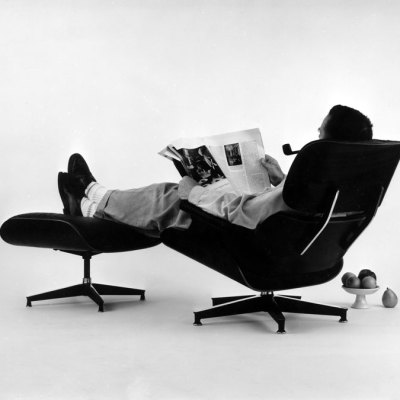
For a special issue of Architectural Design devoted to the work of American designers Charles and Ray Eames in 1966, the British architects Alison and Peter Smithson wryly titled their essay on Eames aesthetics ‘Just a few chairs and a house’. For the Smithsons, this seemingly modest body of work represented a seismic shift in the ‘design climate’ of the 1950s. The Eames’s fibreglass shell chairs were an almost immediate success, covered by international press and furnishing homes, school halls and offices across America and beyond. Their upholstered Lounge Chair followed in 1956 and still represents the epitome of mid-century modernism as a signal of taste, sophistication and ‘good’ design. But what about their architecture?
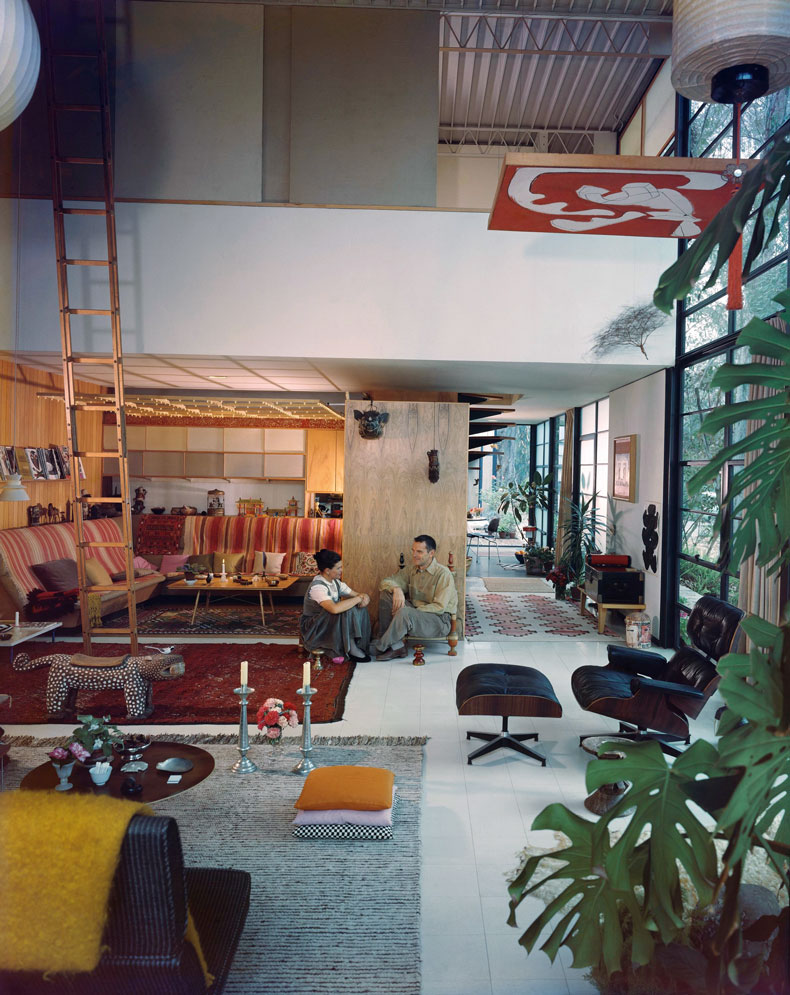
The average Eames fan certainly knows Case Study House No. 8, the designers’ own Los Angeles home, completed in 1949 as part of Arts & Architecture magazine’s influential programme to encourage affordable, post-war housing through innovation and prefabrication technologies. Architects began to make pilgrimage to the double-height, two-volume steel and glass construction on a meadow site nestled between the Pacific Palisades and the Atlantic Ocean. For British architects such as John Winter or Norman Foster it ‘reshaped architectural thinking’. Some Eames fans might also know that the couple collaborated with their fellow Cranbrook Academy of Art graduate Eero Saarinen on a house for John Entenza, editor of Arts & Architecture, on the site adjacent to the Eames House. This single-storey dwelling, conceived as an intimate space for relaxation and recreation, is more cellular in its feel and layout. It shares some of the Eames House aesthetic with black and white panelling, fine steel framing and brightly coloured wall accents.
These two icons of Californian modernism (Case Study Houses No. 8 and 9) are the best known of the Eames’s residences. But new research, presented in an upcoming book and exhibition, shows how Charles and Ray continued to investigate the potential of the house for generating new ideas about how to build and how to live. A handful of private clients – usually friends or professional contacts – provided the means for experimentation. While working with Saarinen on the Entenza House and evolving the design of their own home, the Eames were commissioned by film director Billy Wilder to design the ‘best small house in the world’ for a three-acre lot in Beverly Hills. The first design for Wilder’s house shared much of the structural and aesthetic language of the Eames House. Despite Wilder’s affection for Eames-style inside-outside living, he rejected this scheme and in 1949 the Eames’s began work on a second design: a larger single-storey open-plan arranged around a central living space. By 1950 Wilder had married the actress Audrey Young; the newlyweds decided a sizeable new house was too much to take on for a couple living alone and the commission halted.
The Eames’s interest in making the most out of prefabrication and standardisation led them to develop the ‘Shelter House’ concept (1950–52). A simple open-plan, wood-frame structure with a curved roof offered generous internal volumes, configurable to suit different needs and lifestyles. Charles called it the ‘supermarket house’, hoping buyers would purchase a kit ‘off-the-shelf’ to assemble with local tradespeople and adapt over time. Funding to develop the concept was hard to secure but eventually the California-based company Kwikset Lock Inc. stepped in to finance the next phase of research. The design system evolved and in 1952 a plot near the Eames House was purchased so a prototype could be built. For reasons still unknown, Kwikset pulled out of the project later that year. Their business focus returned to locks and associated hardware and the Eames’s abandoned their pursuit of low-cost, prefab mass housing.
As with most Eames Office projects, design concepts developed simultaneously and often overlapped. While working through the conundrums of large-scale prefabrication, the Eameses brought their mass-manufactured fibreglass chairs to market. They also launched a range of ‘architectural’ toys: The Toy, a configurable playset of large-scale coloured panels, dowel rods and pipe cleaners to create mini pavilions, stage-sets, tents, kites and so on, came along in 1951. A table-top version, The Little Toy, followed the next year, along with the now iconic House of Cards and, in 1953, the Hang-it-All coat rack for children (and adults). All were manufactured by Tennessee-based Tigrett Enterprises, founded by John Burton Tigrett.
On a visit to the Eames Office, Tigrett saw the Shelter House prototype and thought it ideal as a flexible guest house or studio workshop. The Eames were also working on a family house for Max De Pree, heir and future CEO of Herman Miller, manufacturer of Eames furniture since the late 1940s. Charles and Ray felt the Shelter House unsuited to either client’s needs and instead developed designs more reminiscent of the flat-roofed, modular bays of the Eames House for Tigrett, and a larger residence, rich with warm, natural materials like cork, cedar, teak and rosewood for De Pree and his growing family. Tigrett Enterprises ceased trading in 1954, and the project was abandoned. The De Pree House was completed in 1954, and it remained the family’s home for 20 years, with few modifications. It was the last residential architecture project that Charles and Ray completed in their lifetime.
At the Eames Office, architectural concerns found new expression at a larger scale and through new forms, notably film. In House: After Five Years of Living (1955), the Eameses assembled hundreds of 35mm transparencies into a 10-minute animated film to paint a cinematic portrait of Case Study House No. 8. The exercise here was to experiment with new ways of looking at architecture through film. What resulted was a love letter to the experience of architecture – light, shadow, texture, form, composition, nature, scale, details, furniture, objects; and their constant interplay. For Charles and Ray Eames, everything was architecture.
‘The Eames Houses’ is at the Triennale di Milano, from 21 April–10 May.
From the April 2026 issue of Apollo.