From the April 2026 issue of Apollo.
It’s a disconcerting feeling when the art you’ve grown up with starts to be spoken of (and indeed displayed) in canonical terms. For me, Tracey Emin is a case in point: the first artist I ever really liked, and one I’ve followed ever since my initial encounter with her messy, tabloid-baiting art in 1999. I was 12 years old and the occasion was her exhibit at that year’s Turner Prize, an extraordinary show-within-a-show that shot her to household-name notoriety. By turns chaotic, sentimental, harrowing and unashamedly parochial, the display – featuring videos, appliqué quilts and that infamous generator of manufactured controversy, My Bed (1998) – was something that even then I understood as a transformative moment. Emin didn’t talk down to her audience as she regaled us with stories of her sex life or her first abortion; her message was direct and it hit me like a freight train.
Many of the pieces in that show – the bed, the astonishing videos Why I never became a dancer (1995) and How it feels (1996), among others – figure in Emin’s touching and intelligently constructed retrospective at Tate Modern. They are presented with reverence, as historical pieces so well known that they barely merit caption explanation. Emin, after all, frequently leaves little to the imagination in her work. Titled ‘A Second Life’, the exhibition could be taken as a message that the artist has made peace with her youth; that the supposedly shocking conceptual work with which she established herself is no longer the reputational millstone it might once have been. It is, moreover, a show about painting, a discipline Emin always wanted to pursue but to which she returned only relatively recently. She wasn’t taken seriously, so stormed the art world from a different position entirely.
Her first solo exhibition, in 1993, was an early sign of this intent. My Major Retrospective 1963–93, the work that lent the show its name, was a display of Polaroids documenting paintings she’d made and, in serial fits of self-loathing, subsequently destroyed. Emin made a second version of the work in 2008, which is the one on display here. Looking at it, you have to lean in close to get any sense of the style and form of the original works – an angsty, gestural aesthetic that seems to owe a lot to Schiele, Munch and Georg Baselitz. As a means to get the viewer looking carefully, the form is both ingenious and demanding, presenting a choice between captive scrutiny and indifference. Emin thought she’d never get another show and it’s apparent that in those years she was throwing all she had at her art while she could.
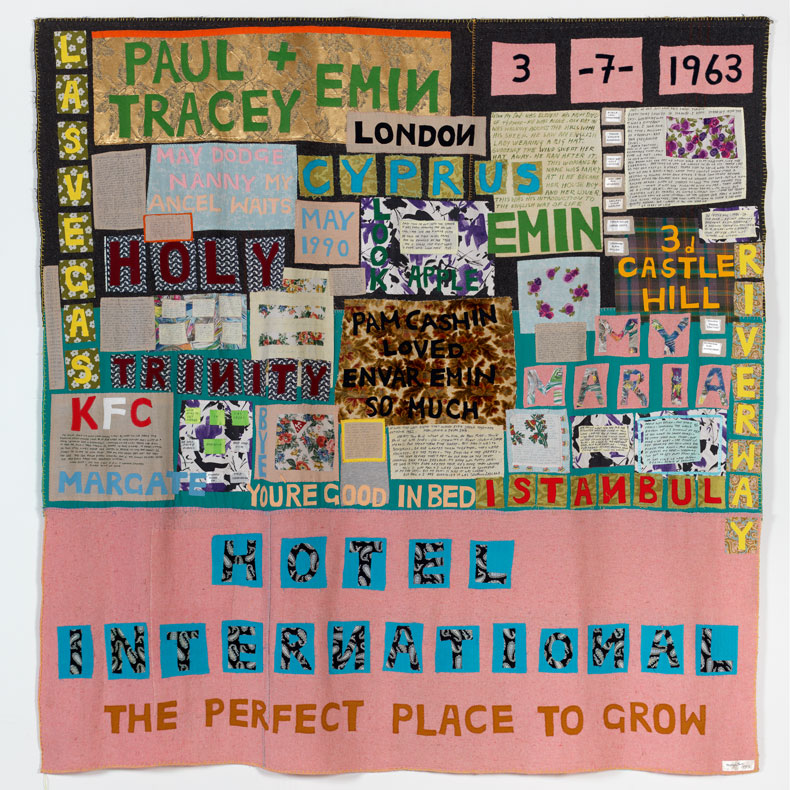
She spilled out everything – memories, confessions, family histories – into any medium she could. The appliqué piece Hotel International (1993) is a punkish collision of textiles and text that could really be a collection of very short stories. In one, she remembers growing up in a council flat above a chicken shop with her mother and grandmother: ‘Whenever I see the sign K.F.C. + Colonel Sanders,’ she writes in one corner, ‘I always think of home.’ A gallery devoted to Margate – she grew up there and, after years in London, has now moved back – takes her origin story further, exploring her relationship with her largely absent Turkish-Cypriot father and the racism, both casual and direct, that she encountered as a child. Far from appearing self-obsessed, an accusation she has levelled at herself, this strand of Emin’s art seems in tune with auto-fictional literature. Annie Ernaux, one senses, would surely approve.
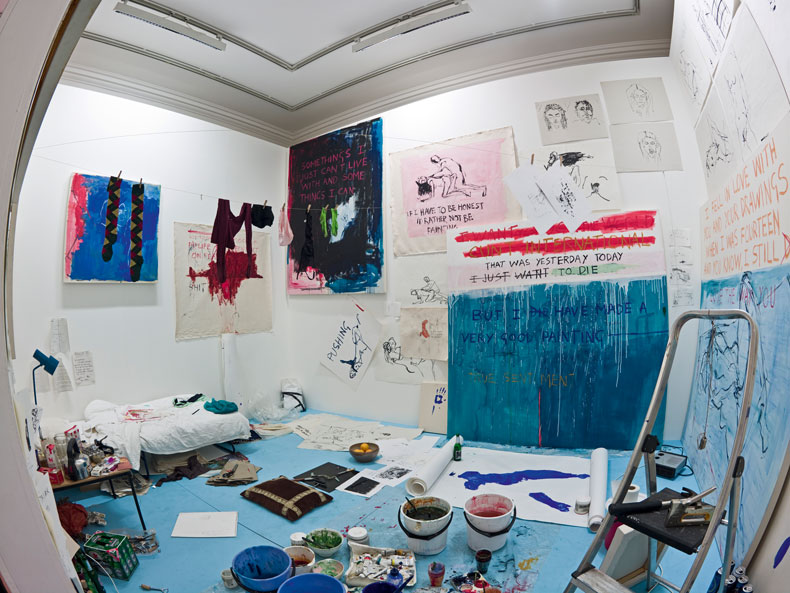
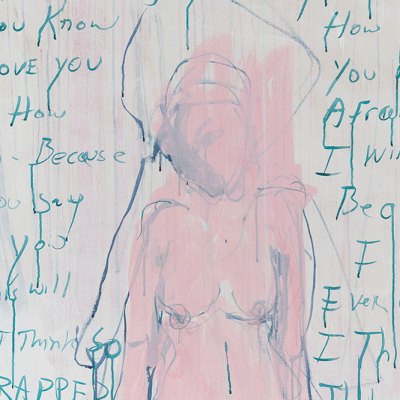
A climactic halfway point comes with her installation Exorcism of the last painting I ever made (1996). A loose recreation of her old studio, it’s almost entirely walled off within the gallery, permitting the viewer only a partial glimpse at the text paintings, homages to her artistic heroes and louche detritus within. There follows a curveball, a narrative change of gear the artist herself describes as ‘corny’. Thus far, Emin has presented a selective overview of her ‘first life’, when she was on the up but nonetheless ‘miserable’. Her second, brought on by the death of her mother and radical surgery for bladder cancer in 2020, seems to have given her perspective and an evident creative reinvigoration. The curatorial schism is less chronological than formal. Essentially, the works in the first half of the show rely heavily on the written word; in the second, Emin feels confident that her art speaks for itself. Here we encounter a host of monumental bronze sculptures and examples of her painting from the last decade – as well as My Bed, which in the context seems to prefigure Emin’s change of direction.
The more recent works look better here than they did when displayed at White Cube in Bermondsey in 2019 and 2024. In that context, they seemed repetitious and effortful, appearing to support her critics’ accusations of self-parody. There were too many of them and their narrow variations in palette and imagery quickly became boring.
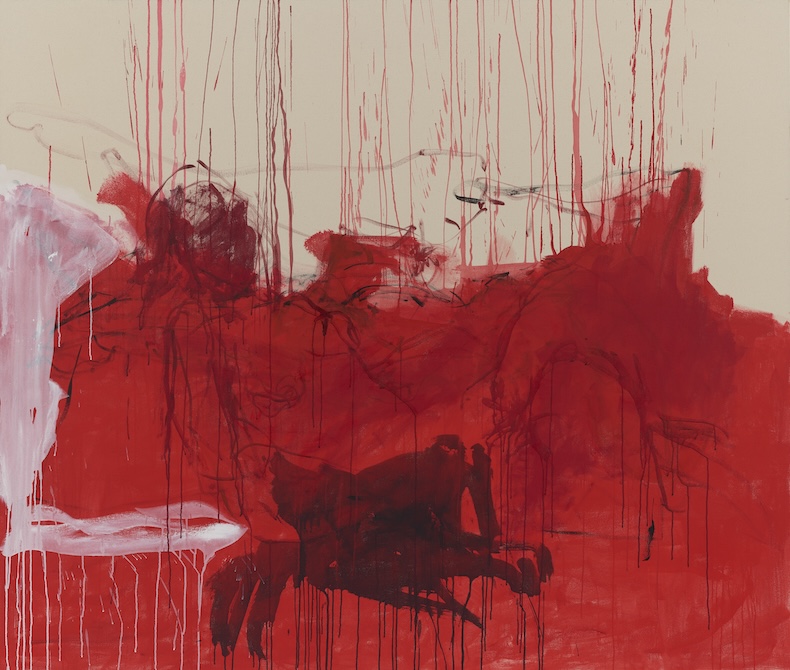
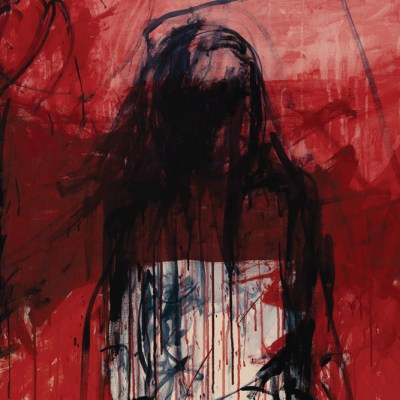
At the Tate, however, a selective approach invites reconsideration. A painting like I watched Myself die and come alive (2023) stands out as a fascinating individual composition. Emin daubs a writhing, naked female body with an expressionistic tangle of red strokes that nods as much to Frank Auerbach’s drawings as it does to her more obvious painterly touchstones. Below the bed’s feet is a screen-printed impression based on a Turkish carpet, an acknowledgment of her origins and a nod to her ‘otherness’, something often missed in previous discussion of Emin’s work.
Her painting, then, is the destination point of a show structured as a personal ‘journey’ – from underdog to establishment figure; from youthful misery to middle-aged contentment; and, most importantly, from one medium to another, then back again.
If this formulation recalls the language of reality television, the ascendancy of which was more or less concurrent with Emin’s own, that’s intentional on my part. The show and its contents often do share qualities with trashy TV: a redemptive narrative arc storytelling that comes via peaks, troughs, dramas and other subplots. ‘Corny’? You bet. But where I’m concerned, every bit as compelling as it was 28 years ago.
‘Tracey Emin: A Second Life’ is at Tate Modern, London, until 31 August.
From the April 2026 issue of Apollo.