From the April 2026 issue of Apollo.
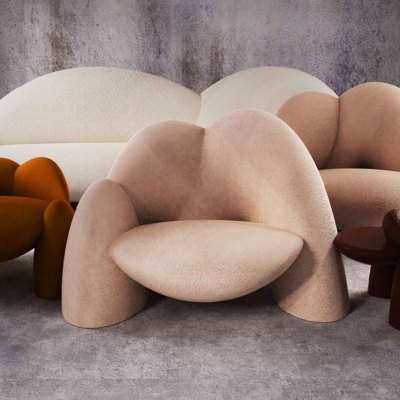
Milan has long had a reputation as Italy’s capital of finance and, since the economic miracle of the 1950s and ’60s, of design and fashion too. Salone del Mobile, launched in 1961 to promote Italian furnishings, is now the world’s leading design fair. Its 64th edition takes place later this month (21–26 April). Fashion houses from Prada and Zegna to Etro and Marni have made Milan their home. Giorgio Armani’s empire began there in 1973. In 2025 he said that his idea of good design was ‘essential, refined, simple […] comfortable and functional’. Many consider it a good description of the city itself.
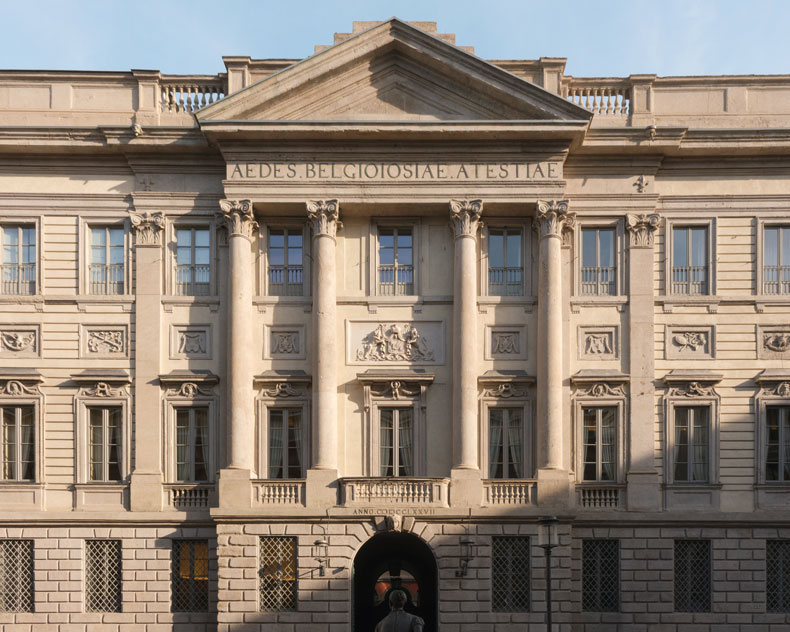
But now business-oriented Milan is acquiring a new reputation – as a marketplace for contemporary art. Thaddaeus Ropac, which represents major figures such as Joseph Beuys and Gilbert & George and has spaces in London, Paris, Salzburg and Seoul, opened a new gallery in the neoclassical Palazzo Belgioioso last September. Hot on its heels is the ultra-fashionable Paris Internationale fair. Its first edition in Milan will coincide with Miart (17–19 April) and Salone del Mobile.
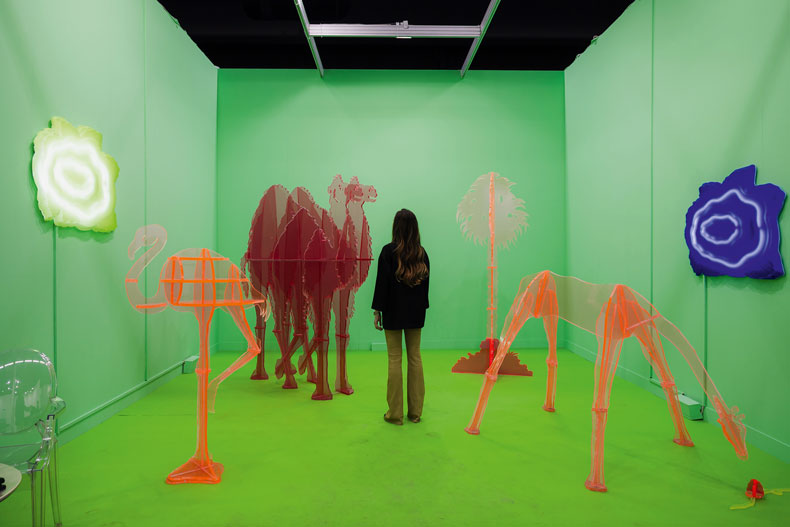
Miart, with a mix of international and Italian galleries, is the city’s more established fair. For its 30th edition it is getting a much-needed facelift, moving to the Allianz MiCo convention centre, with its extraordinary Mario Bellini-designed crumpled steel canopy roof. ‘We will finally have a venue that aligns with the expectations of international visitors for a fair taking place in the home of fashion and design,’ says the fair’s artistic director, Nicola Ricciardi.
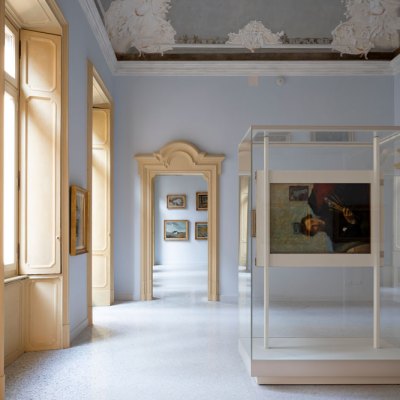
Despite Italy’s unrivalled artistic heritage – and high profile on the contemporary art scene – its art market is small, and has lagged far behind cities such as London, Paris and Berlin. Some say this is a result of cultural indifference, at least at state level, to contemporary art. Milan, despite its wealth, still does not have a dedicated, state-funded contemporary art museum, even with the opening of the Palazzo Citterio in 2024, instead relying on private collectors. In 2004 the tyre manufacturer Pirelli began to convert a factory in an industrial area of the city into a contemporary art space. Eleven years later, the Fondazione Prada opened, funded by Patrizio Bertelli and Miuccia Prada, the husband-and-wife team behind the fashion brand.
Then there is Italy’s infamous bureaucracy. Regulation of the Italian art market is divided between 15 regional offices and the national government. Until recently Italy charged 22 per cent value-added tax (VAT) on sales of works, one of the highest rates in the European Union. It also charged 10 per cent VAT on works brought in from outside the EU, which put it at a big disadvantage for importing high-value works of art for sale compared with neighbouring France (5.5 per cent). Rules surrounding the export of major works of art – for sale in London or New York or to foreign buyers – have long been considered burdensome. All this has strangled the Italian art market, experts say. Arts Economics, which produces the annual Art Basel and UBS Art Market report, estimates that Italy has a less than one per cent share of the total international art market, compared with eight per cent for France and 18 per cent for the UK, and that it shrank slightly in 2025.
But change is in the air. To the astonishment of the artists, dealers and art fairs that had been lobbying the government without much hope, Giorgia Meloni’s right-wing administration suddenly announced last year it would slash both import and sales VAT on art to five per cent. The new rates came into force last July.
‘We had an insane position where neighbouring countries such as France and Germany lowered their VAT rates, and collectors here were saying to me: “Why would I buy art in Milan when I can drive across the border to France and pay 5 per cent on top of the price rather than 22 per cent?”’ Ricciardi says. ‘Lots of Italian galleries were thinking of moving there.’ But now Italy is competitive both for buyers inside the EU and for galleries that want to bring, say, American, Chinese or British art into Europe. ‘These changes are a huge incentive to buy art, in Italy,’ Ricciardi says.
Milan is also feeling the benefit of other tax policies. In 2017 the centre-left government of Matteo Renzi announced tax changes designed to attract foreign investors. The centrepiece was the so-called ‘flat tax’ regime, which allowed qualifying foreign residents to pay €100,000 in tax each year to cover all overseas income. Take-up was initially slow: according to Italy’s ministry of the economy, around 2,700 people applied between 2017 and 2022. But even though the tax has since risen to €300,000, numbers are rapidly increasing. According to Milan’s Bocconi University, this has been driven by the UK closing its 226-year-old non-dom tax scheme, fears in France of new wealth taxes, plans in Switzerland to increase inheritance tax to 50 per cent, and Americans who dislike President Trump. Marco Garbuglia, co-owner of the Milan branch of luxury property firm Barnes International, predicts that 8,000 ultra-high-net-worth individuals will move to Italy this year, many from London. Typically, he says, around half settle in business-friendly Milan. Luxury property prices have increased by almost more than 40 per cent in the past five years. And Garbuglia says that – happily for the art market – many of the new émigrés collect art and have asked him to find properties to show it off.
‘Milan is bubbling over with energy at the moment,’ says Antoine Levi, co-founder of gallery Ciaccia Levi and, with a group of other edgy galleries, of the Paris Internationale fair in 2015. The first Milan edition will be held in the Palazzo Galbani, a 1950s office block with structural engineering by Pier Luigi Nervi. Around 30 galleries, including Crèvecœur and Gregor Staiger, will take part.
Of course, Italy has many other culturally rich cities – and some are attracting international galleries. Hauser & Wirth has just bought the magnificent Palazzo Forcella De Seta in Palermo, Sicily. London’s Herald St launched a third space in Bologna at the beginning of this year. Michele Barbati, a former director of David Kordansky gallery in Los Angeles, opened a space in Venice in 2022, while London gallery Victoria Miro launched an offshoot there in 2017. Thomas Dane opted for Naples in 2018, while Gagosian was an even earlier adopter, opening in Rome in 2007. Not all of these arrived primarily, however, to woo Italy’s collectors. ‘We had worked with [the late] Bruna Aickelin and her Il Galleria Il Capricorno for about 20 years, when she asked us to take over the gallery,’ recalls Miro president, Glenn Scott Wright. ‘She was a pivotal figure, she brought Warhol, Johns, Rauschenberg to Venice. Our artists loved showing there, we loved it too. When the Brexit vote happened, we thought it might be a good idea to have a foothold in Europe.’ It works commercially, because the gallery’s international collector base finds it hard to resist openings in the city. ‘The idea of a weekend in Venice, or Palermo or Naples, to see an artist you support and buy some art […] it’s incredibly seductive. We have a lot of people willing to fly to Venice for an exhibition.’
Federica Sheehan, senior director of Thomas Dane in Naples, agrees. The gallery has a space for its artists to work in residence and puts on three exhibitions a year. ‘Thomas [Dane] thought about it more from a personal and artistic point of view – Naples is an inspirational city, with a long art history and a place where many of our artists would want to have a show.’ It appeals to the gallery’s collectors too. ‘They travel from London, from the States… from all over for the openings, which are always at a weekend,’ she says. ‘You can buy off JPEGs or PDFs,’ adds her colleague Simone Battisti, ‘but sometimes if you want to get something great, you have to show up.’
Some have opened to tap into Italy’s network of major collectors, to work with Italian artists or deal in secondary market works from Italian collections – which present different challenges. Thaddaeus Ropac told the Art Newspaper that when he first told Italian dealers he knows in London that he was thinking of a gallery in Milan ‘They said: “You’re crazy. We’re leaving Italy.” But I just had a gut feeling about [the city].’ That was before the VAT cuts, which Elena Bonanno di Linguaglossa, the Milan gallery’s director, says are ‘potentially a major boost to the Italian art market’. She says that the gallery wanted to present their artists to the many serious collectors in Italy. ‘Italians have always been great collectors, and they are adventurous and embrace the avant-garde,’ Bonanno says.
The gallery’s opening show paired the 87-year-old Georg Baselitz with Italian master Lucio Fontana (1899–1968). Bonanno is a specialist in the secondary market and needed all her expertise to put together the selection of work by Fontana. ‘He is in the DNA of Milan, but it took some months to put together a show of great works from major Italian collections,’ she says. Part of the difficulty is that owners of important Italian works are reluctant to consign them for sale in case they fall foul of Italy’s notoriously complex export rules, although this is changing. According to Bonanno, there is a greater understanding at government level of the value of the art market and individual ownership: ‘It is not as complicated as it was, if you know what you are doing.’
Still, many find Italian heritage laws daunting. Until 2017, works of art more than 50 years old by an artist who had died needed an export licence. If a licence was refused on the grounds of important cultural, historical or artistic interest, works could be ‘notified’, meaning they couldn’t leave Italy – dramatically reducing their value. While this was generally taken to apply to Italian artists, it could also cover foreign artists such as Cy Twombly, who was American but worked in Italy, or even international collections of art. Amendments to heritage laws were used by the government in 1998, for example, to try to prevent the loan of key works from the Peggy Guggenheim Collection in Venice to the Guggenheim in New York.
In the early 2010s, owners of works by Italian artists including Fontana, Burri, Manzoni, Castellani and Boetti realised that art made in the 1960s was about to be caught by the export licensing regime and rushed to get it out of Italy. By 2015, sales of Italian art at Sotheby’s, Christie’s and Phillips in London and New York had reached $555m, falling back to $165m today, according to analysts ArtTactic. The time limit has since been extended to 70 years, though modern and contemporary dealers and auction houses were hoping for 100 – while Old Master dealers would like the whole system overhauled. In the UK and France, the state is obliged to buy works blocked from export at international market price – which forces more concentrated decision-making. That’s not the case in Italy, where 15 regional offices have significant discretion in interpreting ‘national significance’ and, according to the art lawyer Giuseppe Calabi, it is difficult to challenge decisions in court. Courts are reluctant to overturn the government’s evaluation of the cultural interest of a work with an alternative opinion.
‘The difficulty is not that many export licences are denied, it is the uncertainty. Even if only one per cent of art was stopped, no collector wants to be in that unlucky group.’
This is one of the reasons why, despite growing interest in the work of living artists – who are unaffected by export rules – Milan’s auction market has remained stubbornly small. It totalled just $20.4m (around €19m, hammer value without fee) in 2025 at Sotheby’s and Phillips – Christie’s last conducted sales there in 2024. Compare that with the $175.3m (£106.5m, hammer value without fees) achieved by Sotheby’s in a single modern and contemporary evening auction in London last month.
None of this is denting Milanese ambition. Tommaso Sacchi, the city’s deputy mayor for culture, says that ‘Milan has become a point of reference for contemporary art.’ But, he says, it could soon ‘play a more decisive international role [with] a dense network of museums, foundations, galleries, art schools, independent spaces, collectors, publishers and creative industries.’ Miart director Nicola Ricciardi goes further: ‘We are not at the same level as Paris or London – but we are getting there. If we grow steadily and slowly, we could match these other cities.’
Since Brexit, the competition to become the new capital of the European art market has been a one-horse race. Paris, with its world-class museums, auction houses (both Christie’s and Sotheby’s are now under French ownership), concentration of commercial galleries and now its own Art Basel fair, has been odds-on favourite. Milan remains an outsider: it is not a ‘world’ city like London, Paris or New York, its art market is small and to change it the Italian government has much more to do. But some people are tipping it for the top.
From the April 2026 issue of Apollo.