From the April 2026 issue of Apollo.
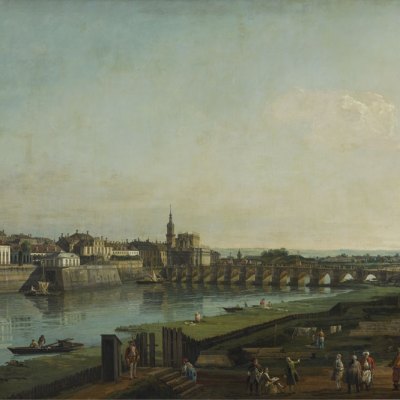
In 1727, near the end of his life, Augustus the Strong, Elector of Saxony and two-time king of Poland, decided to rebuild the medieval bridge over the river Elbe that connected the centre of Dresden with Altendresden, the developing suburb on the north bank of the river. Augustus wanted a grand sandstone bridge that would outshine those in Prague and Regensburg and by the time his architect, Matthäus Daniel Pöppelmann, was finished four years later, it did just that. The Augustus Bridge was 437 metres long, 11 metres wide and could ferry both traffic and pedestrians, who might stop and admire the view from one of the alcoves dotted along its length.
To crown his achievement, Augustus insisted that his statue be placed on the bridge, in the style of that of Frederick William the Great on the Lange Brücke in Berlin. In 1736, three years after Augustus’s death, an imperious gilded statue of the Elector, looking determinedly into the distance and seated on a rearing stallion, sprang up on the market square by the northern end of the bridge. Go to Dresden today and the statue is still there, at once welcoming visitors into the heart of the city and leaving them in no doubt as to who made it great.
To say that Augustus the Strong was a vain man would be an understatement, but when it comes to the artistic and cultural legacy he left in Dresden, the city of his birth and the capital of Saxony, the state he ruled for almost four decades, his vanity feels justified. If, as Tim Blanning writes in his recent biography, few European rulers in history could count ‘a longer list of military failures’ than Augustus, his cultural achievements, which included making Dresden ‘one of the most beautiful cities in Europe’, undeniably marks him out as a great artist.
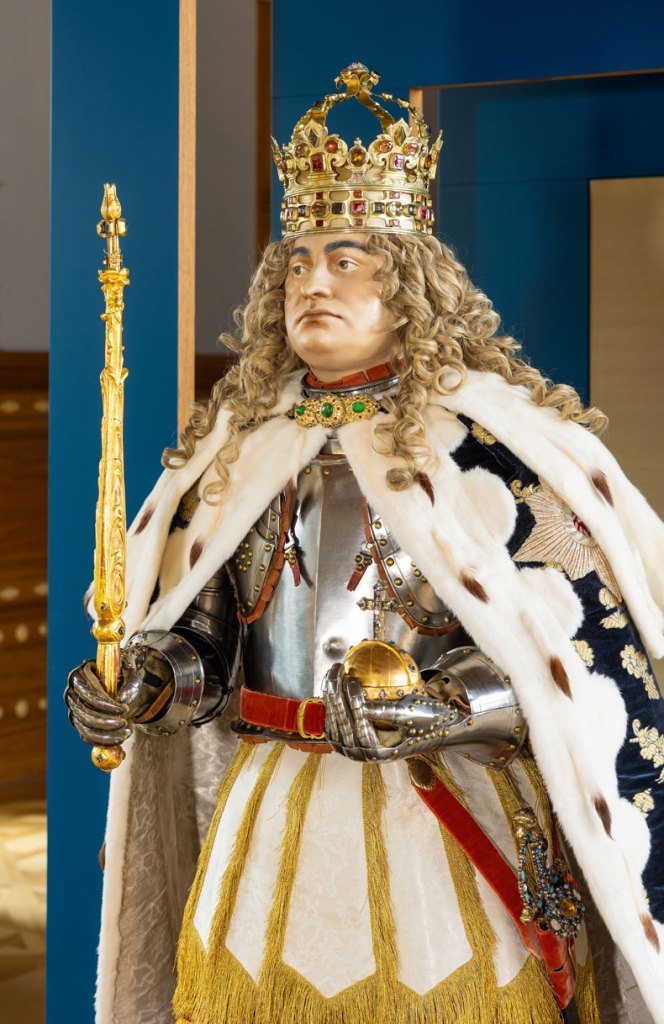
His list of successes included collecting some 29,000 pieces of porcelain from East Asia; founding the Meissen works, the first European porcelain manufactory; collecting and commissioning some of the most opulent and inventive pieces of jewellery, weaponry and objets d’art of the day; employing and patronising the most talented goldsmiths, silversmiths and jewellers in Europe; building the magnificent Zwinger Palace; and refashioning and expanding the Residenzschloss (Royal Palace), which in 1701 had been half-destroyed in a fire. As a young man Augustus had embarked on a Grand Tour that included a stop at the Palace of Versailles, in the middle of its expansion and decoration by Louis XIV. He would spend the rest of his life obsessively pursuing the kind of splendour he encountered there.
Today Dresden looks quite different from the well-known pair of views of the city painted by Bernardo Bellotto in the 1740s, both of which placed the Augustus Bridge centre stage. The main reason for that hardly needs repeating: the carpetbombing campaign by British and US planes in February 1945 that killed 25,000 and left much of the city in ruins. (A few days after I visit the palace in early March, an unexploded Second World War bomb is found and results in some 18,000 citizens being evacuated from the city centre.) Dresden’s collections of art and artefacts had already been moved in the first couple of years of the war to various fortifications along the river Elbe, including the high-security Königstein fortress. After the war they were confiscated by the Soviet Union and were returned only after Stalin died and Khrushchev was leader. Marius Winzeler, the director of the Armoury and the Green Vault, two of the museums that today make up the Residenzschloss complex, tells me that the Russians saw the return of Dresden’s treasures as a favour to their ‘brothers in the GDR […] It was a very ideological thing, but of course we are very happy about it.’
When the war ended, German authorities set about rebuilding the Zwinger immediately and it reopened in 1963. The Residenzschloss was a different proposition. ‘During GDR times it was a financial challenge’ to rebuild the palace, says Bernd Ebert, who in May last year became head of the state collections of Dresden (SKD), a huge body that governs around 15 museums including the whole of the Residenzschloss, which, as well as the Armoury and Green Vault, counts the Collection of Prints and the Cabinet of Coins among its various collections. The ‘mood changed’ in the 1980s, Ebert tells me, when the decision was finally taken to rebuild the Residenzschloss, which at this point was little more than a smattering of ruins, with vegetation growing from crumbling walls and animals nesting among the rubble.
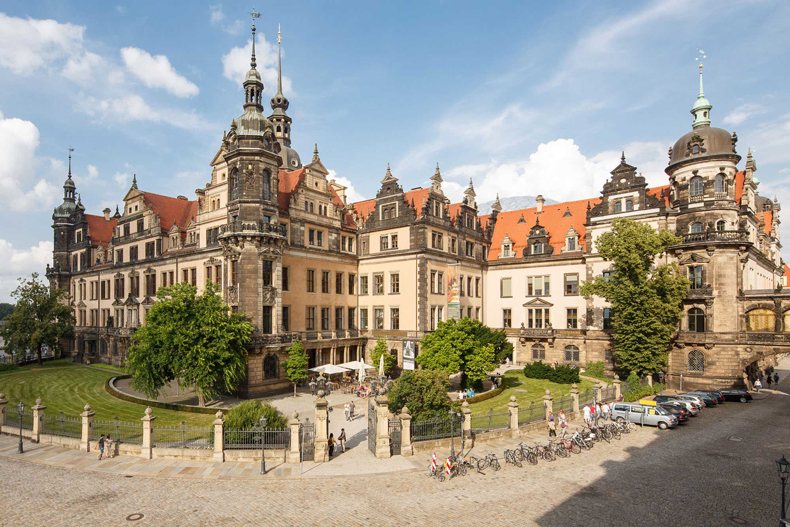
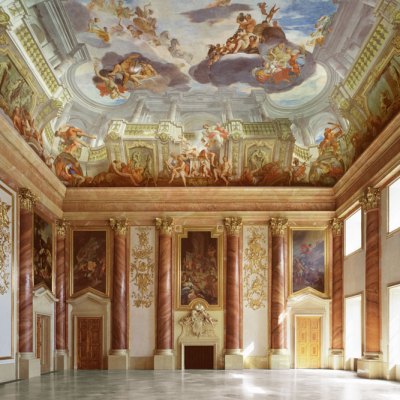
The process of reconstruction has been a long one, though the palace is at last entering the final stretch. In 2019 the first rooms of the Royal State Apartments on the second floor, or bel étage, of the building opened to visitors in restored state; last year Dresden celebrated the reopening of the palace chapel. This month the final two rooms of this floor, the Great Ballroom and Proposition Hall, will be unveiled, marking the completion of the whole floor – the part of the building that Augustus the Strong had built in order to celebrate the marriage of his son, Prince Friedrich August II, to Maria Josepha, daughter of the Austrian Emperor. There are things left to do – much of the courtyard in front of the Altan, a four-storey loggia, is still a building site. So are several rooms on the ground floor of the east wing and in the basement, which will be dedicated to teaching visitors about the history of the site. Unless there are any major hiccups, the whole Residenzschloss will be done and dusted by 2028.
‘The decision to reconstruct the castle is a major one,’ Ebert tells me, ‘but then what do you reconstruct?’ The Residenzschloss today is of course not a historical copy but ‘a fantasy’, he says – an amalgam of how the palace looked at various times in its history, often depending on what images have survived and can be copied. It’s a choice that not only derives from necessity but also allows for a certain freedom: ‘If you reconstruct something at a specific time, you can hardly change anything.’
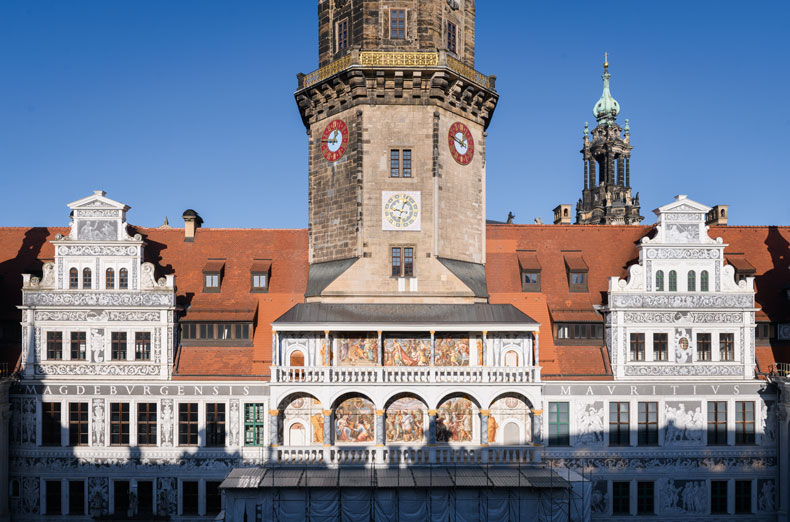
Parts of the Residenzschloss – much of the armoury, for instance – have been rebuilt in the style of a modern museum. The facades of the Altan are covered in frescoes that look like Renaissance paintings. Originally commissioned by Elector Moritz in the 16th century from various Italian artists, these have now been lovingly repainted over some eight years by Matthias Zahn. Since there were no photographs or original parts of those earlier frescoes, Winzeler says, these are a ‘reinterpretation of the lost originals’ that were documented in drawings and engravings from the 16th and 17th centuries. The main courtyard of the building has been decked out with a soaring glass-panelled roof – very much like the British Museum – put in by the late architect Peter Kulka, allowing light to stream into the space and banish any fustiness that might threaten to creep in.
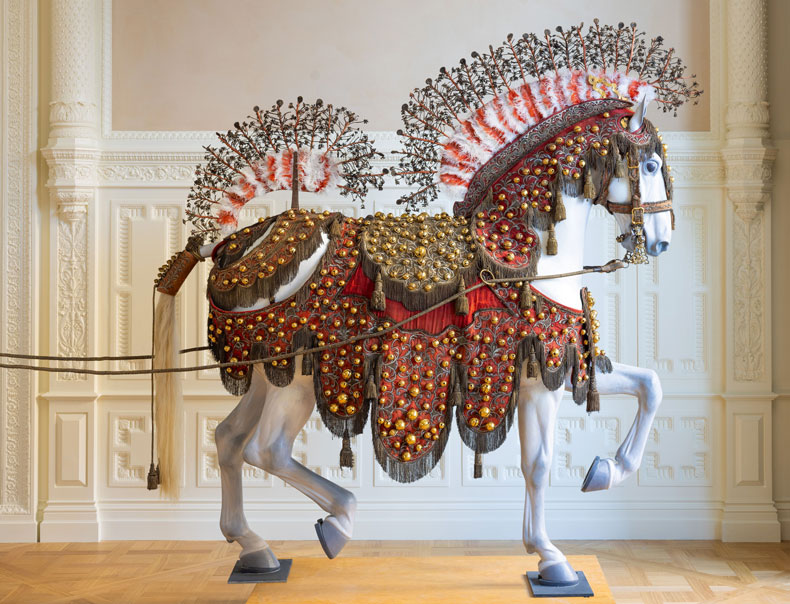
Even though, as Ebert says, the ‘state you see it in has never existed’, the reconstruction aims to evoke the ‘time that formed Dresden: the time of Augustus the Strong’. That is most obviously the case on the second floor, where a permanent exhibition opens this month to celebrate the completion of the Great Ballroom and the Proposition Hall. These long, wood-panelled rooms are less ornate than the rest of the State Apartments, which lean more towards what one might think of as a European royal palace: wine-red velvet wall-hangings, painted ceilings, parquet floor and elaborate gilding. The exhibition, ‘Masks and Crowns’, curated by Winzeler and his colleague Holger Schuckelt, more than makes up for that, however, with its exhibits of courtly splendour. The display in Proposition Hall focuses mainly on Augustus’s coronation as King of Poland in 1697, while the Great Ballroom has been furnished with objects used for festivities at the Dresden court, including a massive wooden horse dressed in an astonishing velvet caparison, worn by the horse that pulled Friedrich August and Maria Josepha on a sleigh ride at the Viennese court in 1719. Newly restored, the piece is decorated in 538 small bells that were designed to ring out in different arrangements as the horse trotted along.
I am here some six weeks out from the exhibition’s opening, and much is yet to be put in place – hence the great tables laid out with decorative shields, crystal spurs and much else, all of which feels almost unbearably tempting to reach out and touch. Here I spot one of the star lots of the exhibition: the great golden sun mask fashioned by the most accomplished of Augustus’s court goldsmiths, Johann Melchior Dinglinger, for Augustus to wear during the festivities that accompanied the visit of the Danish king in 1709. It’s chilling to imagine what Augustus – a beefy figure who by all accounts more than earned his sobriquet – would have looked like sidling up to you wearing it. As a piece of symbolism it couldn’t be clearer: Augustus was in the business of self-fashioning as both Apollo, god of the arts, and his personal hero, the Sun King.
A casual visitor to the Residenzschloss might get the impression that the State Apartments were private, homely spaces. But for Augustus, the personal was political. The State Bedroom is furnished with a golden bed, pushed up against a wall, that turns out to be completely wooden. It’s just for show, a nod to the marriage these rooms were built to celebrate. They were never intended to be occupied – except on very special occasions – but were much closer to a gallery, Winzeler tells me: ‘From the 19th century onwards you could ring a bell and ask if it was possible to visit the rooms,’ a request that was usually granted.
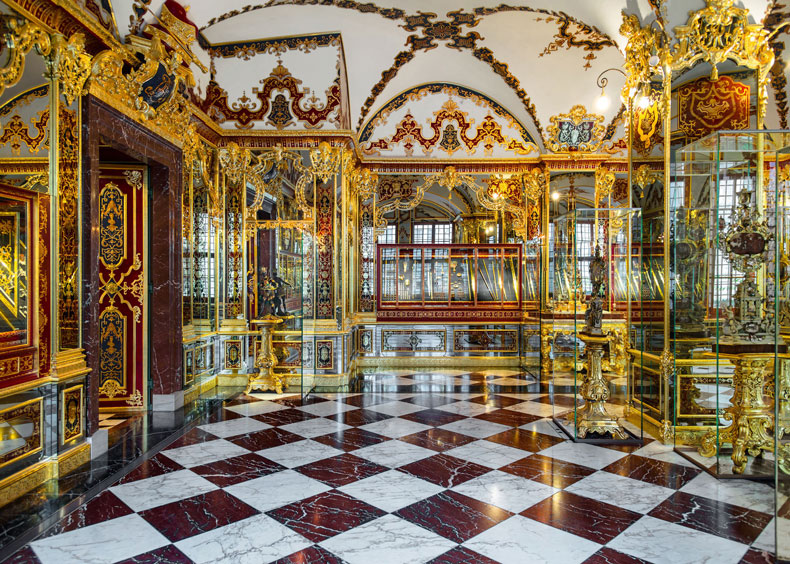
Things were much the same in the Green Vault, located in the basement of the museum, a series of ornate rooms built by Augustus to house his most precious artefacts. This is the most popular part of the Residenzschloss, in terms of visitor numbers, and it’s easy to see why from the sheer lavishness and inventiveness of the objects on display, including gilded nautilus cups, Limoges enamels, water basins set in mother of pearl, bronzes by Giambologna and Adriaen de Vries, carved ivory statues, gold ruby jugs and silver goblets in the shape of owls, chickens and pineapples. A ruler’s Kunstkammer was traditionally a site of private pleasures, but Augustus did not see the point in hiding away his bounty: from the 1720s onwards, any citizen of Dresden, providing they were dressed half-decently, could visit the Green Vault. Augustus had turned Dresden into a world-leading hub of craftsmanship, and he wanted people to know about it.
It is difficult to overstate the significance of the Residenzschloss project to Dresden, a city that trades on its status as a cultural destination more than just about anywhere else in Germany. The city is the ninth largest in the country and the second largest in Saxony after Leipzig. There are, as of this year, no direct flights from London to Dresden. And yet the group of state museums over which Ebert presides is second in size in Germany only to Berlin. ‘Opera? Museums? If you go to Dresden, that’s what you do,’ Ebert says, adding that he has regular meetings with the minister president of Saxony – ‘I can think of no other state in Germany’ where that is the case, he tells me.
When, in 2019, thieves broke into the Green Vault and made off with a collection of historic jewels worth £98m, Dresdners ‘were lining up here and crying’, Ebert says, gesturing towards the Taschenberg Platz, just outside his office window. The Residenzschloss has emerged from the fiasco stronger: most of the jewels have been recovered and the state has pumped millions into security, to the extent that after the theft at the Louvre last year, ‘the French ministry got in contact with us’ to see what they could learn. It would surely have been cheering for Augustus the Strong, who dedicated so much of his life to imitating the French king, to instead see France asking the Germans for help, more than three centuries on.
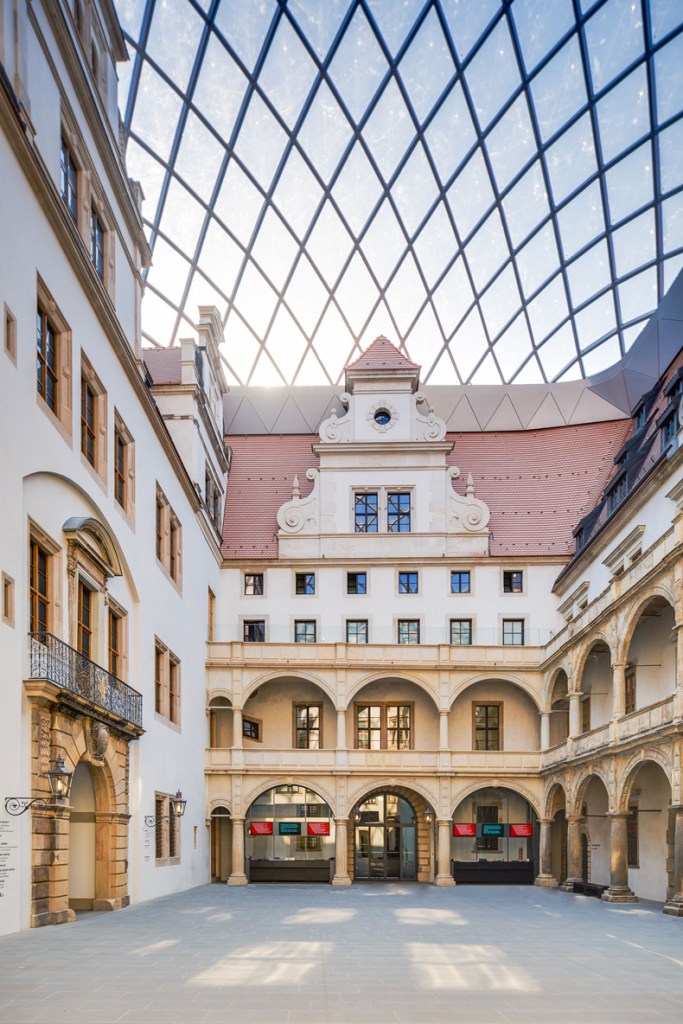
‘Masks and Crowns. Court Festival Culture and Representations of Power’ is at the Residenzschloss, Dresden, from 22 April.
From the April 2026 issue of Apollo.