From the April 2026 issue of Apollo.
The devastation by fire in 2019 of Notre-Dame cathedral in Paris and the subsequent public debates around its rebuilding have brought renewed attention to the French historicist architect Eugène-Emmanuel Viollet-le-Duc (1814–79), who restored the gothic cathedral in the 19th century, famously adding a spire that had never existed in the first place. Viollet-le-Duc is the subject of a new exhibition curated by Barry Bergdoll and Martin Bressani at the Bard Graduate Center in New York. Presenting more than 120 drawings – a fraction of the vast collection held by the Médiathèque du patrimoine et de la photographie (Media Library for Heritage and Photography) at Charenton-le-Pont – as well as objects related to his practice, the exhibition focuses on the critical role that drawing played in his historicist theories, publications, restoration and building projects, including his own home in Lausanne, christened ‘La Vedette’ (Star). Organised chronologically, the ground floor introduces viewers to his start as a draughtsman, while the first floor turns to his impassioned involvement in the restoration of Notre-Dame. Drawings related to his late unorthodox interests are displayed on the second floor, while the fourth includes modern responses to his work, such as a project by architectural students at ETH Zürich to reconstruct the now-demolished home of the famed reconstructor.
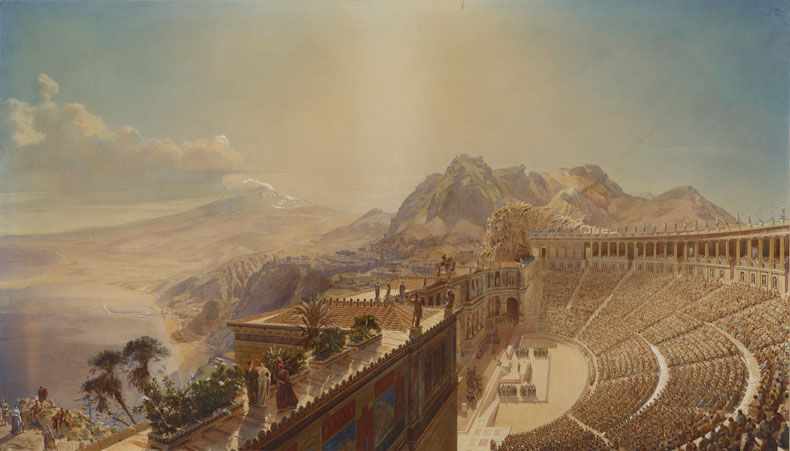
It is hard not to be seduced by the architect’s graphic dexterity. Among the first drawings one encounters in the gallery is his 1840 reconstruction of the ancient theatre at Taormina in Sicily, a grand-format image of the open-air structure shown from an inhuman perspective that encompasses ocean, sky, monument and mountains, down to toga-wearing spectators: this guy wanted to show it all.
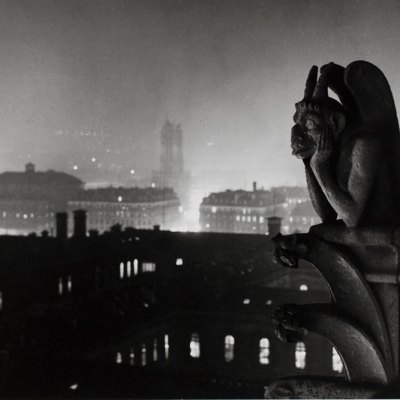
Born in 1814, Viollet-le-Duc grew up in a Paris torn between nostalgia for Napoleonic greatness, revolutionary instability, and a reactionary Bourbon monarchy. He was above all the product of a bourgeois, juste-milieu France. Educated at home, he took advantage of family connections to learn how to draw outside the ambit of the École des Beaux-arts. He pointedly refused to enrol in the architectural pedagogy of the period and his picturesque landscapes and interior views form a stark contrast to the conventional archaeological studies by his older contemporary Léon Vaudoyer. Rejecting the classical past, he turned to France’s neglected medieval monuments, their fragments and ruins becoming the cornerstones of a fervently romantic nationalist mythology. When Viollet-le-Duc and his partner Jean-Baptiste-Antoine Lassus (1807–57) won the prestigious commission to restore Notre-Dame in 1843, it was the chance to put his stamp on a French national symbol, making it better from top to bottom than it ever was. His drawings related to Notre-Dame range from large workshop renderings for a chandelier to the meticulously annotated images of the stonework around the windows and niches of Notre-Dame in the attachements, technical drawings used by architects and stonemasons that recorded the state of projects. By contrast, quickly sketched depictions of gargoyles have a playful, almost feline quality, evoking the architect’s charming pictures of his cat, which he drew slinking, pouncing and arching across the page.
The drawings for the unbuilt ‘monument to be erected in Algiers under the reign of Emperor Napoleon III’, tucked away on the third floor, are the most intriguing works in the show. (Having accidentally taken the elevator to the top floor, these were among the first works I encountered.) Here we encounter not the towering genius in tuxedo tails holding a miniature Notre-Dame in the palm of his hand, but an out-of-touch architect struggling to understand the complicated briefs of the Second Empire, as Napoleon III, in a nostalgic evocation of his uncle’s first military adventures in North Africa, sought to expand France’s territorial conquests. The flaws of a historical figure rather than his genius are often what reveal to us the complexities of his time. Exhibited in two versions, this monument was meant to show off Napoleon III’s attempts to grant greater autonomy to the French colony in Algeria, established in 1830. Monuments like this were the bread and butter of students at the École des Beaux-arts, who toiled away at grand prix exercises in order to acquire an architectural vocabulary that could respond to the political demands of a brief.
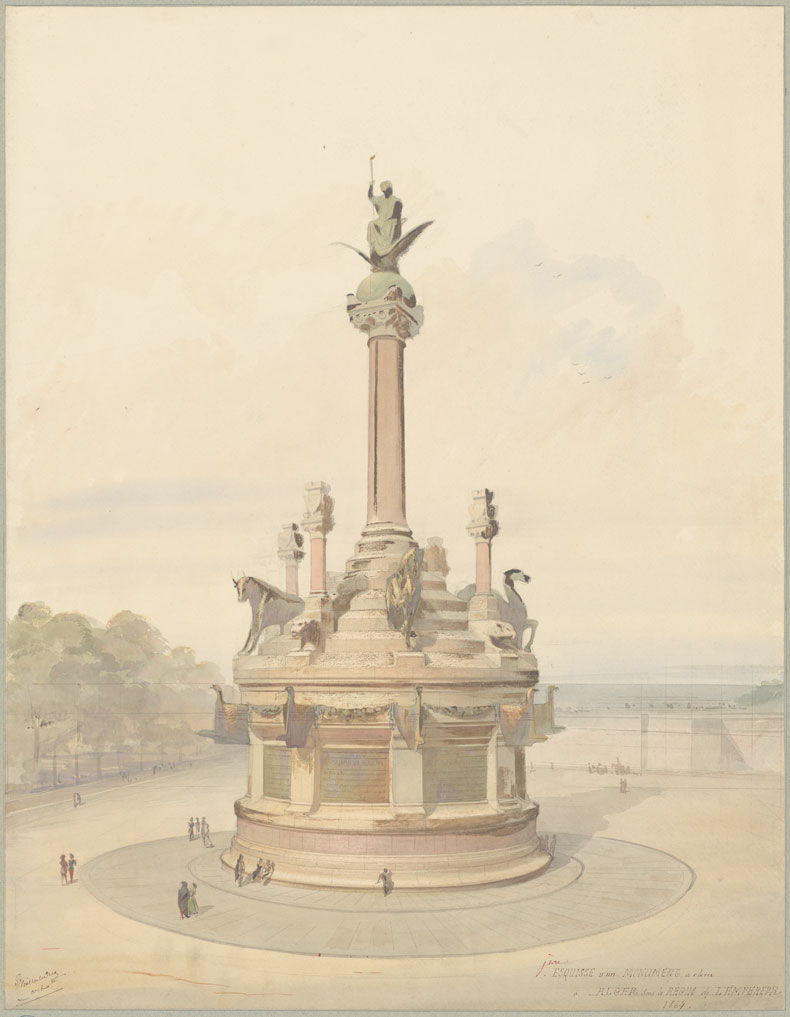
Viollet-le-Duc’s design drew instead upon his own developing theories of architecture based on Aryan and Semitic typologies, inspired by the work of his friend Arthur de Gobineau, author of Essai sur l’inégalité des races humaines (1853–55), who believed in the superiority of the Aryan race and the French aristocracy. The first sketch from 1864 shows the figure of France seated on an orb with an eagle at her feet, balancing precariously on a pink marble column set within a stepped circular structure resembling the tiers of a cake, with smaller columns and a bull, camel, and horse, animals representing Algeria, perched atop it like party candles. The urban monument dwarfs passersby, nothing suggesting its location in Algiers. Viollet-le-Duc was asked to return to the drawing board, incorporating more ‘Arab features’ in his second version because (according to the label) ‘his first scheme was deemed insufficiently respectful of Moorish traditions’. He turned instead to a trefoil plan, replacing the circular base with medieval turreted forms that accommodated openings with a horseshoe ‘qusibah’ arch in between, and replacing the pedestrians depicted in the earlier drawing with the lone sentry.
There is something poignant about seeing an architect so nimble with gothic vaults, masonry and the trajectory of medieval catapults struggling to find the right design language for bourgeois colonial expansion. The unrealised project points to the limits of a nationalist architectural rhetoric that could veer into pastiche when trying to imagine other cultures: a fitting monument, in other words, to the failures of Napoleon III’s imperial ambitions.
‘Viollet-le-Duc: Drawing Worlds’ is at the Bard Graduate Center, New York, until 24 May.
From the April 2026 issue of Apollo.