It was an engagement present from my in-laws-to-be, from a gallery in London that specialises in Bloomsbury artists. Our painting is obviously later but maybe the colour palette is similar: a sort of richness or depth of drabness. I tend to like paintings with these colours, it doesn’t really matter what they’re about. And not just paintings – novels or stories in which nothing much happens, and nobody’s particularly happy or miserable and yet there’s still somehow (or because of that fact) a reality or depth of feeling. One of my first memories is looking out of a second-floor window in London, on a rainy day, as a bus went by. I was eating a pot of yoghurt with a spoon, and the metal clinked against the glass. This has a similar feel, although of course the subject is very different.
I don’t know that it’s raining in the picture, but the atmosphere is certainly thick. The whites are dingy, there’s a lot of grey, and most of the colours are the muddier versions of themselves – ochre rather than yellow, but I like the little column of red, underneath the patch of whiter white and blacker black, by way of contrast. It’s a Cornish scene. Michael Canney was a Cornish painter, who died about 25 years ago and knew Alfred Wallis, Barbara Hepworth and Ben Nicholson, and others from the artist community based in St Ives. (He also taught in California and spent time in Italy and France.) The grey in the painting may be Wallis grey, but the slabs or patches of colour feel more structural or geometric than in Wallis, and less childish. And you can see the scrape of a knife instead of the stroke of a brush.
As it happens, we spent our honeymoon in Cornwall, in late November. The sun shone all week; it was T-shirt weather and hot enough for clouds of midges to bother us when we walked the coastal paths. For my 40th birthday, my wife gave me a second Canney painting – also a Cornish scene, more obviously figurative (it’s a view Wallis might have painted, as if nothing had changed), this time in watercolours. Another cloudy day, three boats resting in the sand, while the tide comes in against a high wall, with houses on the other side of the wall, and a hill above them, and a tall narrow chimney bisecting the sky. The angle of the boats is a little hard to read. It suggests a kind of crowding, of the perspective, too, but other than that nothing feels particularly abstract.
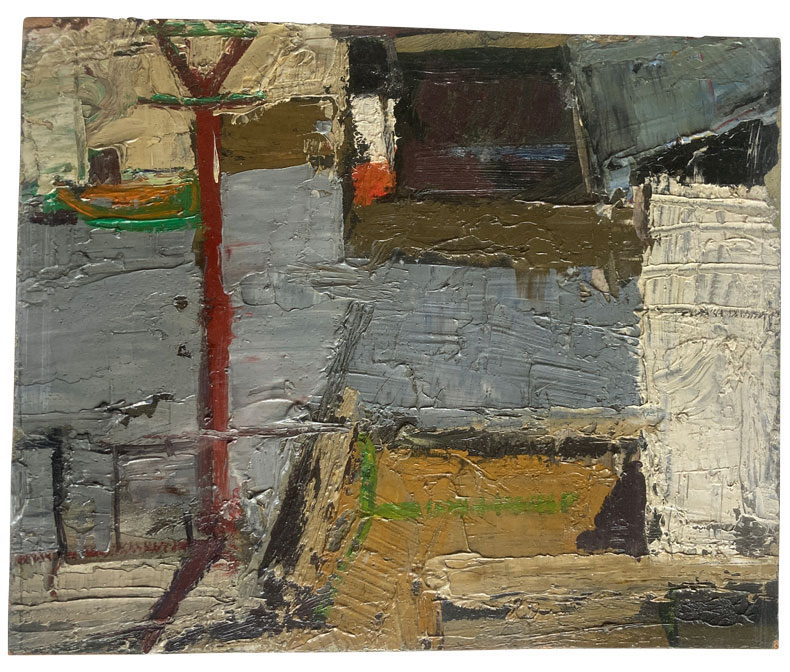
It’s earlier than this painting, and in fact, as Canney’s career went on, his work became more and more abstract, and I like it less. But in our engagement present the tension between figuration and abstraction seems almost perfect. I can imagine it as a puzzle of awkward shapes, but I can also imagine that if I squinted a little or were just better at looking, those shapes would resolve themselves into a straightforward view of a bit of harbour, a bit of sea, a bit of boat – on a grey morning or an overcast afternoon, when there’s work to be done, but still some comfort to be found in a kind of intimacy with things, even if they aren’t, in this light, especially beautiful.
Canney’s later work feels like pure geometry. The colours are mostly cleaner, too; you feel none of that tension between the realities that people are stuck with and the shapes that artists want to make. But, of course, I know he could have painted more paintings I’d have loved if he had chosen to; he just didn’t choose to. And I’m sure his tastes were more sophisticated than mine. This picture just reflects a moment of perfect overlap between what he wanted to paint and what I want to look at.