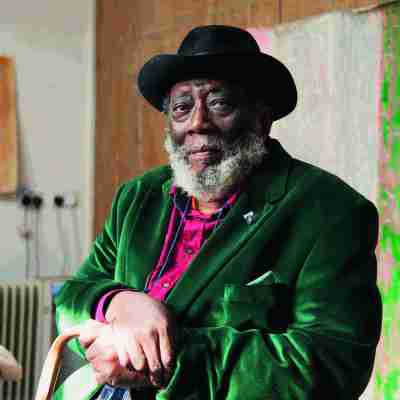
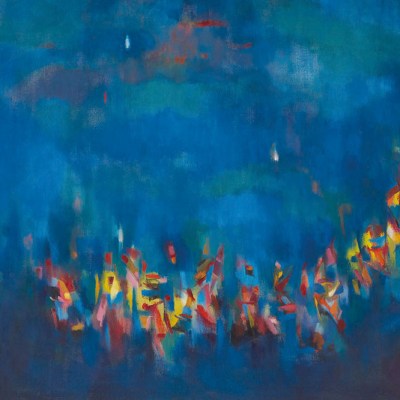
How do you sum up the life’s work of a still-working artist? At the Fitzwilliam Museum in Cambridge, ‘Frank Bowling: Seeking the Sublime’ spans the more than 60-year career of the Guyanese-British artist who, in the past decade, has come to be recognised – after a much longer period of critical and institutional neglect – as one of the foremost painters of his generation. But this is not a completist project. The entire show consists of only 11 works, 10 of them confined to the space of a smallish gallery with eight walls. The last painting is hung a few rooms away in the museum’s permanent collection, alongside a work by Bowling’s contemporary and compatriot Aubrey Williams. The effect is striking: less a survey than a synthesis.
The earliest work, 4 Horsemen of the Apocalypse (1961) – shown here for the first time after extensive restoration – was painted during Bowling’s studies at the Royal College of Art in London: a response to a classroom prompt to make a work on a biblical theme. The schematic forms of the horses and their riders emerge from a murky backdrop – green, yellow, black, white, red, orange. Another painting from around the same time, Beggar no. 5 (1962–63), depicts a memory from the artist’s childhood in what was then British Guiana. A figure in a stripey T-shirt appears in front of Bowling’s Variety Store, the family home and shop where the young Frank’s mother would sometimes invite beggars in for a hot meal – but only after making her son wash their feet. Bowling later described this ordeal as a ‘trauma’.
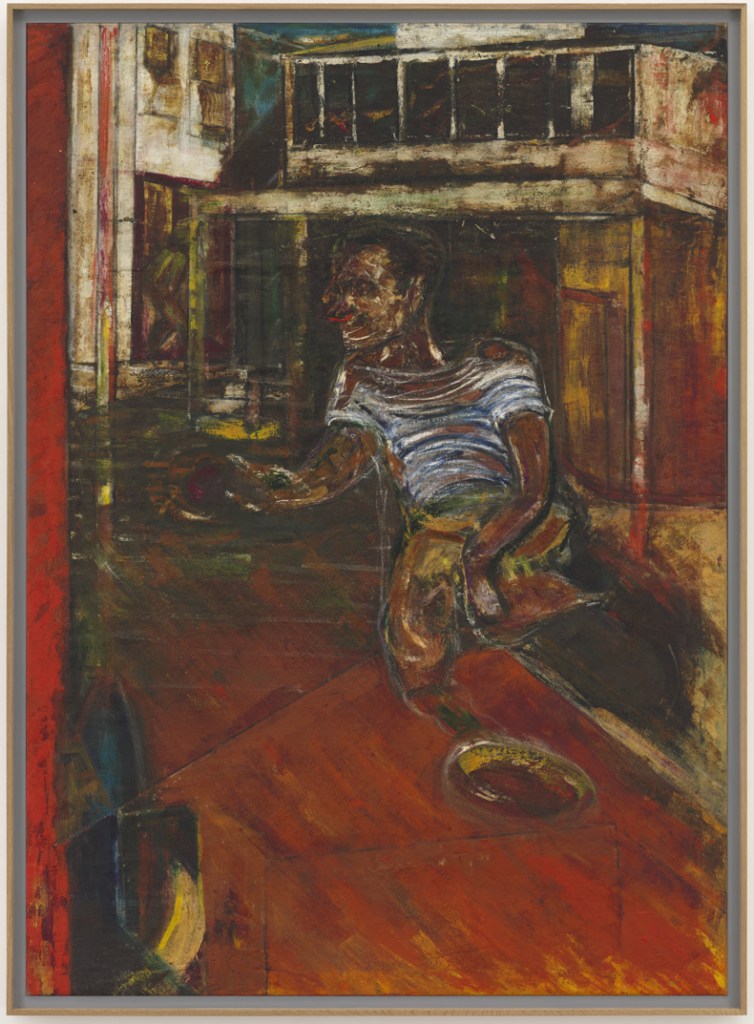
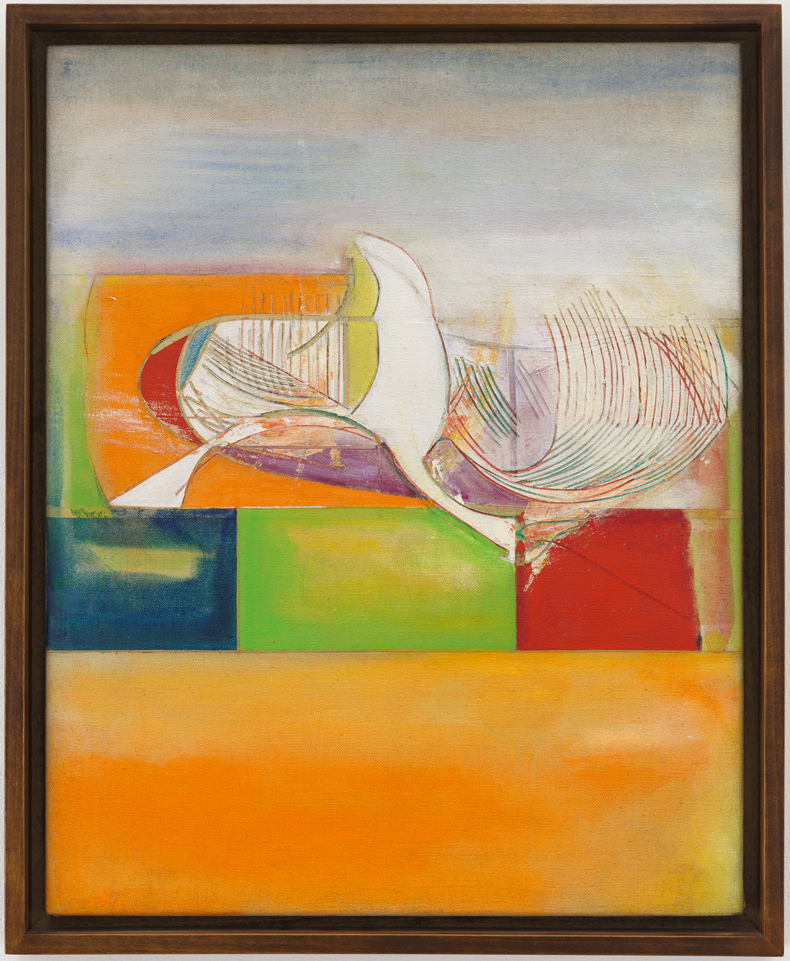
These early canvases are usually considered to belong to Bowling’s ‘immature’ phase, before he found his voice. There is some truth to this. The Expressionistic rendering of angst owes an obvious debt, as the wall text notes, to Francis Bacon, an early mentor. Also seen as minor, or transitional, are two small works from his Swan series of 1964–65, in which the distorted form of a dying swan is set against geometric patterns and blocks of colour. In 1966 Bowling left London for New York and, so the narrative goes, discovered a new direction: abstraction. Only then did the Frank Bowling we now know and love – the modernist who is above all concerned with exploring what he has often called ‘the possibilities of paint’ – show up. At the Fitzwilliam, that revelatory period is exemplified by a pair of thin vertical ‘poured’ paintings from 1976, created by tipping acrylic paints in assorted shades on to tilted canvases. Potarospray (1980), the work hung in the main collection space, is a densely layered and textured scramble of amorphous shapes and lines.
The emphasis in this show, however, is on continuity rather than rupture: the threads that run through an artist’s oeuvre. Across the works on view, the line between representation and abstraction is revealed to be something of a mirage. In the earliest works, figures blur into colour and form: notice, for instance, the mysterious dark void where the left foot of the beggar, the site of recollected trauma, ought to be. Elsewhere, the external world – stories, memories, people, places – never stops intruding on the ostensibly pure painterly realm. Bowling knows and embraces this; one of the poured paintings, with its flume-like cascades of colour, is titled Lenoraseas, an allusion to a coastal village in Guyana, a country whose name translates to ‘the land of many waters’. Pondlife (after Millais) (2007) invokes another watery image: the famous Pre-Raphaelite painting that depicts the drowning of Ophelia. Tracey’s Bouquet (At Swim Two Birds) (2011) contains embedded remnants of flowers sent to the artist by Tracey Emin, as well as scraps of fabric that allude to the textiles once sold in Bowling’s Variety Store.
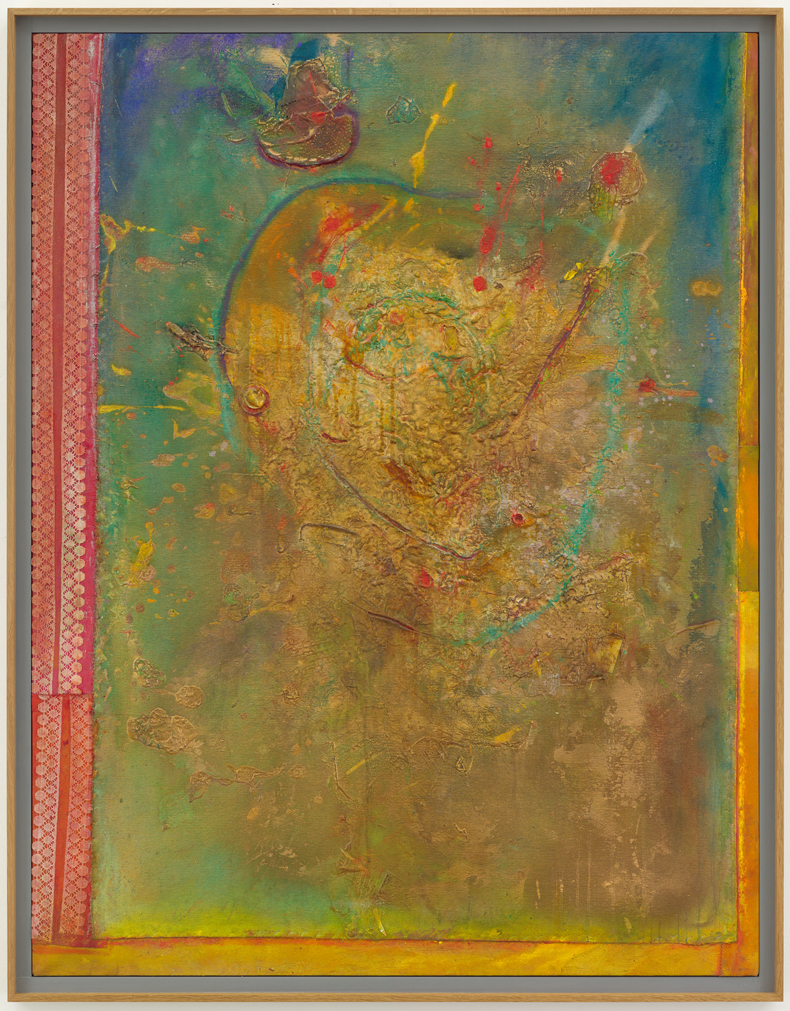
The newest works are explicit in their callbacks. In Swan Upping (2020), the dark silhouetted outline of the creature’s neck and head is lifted right out of the composition shown beside it, from more than 60 years earlier. Yellow Map (2025) revisits Bowling’s best-known series: his monumental ‘map paintings’ of the late 1960s and early ’70s, in which abstract fields of colour are overlaid with the stencilled landmasses of Africa, the Americas and Australia. Here, two parallel lines of pink glitter are smeared down the middle of South America. It’s a little odd to see this updated version without its precursors. There are other important periods of Bowling’s work missing here: most of the 1980s and ’90s in particular. But that’s unfair. The show makes no claim to being comprehensive – and it puts its scale to good effect. Lining the walls of the octagonal gallery, the paintings crowd around you, more like a panorama than a sequence of discrete works. All at once, a life’s work is laid out before you.
‘Frank Bowling: Seeking the Sublime’ is at the Fitzwilliam Museum, Cambridge, until 17 January 2027.