The pomp of the Albertina Museum’s red-carpeted and chandeliered palace is an unlikely space in which to encounter the 19th-century French printmaker, sculptor and painter Honoré Daumier. Here is an artist who never relented in his laceration of the ruling classes, whose career was bookended by a six-month stint in jail in 1832 for his caricature of Louis Philippe I as Gargantua and by an enthusiastic few weeks supporting the Paris Commune in 1871. So there’s more than a touch of irony in the fact that this major survey of his work is being held in the former home of an arch reactionary, Archduke Albrecht, who gave orders for the army to fire on students in the failed revolution of 1848.
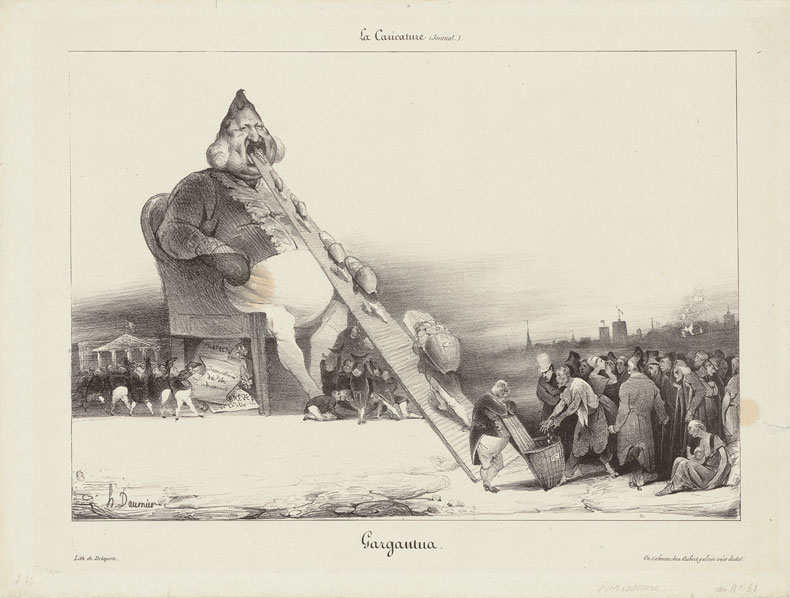
Fortunately, the power of Daumier’s vision emerges undiminished from the six packed rooms of this exhibition. Born in 1808, Daumier was self-taught and spent most of his life producing daily lithographic caricatures as well as droll illustrations of urban life in Paris for political magazines (chiefly Le Charivari, La Silhouette and La Caricature); in later life he displayed his paintings in the Salon. His lithographs had a wide circulation beyond the private sphere of the demi-monde: on the walls of Parisian coffee houses and in shop-window displays in the arcades. While the undeniably popular dimension to his work, with most of his work appearing in periodicals, has somewhat diminished his art-historical stature, Daumier’s gestural economy and mastery of negative space were held in high esteem by contemporaries such as Baudelaire, Manet and Degas. The influence of his work in 20th-century popular culture can meanwhile be sensed in, for instance, the bulging eyes and lolling tongue of Tex Avery’s Big Bad Wolf, Philip Guston’s testicular Nixon drawings and the original run of Spitting Image puppets.
A keen observer of the turbulent Pax Britannica that just about held in Europe between the end of the Napoleonic Wars and the First World War, Daumier cuts an alarmingly contemporary figure in 2026. While this survey sticks to his work across sculpture, caricature and painting, and avoids didactically pointing out present-day parallels, several resonances inevitably come to mind when encountering Daumier’s gallery of political grotesques. For instance, his ‘pear-shaped’ caricatures of Louis-Philippe I recall Chinese netizens using Winnie-the-Pooh as a stand-in for Xi Jinping, while his gouty, corpulent bronze July Monarchy busts evoke recent fat J.D. Vance memes.
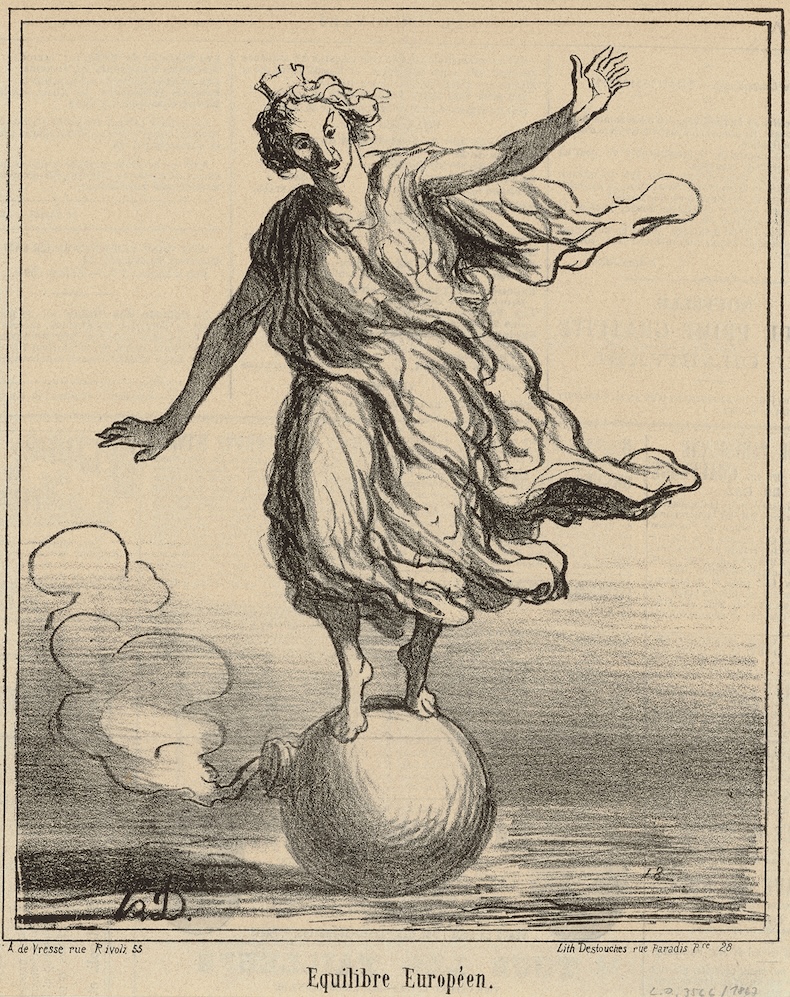
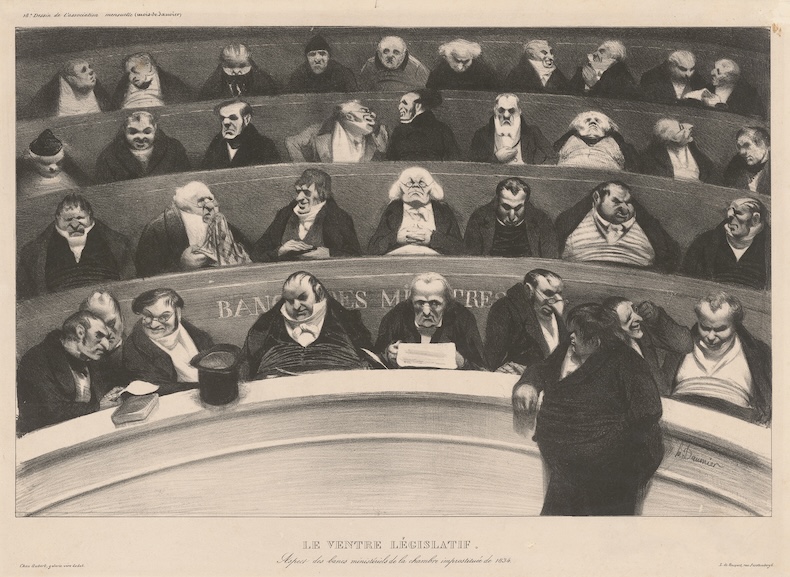
The opening rooms of the exhibition present his lithographs. Selecting from the roughly 4,000 prints Daumier produced in his lifetime is an unenviable curatorial task, yet the curators nimbly find a route here between the shifting tonal registers of Daumier’s crayons. The antic Masks of 1831 (a comic bestiary of grimaces, leers and scowls) hangs not far from the unflinching realism of Rue Transnonain, April 15, 1834 (a depiction of the aftermath of a massacre by government troops). Drawing in most instances directly on to the limestone plate, Daumier exploits the versatility of lithography’s sharp contrasts, the importance the medium gives to the intelligent deployment of negative space and the legibility it gives to the mark of the hand in the rapid strokes of the caricaturist’s crayons – anticipating the en plein air work of the Impressionists by several decades.
Later rooms depart from politics with a capital P to explore other aspects of Daumier’s work. Like Balzac, he was more interested in capturing the ‘great small things’ of everyday urban life than in reproducing lofty classical or religious themes. When he did approach the latter they rarely escaped ridicule – see the sculpture Pygmalion has brought to life stooping to steal her maker’s snuff in an illustration of 1842. He was particularly attracted to cramped urban spaces like packed train carriages, bathhouses, art galleries and theatres, and alive to (if not a little threatened by) new technologies such as photography. As Daumier declared, ‘You have to be a man of your time.’
Although some art historians have followed the artist’s contemporaries in seeking to distinguish his prints from his paintings, often elevating one at the expense of the other, the Albertina’s display allows us to trace the continuities throughout his work. We can see, for instance, how the louche contrapposto of the Ratapoil (Ratskin) caricature gets reprised in the famous Don Quixote paintings.

The most extraordinary painting here is The Thieves and the Ass (1858), based on a fable by La Fontaine in which two thieves argue over a stolen donkey, while a third steals said donkey from them in turn. The dense, rhythmic knot of his impasto wrestlers in the foreground is a wonderful instance of what Michael Fried calls compositional ‘absorption’ in painting – the strategies by which a painter sustains the fiction of the spectator’s absence; yet, ever the trickster, Daumier introduces a theatrical element to his picture to destabilise this absorptive effect. The pencil grid used to compose the work is left partially visible underneath the diluted wash of oil, revealing the construction of the whole composition in a manner that makes Daumier not just ‘a painter of modern life’ but an artist who anticipated our own constructed realities.
‘Honoré Daumier: Mirror of Society’ is at the Albertina Museum, Vienna, until 25 May.