From the May 2026 issue of Apollo.
What societies do with their windows can tell us much about how their denizens approach the condition of seeing and being seen. In Belgium, the Netherlands and parts of Norway, to draw the curtains is to signal that you have something to hide. In Saudi Arabia, the traditional mangour – essentially, a perforated screen – permits the inhabitant of a building an exterior view while simultaneously concealing their domestic affairs from prying eyes. The thought never left my mind as I walked around of Tate Britain’s superb Hurvin Anderson retrospective, hitting me particularly hard when I came across a 20-year-old series of paintings bearing the collective title Welcome. The works in question are nominally representational, their setting unambiguously Caribbean. Most make voyeurs of us. We’re looking from the street, directly into interior spaces: front rooms, walls plastered with nudie pictures, random blocks of primary colour and semi-abstracted alcohol adverts. Nobody’s in, though there might be an electric fan, a couch or a record player.
But this comes at a remove: the scenes within are carved up by bright red lines. In contrast with the precisely rendered interiors we glimpse through them, they seem almost crudely executed. This is less wilful abstraction than faithful mimicry, Anderson’s Hockney-ish way of foregrounding the colourful wrought-iron grilles that cover windows and doors throughout the Caribbean.
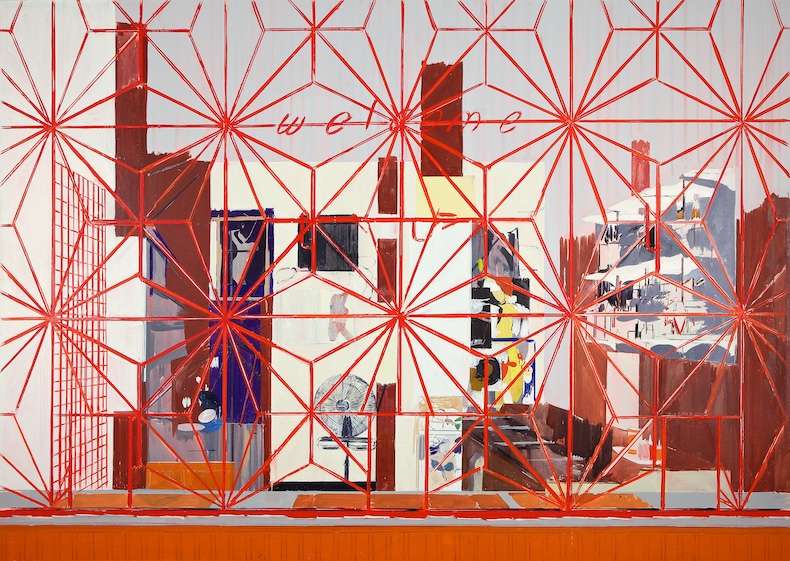
As if disowning an earlier image, the artist renders these metal barriers as a network of thick lines, verticals, diagonals and horizontals which meet in starbursts and fracture the domestic scenes beneath into puzzling mosaics. The Tate’s captions tell us that these structures are strictly exclusionary. Words of greeting are bent into the bars that slice up Welcome: Carib (2005), for instance, but the real message, we’re told, is ‘keep out’.
The dwellings Anderson depicts here are private yet open, visible to all but inaccessible. The grilles shielding could be decorative, or – as the Tate’s captions have it – hostile and exclusionary. There’s a psychological reading to be made, too: Anderson is the eighth and youngest child of parents who moved from Jamaica to Birmingham in the 1960s and the only one to have been born in Britain. He didn’t visit the island until his teens and never felt entirely at home there. ‘I don’t know [Jamaica] and I know it,’ Anderson told the Financial Times in 2021. He was, he says, ‘the English boy in the Jamaican conversation’. Granted, the pictures are based on photographs taken in Trinidad, but might these barriers, at once decorative and functional, stand in for the artist’s first-generation estrangement from the Caribbean?
Identity, however, has never been a problem where Anderson’s art is concerned. He came to painting in his early thirties, when the medium couldn’t have been less fashionable. Working from photographs, he found his niche as a close observer of what might be British art’s least-loved locale: suburban Birmingham. Anderson’s paintings of the late 1990s give us a municipal swimming pool, based on a photo-collage (also on display) and blown up to heroic scale; teens gathered in Handsworth Park, based on a photo he took there in 1980. There are memories here, it’s clear, but Anderson disrupts them with mountainous masses of grey strokes in the distance, ostensibly abstract forms that hint at Turner’s Alpine sublime and Euan Uglow’s tricksy views of the Moroccan Rif.
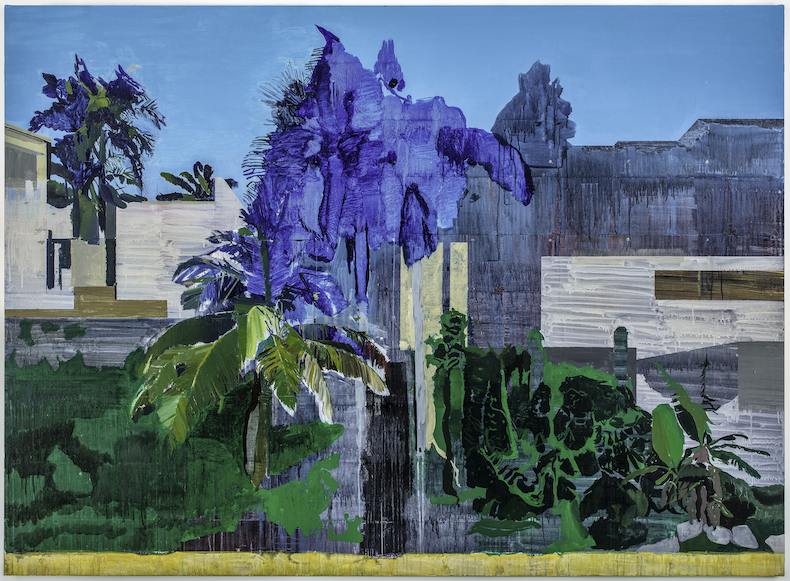
Anderson became ever more confident, riffing on the photographic basis of his work and exposing it in compositions. Grove Lane (2000), another swimming pool scene painted on a vast scale, could easily be taken as an homage to Andreas Gursky’s epic photographic composite Paris, Montparnasse (1993): the pool itself is a turquoise rectangle occupying the bottom quarter of the composition, from which a grid of yellowing concrete shoots skywards. As in Gursky’s picture, it’s pure focus, pushing representation to the point of total abstraction; unlike the German artist, however, Anderson hasn’t been playing around with Photoshop to achieve this. With painting, the work insists, you can show, tell and shock without recourse to digital wizardry.
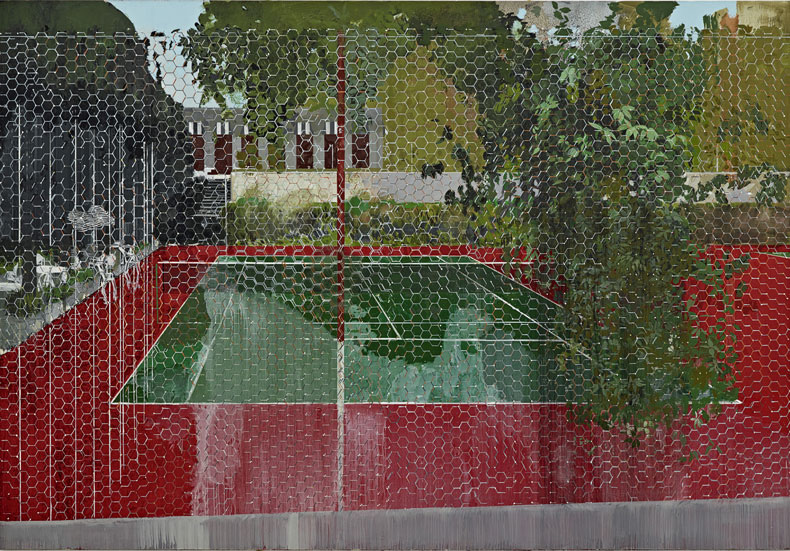
Anderson’s formal touchstone is the grid, a practical aid that he frequently leaves exposed in his paintings. Sometimes, as in the aforementioned ‘Welcome’ series, or in the pictures of Caribbean resorts he made in the late 2000s, he brings it right up to the foreground. Country Club: Chicken Wire (2008) gives us a pristinely maintained tennis court glimpsed through a metal fence, the strands of which repeat in hexagonal forms: lush verisimilitude constrained by forbidding minimalism, like a Stevie Wonder hit drowned out by the strains of Steve Reich.
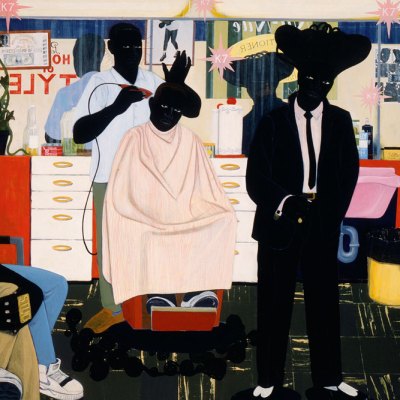
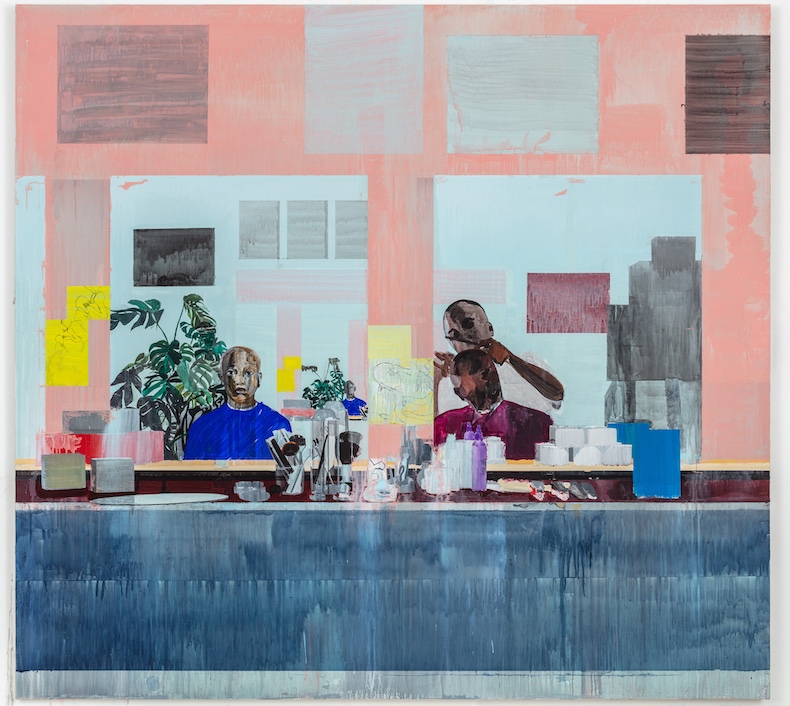
He paints decaying brutalist buildings enveloped in tropical foliage, crowds gathering for Haile Selassie’s arrival in Jamaica in 1966 and, in riposte to both Kerry James Marshall’s De Style (1993) and Manet’s Un bar aux Folies-Bergère (1882), a number of complex scenes set in barbershops. Clients and patrons alike are frequently glimpsed only in mirrors, the walls of the shops plastered with printed matter. Yet where the reference paintings are filled with detail, an Anderson work such as Skiffle (2023–26) renders the flyers and posters taped to the walls as floating abstractions.
Marshall’s work, painted in the wake of the 1992 Los Angeles riots, hinted at a charged narrative. Manet’s pointed to a modernity in which the conventions of realism could finally be shrugged off. Anderson, by contrast, is a cryptic painter. Certainly, there are some obvious biographical references. But why does he paint the supporting structure of a diving board as a great V of turquoise? What is it that connects Jamaica with the West Midlands quite so seamlessly in his art? I’d love to ask him about all those fences, grates and grids: we might sense that Anderson feels shut out; but does he seek to keep us at arm’s length, too?
‘Hurvin Anderson’ is at Tate Britain, London, until 23 August.
From the May 2026 issue of Apollo.