From the May 2026 issue of Apollo.
In 1964, Jasper Johns met Josef Albers, recently retired from teaching at Yale. The two were sitting for a double portrait by the photographer Irving Penn, part of his Close Encounters series. ‘Mr. Albers, I took your colour test. I got all the answers wrong,’ said Johns. ‘That’s wonderful!’ Albers replied. ‘You got a hundred per cent.’ The story is sweet, but odd. For one thing, Albers’ colour course was the opposite of a test. Based on moving around pieces of cut paper, its point was to show students that there was no right or wrong in colour, merely relativity. For another, the thirtysomething American’s work seemed to have nothing to do with the seventysomething German’s. That was rather the point: Penn had a taste in his portraits for unlikely pairings. Johns had made the first of his famous, proto-Pop Target paintings in 1955, at a time when Albers was five years into his resolutely abstract, endlessly refined series, Homage to the Square. What could the two artists possibly have to talk about?
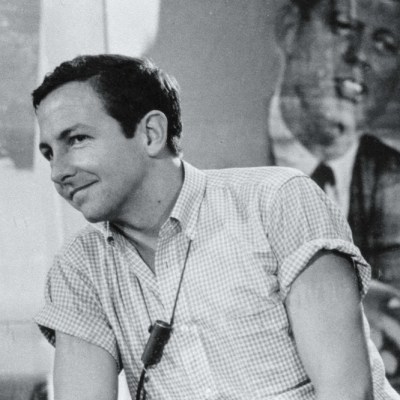
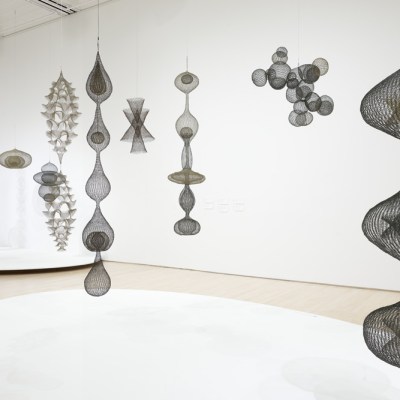
It is a question to ponder as you walk around ‘Night Driver’, the Guggenheim Bilbao’s show of Johns’s work this summer. One obvious subject might have been Robert Rauschenberg – Albers’ former student and, by 1964, Johns’s former lover. Together, Johns and Rauschenberg helped forge a new movement in post-war American art, one that might never have coalesced without the influence of figures such as Albers. In 1948, Rauschenberg had signed on at Black Mountain College in North Carolina, in what was to be Albers’ last year teaching at the school before leaving for Yale. (Among his other students had been Ruth Asawa, subject of this year’s Guggenheim Bilbao spring show.) Albers’ well-known dictum about his teaching was that it was intended ‘to make open the eyes’. It certainly opened Rauschenberg’s. Among the visitors invited to the school by Albers during the young Texan’s time there were the composer John Cage and choreographer Merce Cunningham, lovers as well as artistic collaborators. Rauschenberg had arrived at Black Mountain, apparently heterosexual, with his fiancée, Susan Weil. The pair married in 1950 and divorced in 1953. That year, Rauschenberg met Johns, five years his junior. Their relationship lasted until 1961.
This is a matter of more than prurient interest. In the decade that followed the Second World War, American art had been dominated by Abstract Expressionism. This was hugely influenced by the wartime influx to New York of Surrealists fleeing the German occupation of France, an influence that was subsequently denied. Critics, including Clement Greenberg, set about defining Abstract Expressionism as uniquely and exclusively American.
Abstract Expressionism was self-consciously non-European, or even hostile to European traditions. It was manly and rugged where European art was effete, a stance embodied by the brawling, hard-drinking Jackson Pollock. A notorious upshot of this dual chauvinism was that women were written out of the history of post-war American painting. It would be half a century before artists such as Lee Krasner and Grace Hartigan were included in museum shows of Abstract Expressionism. If the manly stranglehold on the movement was to be broken, in those misogynist days it would have to be done by men. With historical irony, many of these were gay: Cy Twombly, Andy Warhol, Ellsworth Kelly, Cage and Cunningham, and Johns and Rauschenberg among them. Where Abstract Expressionists stuck to painting, these new artists worked across disciplines, integrating the plastic arts with dance and music. It was a European inheritance, via the Bauhaus and Dada.
Given this history, Johns’s meeting with Albers seems less incongruous. Albers may have been heterosexual, but his years at the Bauhaus had left him broad-minded. It was this that had led to his inviting Cunningham and Cage to Black Mountain, opening Rauschenberg’s eyes to the idea of a partnership with another man that was both artistic and romantic. What’s more, Albers was European, and thus by Greenbergian definition un-American. This same quality also explained Johns’s admiration of Marcel Duchamp, who he first met in 1960 and whose Le Grand Verre he would use in his sets for Cunningham’s performance Walkaround Time in 1968. Dance would continue to play a part in Johns’s work, notably in the form of Dancers on a Plane (1980–01).
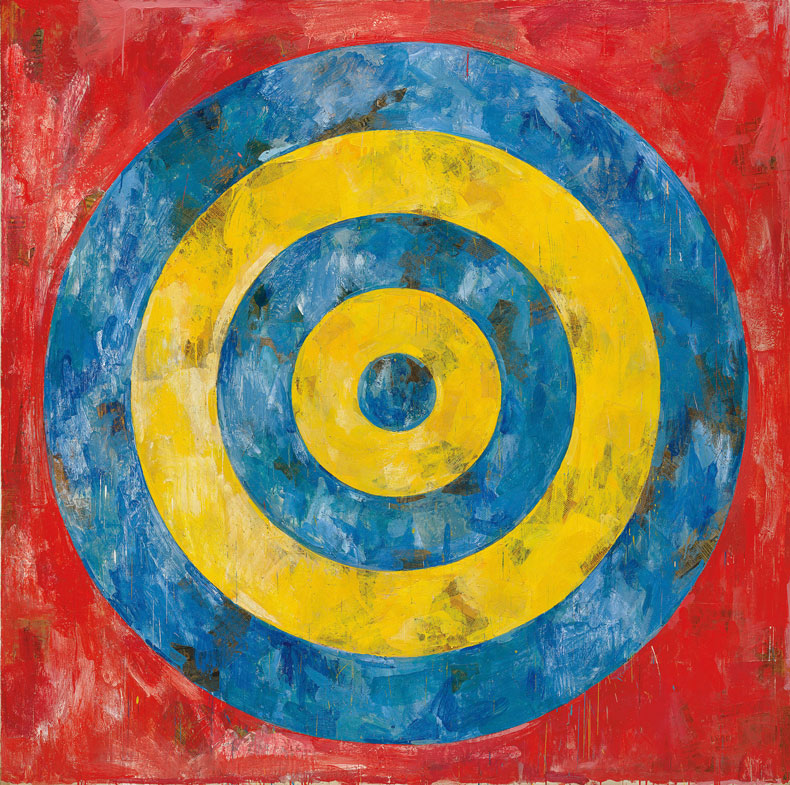
How did all this shape Johns’s painting? It would be wrong to imagine the young Georgian as a gay caped crusader: in homophobic 1950s America, that would have been impossible, not to mention illegal. Instead, he made an art of inscrutability. If, pace the Surrealists, artists such as Pollock had emptied their subconscious unmediated on to canvas, Johns would create an alphabet of what he called ‘things the mind already knows’ – objects and symbols so deeply ingrained in the visual memory that they had ceased to be personal and become universal: numbers, letters, targets, flags. His work was the opposite of spontaneous. Despite the quotidian nature of his subjects, he would be a painterly painter – more so than Rauschenberg, whose art was driven by randomness and chance.
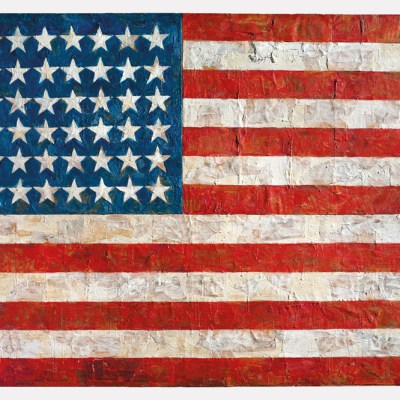
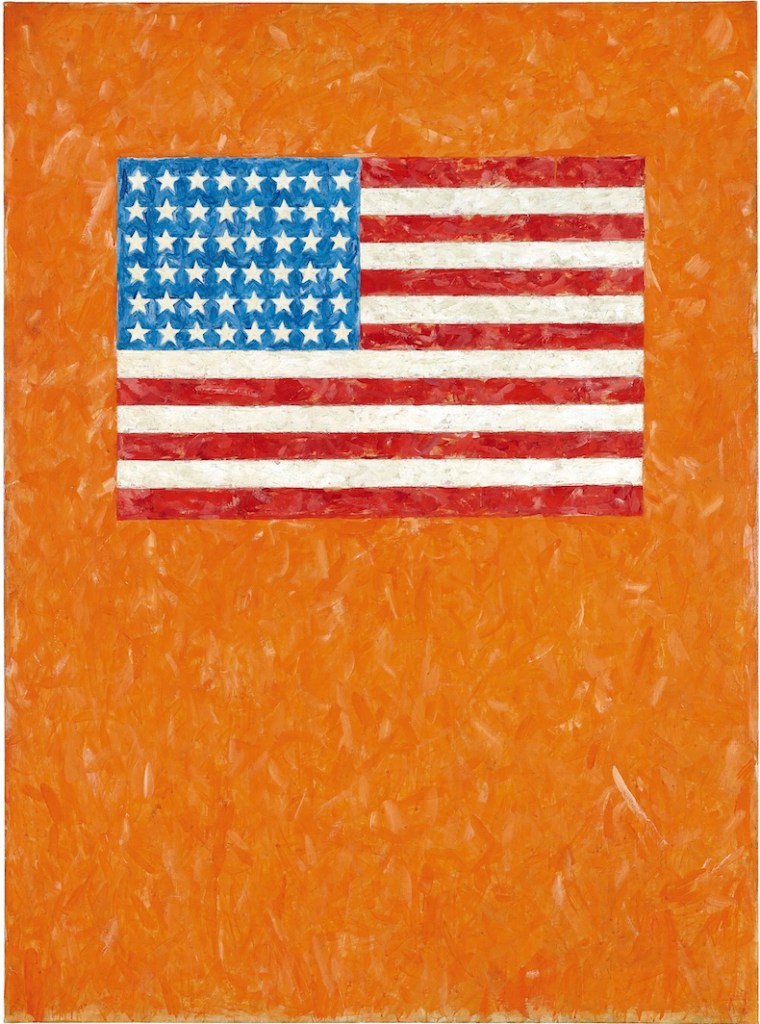
Take, for example, Johns’s Flag on Orange Field (1957). He had painted his first Flag in 1954, after being discharged from the US Army. Like that picture, this later one is made in encaustic, hot beeswax infused with pigment. It was, intentionally, a difficult medium, calling for laborious preparation and deft use, the opposite of Abstract Expressionist paint-flinging. The quick-drying nature of encaustic ‘froze [what I painted] into permanent presence’, Johns said. Its translucence also allowed him to paint in veiled layers, which he saw as helpful in ‘hid[ing] my personality, my psychological state, my emotions’. Flags, like targets, were manly, readable, in-your-face. Johns made them illegible; in the closet, even.
It is more than 70 years since that first Flag. Rauschenberg died in 2008; Johns, who turns 96 this month, is the sole survivor of the artists listed above, still working in his studio in upstate Connecticut. He is often described as the godfather of Pop – Warhol’s Dollar Sign paintings spring to mind – although this tends to occlude his role as godfather to himself. Even if Johns thought he flunked Albers’ colour test, Albers would absolutely have understood the tonal games of Flag on Orange Field, the way its colour interactions defamiliarise the familiar. So, too, Johns’s practice of working in series. The lifetime since Flag has seen a change in social attitudes, but Johns’s art remains imbued with a subtlety learned in the ’50s. His subjects may have moved on – to Numbers and Crosshatch in the 1970s and ’80s– but what remains is an ability to puzzle. Just when you think you’ve got Jasper Johns, his work slips away.
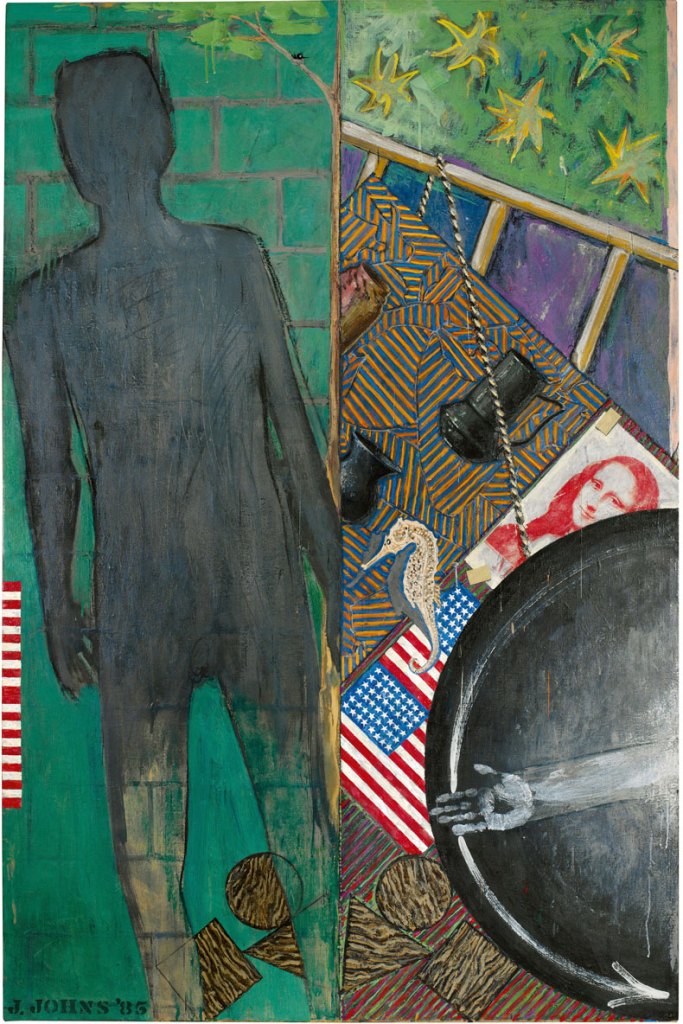
Thus his Seasons series of the late 1980s. The encaustic Summer (1985) fades, a year later, into Fall, which now incorporates Duchampian found objects – wire coat hangers, metal numbers. Johns also paints himself into the picture by means of surreptitious self-reference: Summer includes Fourth of July flags, while both paintings employ rounded forms that read as targets. By now, Johns had given up on keeping himself out of his paintings. As a coming out, it was characteristically discreet.
Johns’s first exhibition was in New York in 1958. According to legend, typically neither confirmed nor denied, the gallerist Leo Castelli had come to visit Robert Rauschenberg in his Lower Manhattan studio. By mistake, he walked into Johns’s studio on the floor below. Castelli was astonished by the flags and targets, the ‘years of work never before exhibited’. He instantly offered the young unknown an exhibition. Like Castelli, the historian and critic Robert Rosenblum recognised the quality of the work in the show, ‘the elegant craftsmanship […] which lends these pictures the added poignancy of a beloved, handmade transcription of unloved, machine-made images’. The images may have changed, but the elegance never has.
‘Jasper Johns: Night Driver’ is at the Guggenheim Bilbao from 29 May–12 October.
From the May 2026 issue of Apollo.