From the May 2026 issue of Apollo.
A glasshouse and an art gallery are not that different,’ Abbas Akhavan tells me, seated in a colleague’s studio in Berlin some weeks before the opening of the Venice Biennale. ‘They’re both temperature-controlled environments in which precious goods are kept alive. They’re ideological spaces of reverence, sanctity, contemplation. I see interesting parallels. I think they’re utopic models of life on Earth.’
This is not an airy critical position. Akhavan speaks of botanic gardens with the passion other artists afford museums. A devotee of Kew Gardens, he despairs of visitors more interested in selfies than charismatic megaflora. His specific area of interest is the flamboyant intersection of nature and culture – in gardens, agriculture and designed landscapes – and the delicate balance involved in maintaining it.
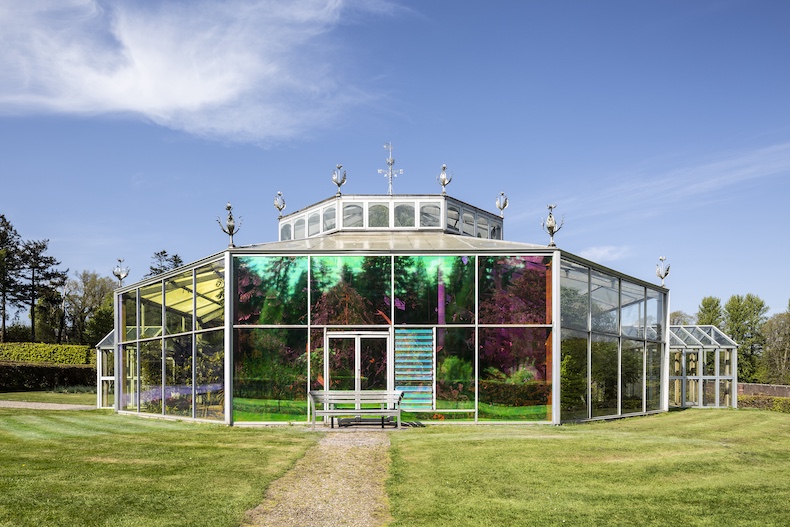
In previous exhibitions, Akhavan has created installations that push venues to the edge, importing the dampness of the glasshouse to the interior of an otherwise moisture-averse gallery. In study for a garden in 2012, he took over a building adjacent to London’s Delfina Foundation, installed a sizeable hedge in a cedarwood planter and soaked one of the rooms with a garden water-sprinkler. Throughout his exhibition at the Museum Villa Stuck in Munich in 2017, the temperature control system was turned off and windows left open. The fragility of the building itself was implied through paint applied on the walls and ceiling to resemble extensive smoke damage.
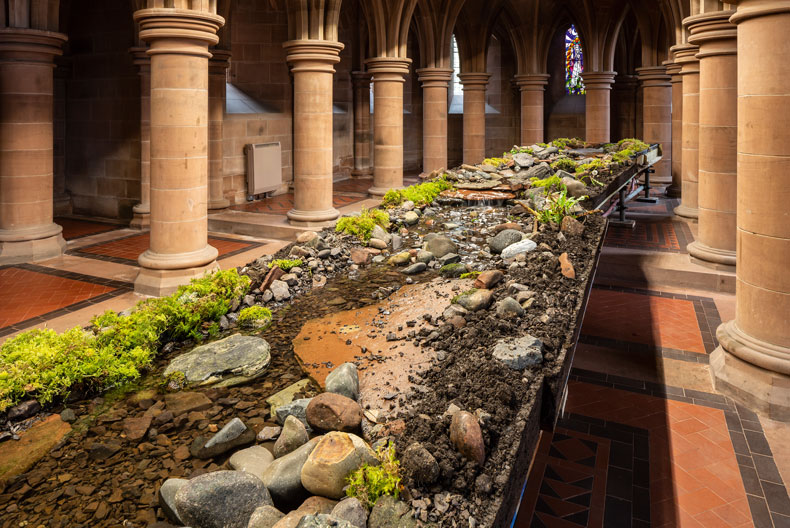
Akhavan’s art sometimes resembles conjury (‘the origins of art have something to do with magic, whether it’s religious or pagan,’ he reminds me). In 2022 he installed a clear running stream, beautifully planted with local species, in the crypt of Mount Stuart House on the Isle of Bute. The work was titled variations on a folly – instead of a fanciful structure in a landscape, Akhavan’s folly was a fanciful landscape in a structure.
The precarious lagoon of Venice feels like fertile ground for this environmentally attentive artist and, true to form, he plans to invite the canals into the Canadian Pavilion, albeit in mediated form. ‘Venice is also a swamp,’ he says, describing its ‘amphibian qualities’ and the emblems of mermaids and sirens that populate its iconography. Wedged between the overbearing imperial heft of the British and German pavilions in the Giardini, Canada’s building is an airy modernist structure built in 1958. A tree runs through its centre – a gesture Akhavan feels is ‘more sentimental than ecological’, but nevertheless one that invites the outside in. At the heart of his installation is a pond, a carefully controlled habitat for botanic royalty: a specimen of the giant water lily species Victoria amazonica, propagated at the botanic gardens in Padua from seeds donated by Kew Gardens.
The circular leaves of Victoria amazonica can grow to more than two metres in diameter. With their upturned rim and geometrically patterned surface, they have an unreal, futuristic quality but are, in fact, ancient. ‘They’re dinosaurs,’ Akhavan says. ‘Their genome goes back 100 million years.’ Part of the reason for the plant’s survival is its sturdy construction: the fleshy petals of its hermaphroditic flowers are strong enough to trap the beetles it depends on for pollination in the wild. It’s also well-armed: both leaves and flowers carry formidable spikes. ‘It’s an incredibly territorial plant. As the leaf opens up, it drags down every life force with it, so that nothing can breathe. And then the objective is that it covers enough of the water surface that nothing grows underneath,’ the artist explains. ‘It wants to live.’
When first invited to show in the Canadian Pavilion, Akhavan started thinking about the origins of the Biennale, its relationship to World’s Fairs, and their roots, in turn, in the Great Exhibition of 1851: a showcase for the British Empire and industry. A botanist working for the British government encountered Victoria amazonica in Guyana in 1837, the first year of Queen Victoria’s reign, and the species was named in her honour. News of the spectacular plant spread across the popular press, shifting newspapers as fast as the latest instalment of The Pickwick Papers (1837), but it wasn’t successfully grown in Britain until 1849. Joseph Paxton, architect of the Crystal Palace built to house the Great Exhibition, was also the head gardener at Chatsworth House. The first botanist to persuade the plant to flower in Britain, he is said to have based the lattice design of the Crystal Palace glasshouse on the ribbed geometry of the underside of a Victoria amazonica leaf. The plants themselves occupied a central position in the exhibition: testament not only to the wonders of nature but also to the expertise of Victorian gardeners.
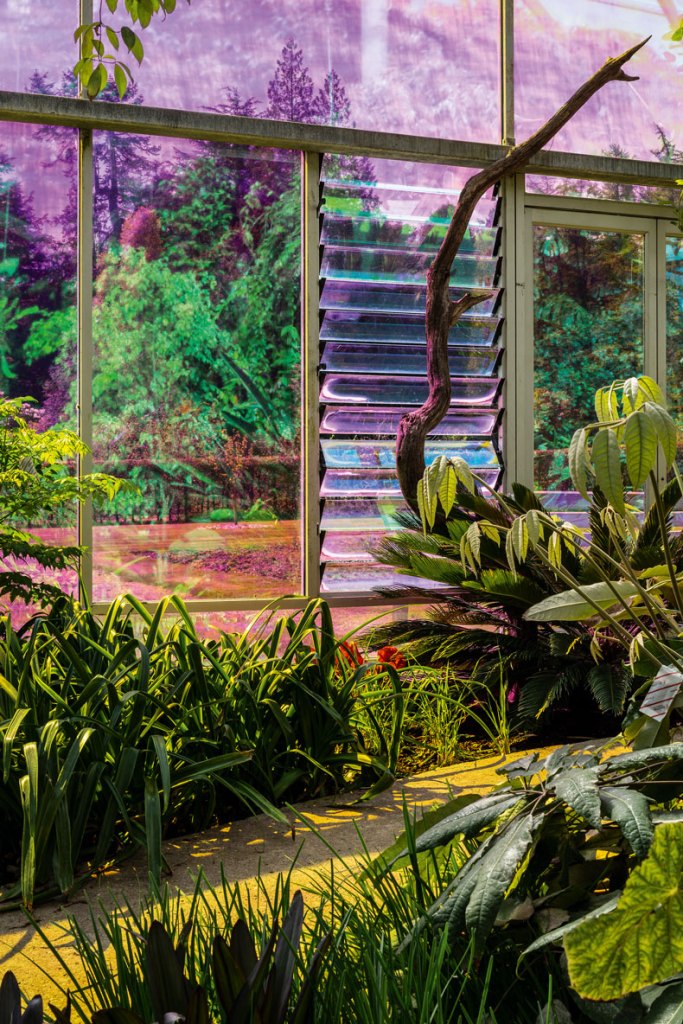
In Venice, the architecture of the Canadian pavilion is being modified with additional glass panels, turning it into an enlarged ‘Wardian case’: a 19th-century terrarium that allowed botanists to keep plant specimens alive during long sea voyages. Akhavan imagines greenhouses as teleportation devices through which visitors to a botanical garden might be transported to the Amazon rainforest. Here instead he is constructing a portal between Venice and Kew Gardens while the original waterlily house is shut for the year. Like Venice itself, the pond is a stage in which drama is invited to unfold.
The life cycle of the Victoria amazonica extends from March to November, which matches the duration of the Biennale. This is great news for anyone visiting in high summer, when the plant will be at its zenith, but is a source of some stress for Akhavan in advance of the opening: ‘It’s the nature of working with these kinds of materials that you have a limited amount of control.’ If the lilies’ growth cycle is unusually slow, ‘it might be a very sheepish-looking project’ at the time of the vernissage in early May.
If Akhavan’s lily-pond is not a straightforward homage to Victorian botany, neither can it be reduced to a simple critique of the colonial urge to name, catalogue and control the natural world. Forming the centrepiece of an exhibition that includes works created in situ from local materials, as well as bronze shipped from Canada (details of which the artist was not able to share ahead of the opening), it raises questions about the fuzzy border between nature and artifice and the hard distinction made in the European tradition between art and artefact. This distinction is not culturally universal. In China, evocative rock formations (gongshi) are displayed on plinths as naturally occurring sculptures with status equal to those created by artists. This tradition has in turn informed modernist artists, notably Isamu Noguchi, who incorporated unworked riverbed rocks into his work. Shown in isolation in the Canadian pavilion, the Victoria amazonica is displayed as ‘a kind of a specimen, the way you would show a bronze sculpture’, Akhavan says. Within the stagey artificial environment of its pond, tended by a resident botanist, it shares top billing with the artist’s sculptures.
A handful of times over the course of our conversation, Akhavan alludes to his age – he was born in Tehran in 1977 and turns 50 next year. Since 2007 his life has been more or less nomadic, pitching from one residency to another (currently his CV lists 22 residencies over 19 years, scattered across the world from Colombia to the UAE). He has no fixed studio, instead travelling wherever invitation and opportunity carries him, like a waterborne seed at the mercy of ocean currents. ‘I always moved as a kid,’ he recalls. ‘Then once we moved to Canada, I lived in Windsor, Ontario, then London, Ontario, then Victoria. On my own, I took off to Montreal, Vancouver, Toronto, San Francisco and now Berlin.’ Living in Europe has suited him during work on the Venice presentation, but in conversation, this artist who feels so strongly connected to the botanical world betrays an unmistakable yearning for an existence that is more, well, rooted. He talks with envious wonder of watching a neighbourhood gardener in Berlin expertly prune and shape his rosebushes.
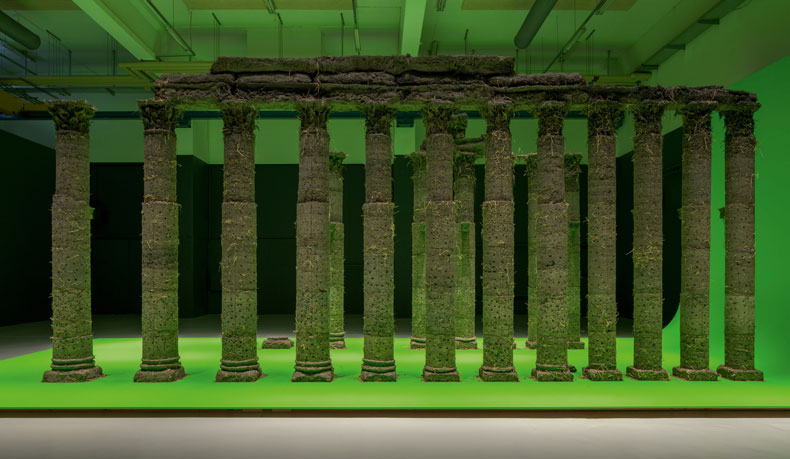
Partly as a result of moving around so much, Akhavan has developed an exhibition style based on ephemerality. He builds large structures from organic materials that can be broken down after the show. For an exhibition at Chisenhale Gallery in London in 2021, he reconstructed a 2,000-year-old colonnade from Palmyra that had been destroyed by Islamic State militants in 2015. Akhavan’s structure was made from cob – an ancient building material blended from clay soil, sand, straw and water.

Variations on Ghost (2017), a pair of vast lion’s feet based on a monumental Assyrian sculpture of a Lamassu (a protective deity) was formed of rammed earth. Like cob, this is a material that can be absorbed back into the soil – an anti-monumental gesture that here spoke of transience, humility and the desire to tread lightly. By the end of the Biennale, the Victoria amazonica will have completed its annual cycle, producing seeds that will be passed to the botanic garden of Padua, a species to add to their collection, by way of thanks.
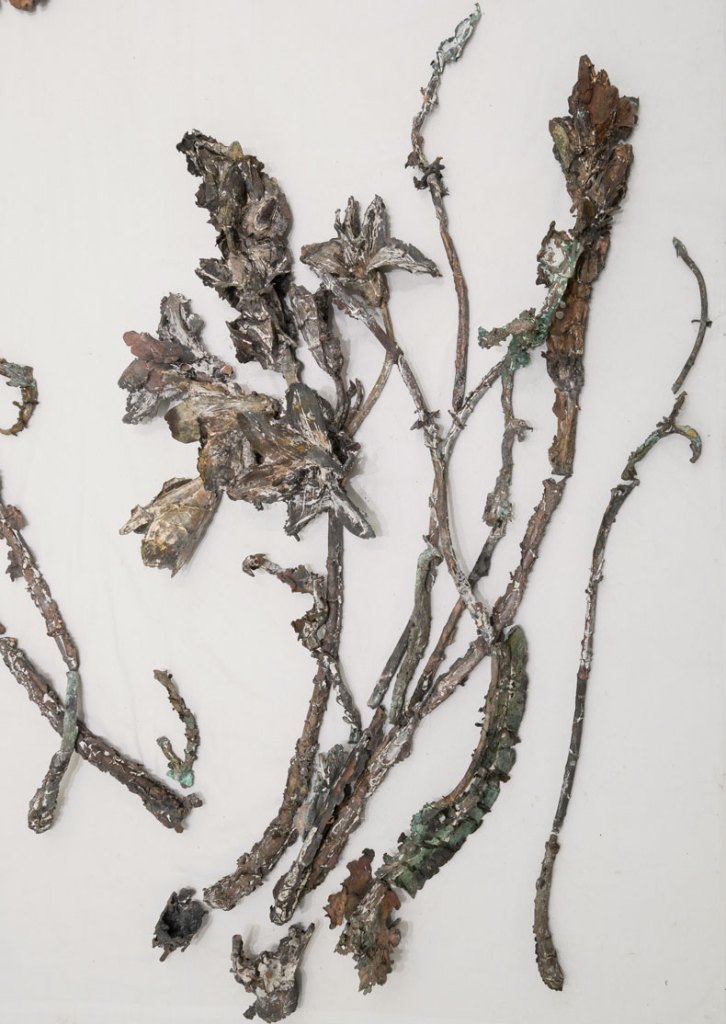
One of Akhavan’s few works constructed to communicate weighty permanence is the ongoing series Study for a Monument (2013–), for which bronze casts of plants enlarged to the scale of human bodies are displayed on clean white sheets. So far, the plant species have all been indigenous to Mesopotamia, the area between the Tigris and the Euphrates – roughly equivalent to modern-day Iraq, and part of the ‘fertile crescent’ in which the first cities and written language appeared thousands of years ago. These are plants that have coexisted with human civilisation since the Bronze Age – an era defined by its use of metal for, among other things, weaponry – that are now vulnerable to the environmental damage caused by pollution, climate change, industry and conflict. Ecocide is a weapon of war and Akhavan’s evolving monument points to the potentially irreversible impact of habitat and species loss that accompanies modern conflict. Rather than being glorified and elevated on a plinth, these bronzes are laid on the floor like bodies awaiting identification.
In constructing his exhibition, Akhavan describes bringing together ‘different kinds of works to create a web of characters that have something in common’, even if their material language is very different. That might include living plants, an architectural intervention, the bronzes of Study for a Monument and the reconstruction of archaeological fragments: objects that all speak in their own way of fragility, mutability, impermanence and interdependence. The Biennale can be a shouting match, with artists vying to outdo one another in spectacle, bombast, grand claims and moralising pronouncements. This is not Akhavan’s game; if anything, he is suspicious of grandeur, and finds the suggestion that art has the capacity for salvation preposterous. ‘Artists just tell the stories of their times. They don’t save the world,’ he says. ‘Often art and artists are held to certain standards that we don’t apply to politicians, priests or mayors. Do you ask a banker if banking can save the world? It seems like we’re asking the wrong kinds of questions of art and artists.’
Among my ‘wrong kinds of question’, I ask Akhavan whether he’s interested in non-human ways of thinking: he counters that we should be thinking more about human ways of thinking and the effect of rapidly transforming technology on our brains. There is a connection between AI and our casually destructive relationship with the environment, not only through the vast resources the technology consumes, but in the distance that it drives between its users and the ‘real’ world of facts and physical objects. Akhavan’s work exists on a different timescale to the Biennale’s overstimulating abundance of digital works: the timescale of a growing plant, of an ancient species, of the rise and fall of civilisations. Working with organic materials such as cob or living plants including the Victoria amazonica reminds him that we have ‘an instinctual and therapeutic relationship of sustenance and joy with what comes from this planet’. It is not the offer of a quick fix, but of a slow moment of re-enchantment.

Abbas Akhavan is representing Canada at the Venice Biennale from 9 May–22 November, commissioned by the National Gallery of Canada.
From the May 2026 issue of Apollo.