From the May 2026 issue of Apollo.
No one was killed when Sicily’s Mount Etna exploded into life in March 1669. Nevertheless, by burning its way through forests, entombing swathes of fertile farmland, bulldozing eight towns and 24 villages, and even scaling Catania’s city wall, the lava from the eruption devastated the lives and livelihoods of thousands of people. Etna may be one of the most active volcanos in the world, but never before or since in recorded history has she punished her region’s inhabitants so brutally.
There are many first-hand accounts of what would soon become known as the year of the great ‘ruin’. One of the most vivid came from a group of English merchants who said they had seen neither sun nor stars for 54 days, been deafened by the volcano’s incessant roar and witnessed a pillar of ash rising from it ‘which exceeded twice the bigness of Paul’s Steeple in London’.
Although many artists recorded the 122-day eruption, Giacinto Platania’s fresco in Catania’s cathedral is my favourite depiction. Commissioned by the Bishop of Catania in 1675 and tucked away in the shadowy sacristy, the bird’s-eye view encapsulates the essence of a landscape where underground can become overground at any moment. Platania paints blood-red skies and ominous clouds above lava belching from a cone low on the volcano’s flank, then flowing across luscious agricultural land, villages and elegant villas before reaching Catania and the coast. Outside the city walls, nothing is left standing in its wake but a solitary church tower.
The fresco is a fascinating impression of Catania before it was razed to the ground by the earthquake of 1693, the most severe Sicily has ever known. Although the jumble of narrow streets and medieval houses are nothing like the city today, two landmarks are instantly recognisable. Castello Ursino, the 13th-century castle, is the first, and the other is the vast Benedictine monastery at the north-west corner, where the fresco shows lava spilling over the city wall.
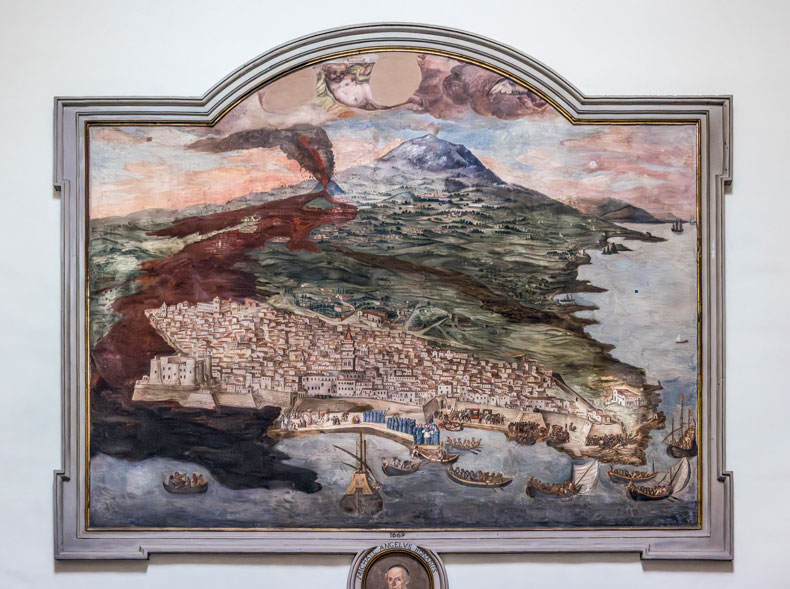
Platania, born and bred on the coast where Etna meets the sea, was one of the most celebrated local artists of his day. Everything about his fresco, from the topography of the landscape to the path of the lava, is strictly accurate. After its incursion into the monastery’s precincts, it diverts around the city walls, through the moat surrounding Castello Ursino, where the solidified lava flow can still be seen today, and into the sea. Its sheer quantity extends the coastline out into the waves, making a nonsense of the castle as a seafront fortification by relocating it a kilometre inland.
Platania shows his patron, the bishop, about to board a boat. Behind him monks and nuns wait patiently to make their own escape. A more chaotic evacuation is underway on the adjoining quay, with people slinging their possessions and themselves into overloaded boats, carriages and even a sedan chair.
That Platania’s painting should tally exactly with first-hand accounts of the eruption is no surprise, for as well as witnessing the devastation, he was involved in the first ever attempt to divert the course of lava from one of Etna’s eruptions. This was radical in 1669, when those living around the volcano still accepted her outpourings as well-deserved punishments from God. But now none other than a local priest gathered Platania and a few others to help in a courageous attempt to re-route lava making a beeline for Catania. They swathed themselves in sodden animal skins before climbing up to the flow. Then they worked for hour upon hour in blinding heat, attacking the flow’s eastern side with pickaxes and sledgehammers until they had carved a new channel. Released from its old course, the lava flowed into it with such force that they were almost overrun and burnt alive. A contemporary account reported that Catania would have been saved by their bravery, had it not been for the arrival of hundreds of armed men from the nearby village of Paternò, convinced the redirected lava would demolish their homes. Outnumbered, Platania, the priest and their gang had no choice but to run for their lives.
All this experience is encapsulated in the fresco hidden away on the shady wall of the sacristy. I urge you to seek out the keeper of the key to the door and relive the tumultuous experiences of 1669 for yourself.
From the May 2026 issue of Apollo.