From the May 2026 issue of Apollo.
The 500th anniversary of Raphael’s death in 2020 was marked with major exhibitions in Rome and London, both of which were unapologetic about taking a squarely traditional approach to an artist at the heart of the Western canon. The Met’s new exhibition, ‘Raphael: Sublime Poetry’, may be outgunned by those European shows in terms of high-calibre paintings, but it discovers fresh ways to tell the artist’s story by giving prominence to Raphael’s exquisite drawings – and by highlighting the influence of women wherever possible.
Few visitors will have the stamina to study even half of the drawings on view. But it does mean that we get a near comprehensive view of the artist’s 20-year career, allowing us to imagine Raphael encountering Leonardo’s designs for the lost Battle of Anghiari fresco and the jolt he felt upon seeing Michelangelo’s ceiling for the Sistine Chapel. The drawings show that this upstart from Urbino not only emulated that look of his predecessors’ paintings but also adopted their materials and methods for preparatory work.
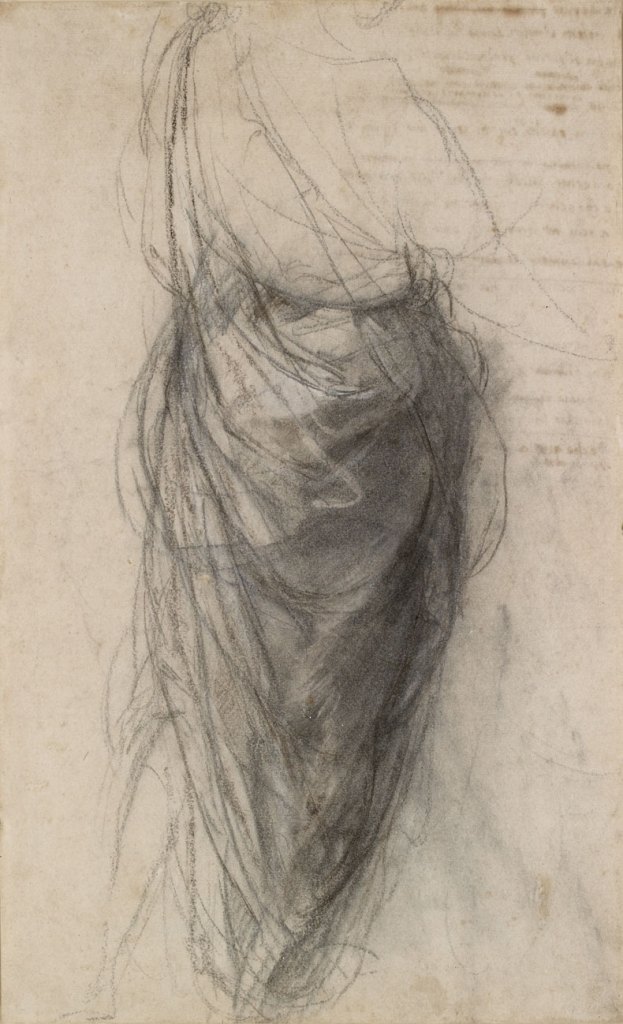
The show begins with the presumed self-portrait from the Ashmolean Museum (c. 1500), wrought in the elegant yet depthless Umbrian style on which he cut his teeth. After meeting Leonardo in Florence when he was in his early twenties, Raphael immediately took inspiration from the older artist. There are several febrile ink sketches here from 1505 in which cartoonish variations on a pose overlap. When the eye moves between them, the tiny images seem to vibrate and come to life, mimicking the kind of compositions preferred by Leonardo: dense, complex scenes composed of multiple interlocking bodies. Raphael’s mastery of this type of composition can be appreciated in his balletic arrangement of mourners in the Baglioni Altarpiece of 1507.
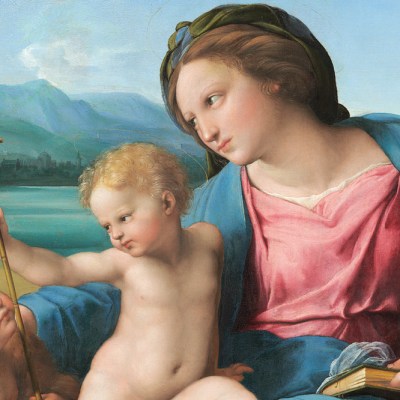
A large cartoon for the Belle Jardinière from about 1507 evinces another takeaway from Leonardo: the way in which vaporous darkness can evoke atmosphere. But Raphael was not fully committed to Leonardo’s sfumato: the resplendent Alba Madonna (c. 1509–11) reverts to luminous forms and pure hues, which, along with the fanning legs and strong, active arms of the central figure, point to Raphael’s admiration of Michelangelo’s Doni Tondo of c. 1505–06.
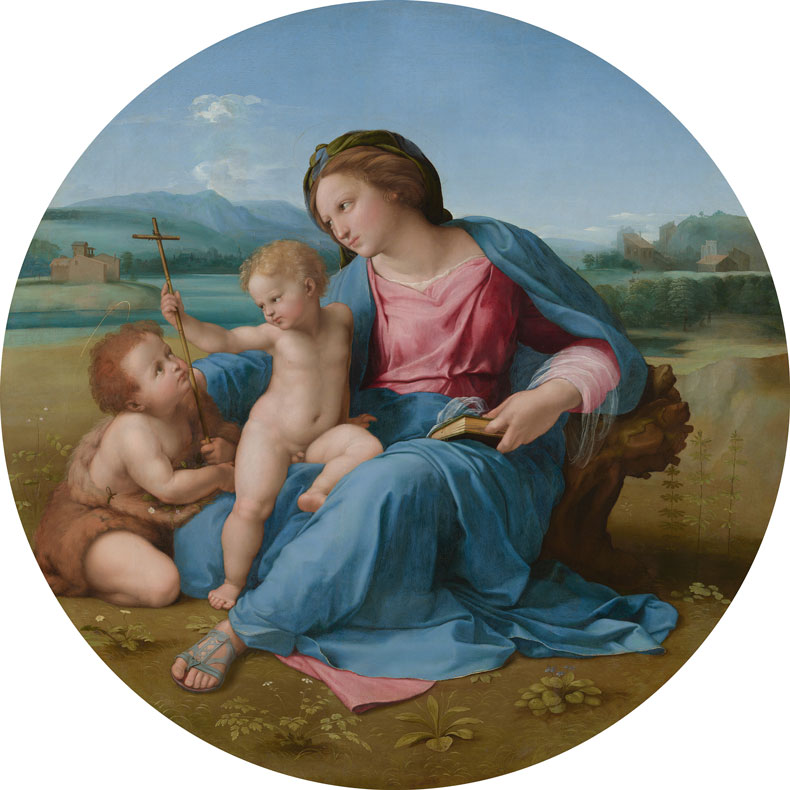
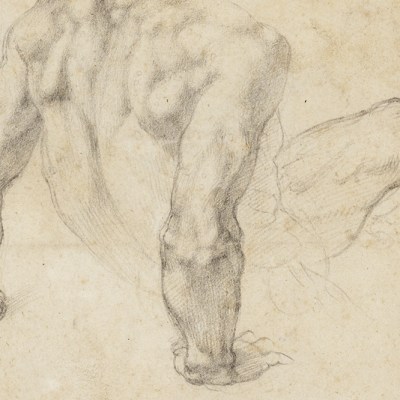
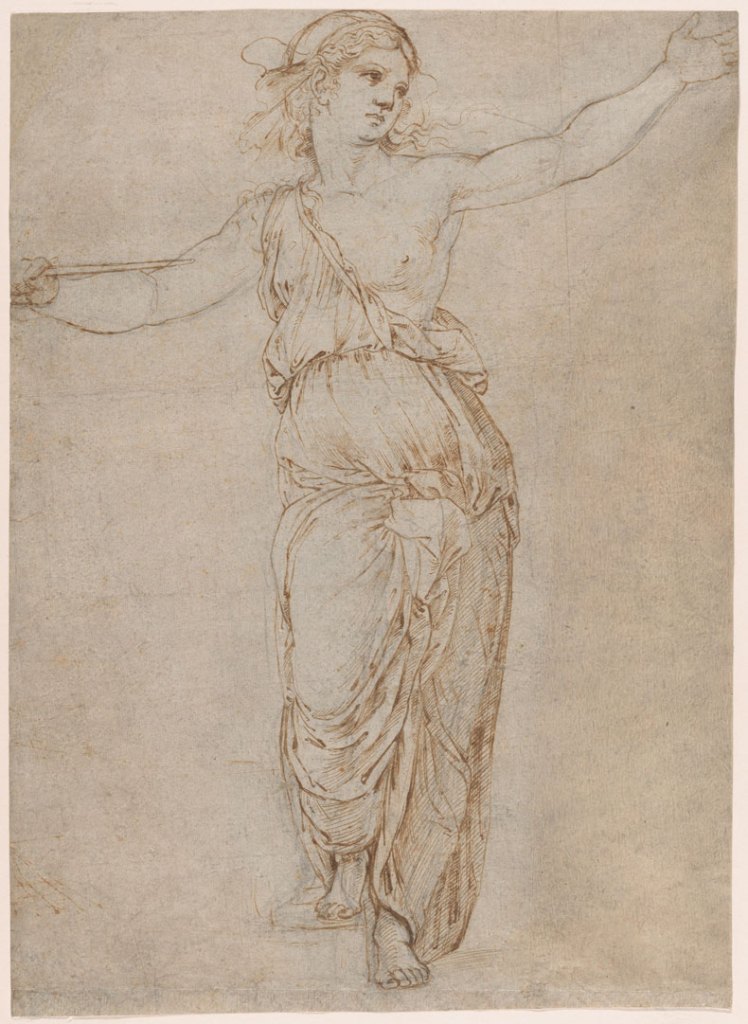
The red chalk studies of nudes that Raphael produced in his Roman period, which began in 1508, show his debt to Michelangelo’s discovery of the expressive potential of the human anatomy. Michelangelo had relied exclusively on nude male models, just as we see Raphael doing in studies for a Seated Virgin from c. 1502–03 and for the Virgin in the Alba Madonna. However, during Raphael’s later years, he began to study the motions of nude female models to capture a more feminine register of experience and emotion. This can be seen in his studies from c. 1517–19 for a kneeling woman, which were probably preparatory sketches for the Villa Farnesina frescoes, designed by Raphael and painted by a group of artists.
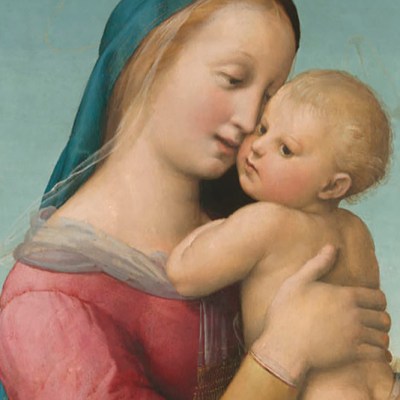
Raphael’s use of female models in Rome is just one manifestation of his interest in women and we should be grateful to Carmen C. Bambach, author of the catalogue and one of the curators of the exhibition, for digging out the scattered references to women in the scholarship on the artist. Occasionally, though, the foregrounding of the feminine viewpoint in the exhibition is misplaced, as when the topic of obstetrics and the death of Raphael’s mother during childbirth are brought up in the context of several devotional images of the Virgin and Child, as if to imply a connection between his childhood memories and his stylistic tenderness. Since many artists and patrons of this era would have experienced the loss of a mother, sister, wife or daughter, maternal mortality alone doesn’t explain Raphael’s particular psyche, let alone the popularity of Virgin and Child paintings in the Renaissance. Clearly, the circumstances of motherhood were but one of many concerns sought by the faithful of both sexes who prayed before these images, a point driven home by Bambach’s theory that the Alba Madonna was commissioned by ‘an ecclesiastic of elevated rank and erudition, perhaps [Pope] Julius II’. Indeed, if the crude illustration of the female reproductive anatomy we see in Johannes de Ketham’s Fasciculus medicinae drawings has a proper place anywhere in this exhibition, it is not near the Virgin and Child paintings, but rather near the aforementioned studies for the Villa Farnesina frescoes, as a reminder of how rare skilled images of the nude female body were at this time and how remarkable it is that Raphael went to the trouble and expense of hiring female models.
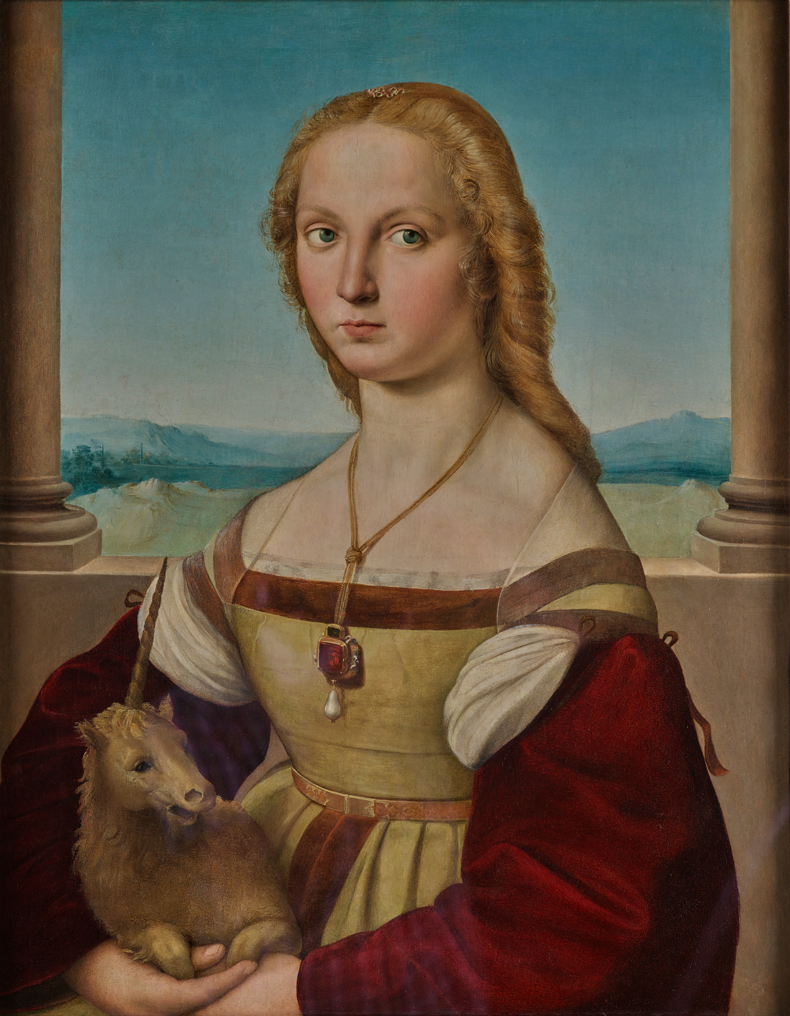
This begs the question of why he made the switch. Borrowing from Leonardo’s theory of the moti, in which the motions of the body and mind were linked, one might argue that knowledge of a woman’s body was vital to the depiction of feminine emotions, which were seen as necessarily different from men’s. Women were the focus of some of Raphael’s most harrowing images of human suffering, many of which were turned into prints and widely circulated by Marcantonio Raimondi in the 1510s, such as The Death of Lucretia (c. 1510–12); The Massacre of the Innocents (c. 1510–12) and Il morbetto (c. 1515–18).
If Raphael was interested in women, they were interested in him too. Women such as Leandra degli Oddi, Atalanta Baglioni and the Poor Clares of Monteluce supported his career long before papal commissions brought him wealth. Remarkably, it was a woman, Giovanna Feltria della Rovere, who was the first person to credit him with artistic imagination when he was only 21; she also helped in his move to Florence, the city that was central to his intellectual and artistic growth. Whereas Michelangelo, according to the 16th-century artist and essayist Francisco de Hollanda, disdained the taste of ‘women and priests’, Raphael seems to have cultivated their appreciation of his art as well as of his person. If Vasari is right that Raphael’s death at the age of 37 was a result of ‘eccessi amorosi’, then it is a cruel irony that women were also his downfall.
‘Raphael: Sublime Poetry’ is at the Metropolitan Museum of Art, New York, until 28 June.
From the May 2026 issue of Apollo.