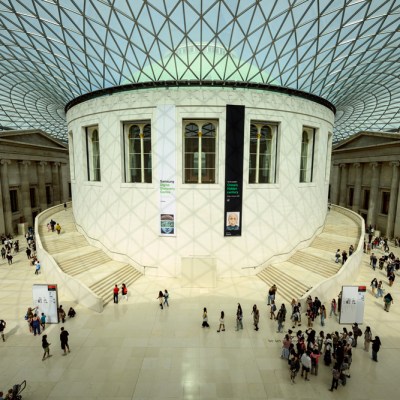
The Danish antiques dealer Ittai Gradel has died of cancer at the age of 61. It was Gradel who, in 2021, first alerted the British Museum to the possibility that gems from its collection were being sold on eBay. He wrote first to the museum’s deputy director (Jonathan Williams), then its director (Hartwig Fischer) and, finally, its chair of trustees (George Osborne). It was only after the British Museum issued a press release revealing the thefts in August 2023 – later revealed to be in the region of some 2,000 items – that Gradel went public, critical of what he regarded as an internal cover-up and failings of the museum’s management. The Metropolitan Police’s investigation is ongoing.
Before his death in a hospice in Denmark, the British Museum awarded Gradel a medal for what its current director, Nicholas Cullinan, called his ‘very significant contribution’. Gradel told the BBC’s culture editor Katie Razzall – with whom he made a podcast and a television programme – that the years he spent as a dealer in gems, from 2013–20, were ’the happiest of my life’.
In 2024, Ittai Gradel was Apollo’s Personality of the Year. From Michael Hall’s interview in the December 2024 issue:
‘I’ve been compared to Sherlock Holmes,’ says Ittai Gradel with a wry smile, ‘which is very flattering, but he would have solved the case much more quickly and would have been less naive than me. I had to stumble my way into what happened simply because I couldn’t imagine that it could be true – that I, sitting at my computer on a small Danish island, should have spotted a thief in the British Museum.’ He is referring to the worst breach of trust to afflict any museum in Britain in living memory: the theft of many hundreds of classical gems, pieces of jewellery and other small items from the British Museum over many years by one of its own curators. ‘I’ve been described as a whistleblower, too,’ Gradel adds, ‘but it’s not a word I like, as it seems to imply I wanted to draw attention to myself, whereas I wanted the affair dealt with discreetly and quietly, without scandal.’ As he goes on to explain with increasing exasperation in his clipped Danish accent, he was foiled in that hope by the behaviour of the museum’s management.