‘Four things to see’ is sponsored by Bloomberg Connects, a free arts and culture platform that provides access to museums, galleries and cultural spaces around the world on demand. Explore now.
Each week we bring you four of the most interesting objects from the world’s museums, galleries and art institutions, hand-picked to mark significant moments in the calendar.
On 20 May 1913, 113 years ago this week, the first Chelsea Flower Show opened in the grounds of the Royal Hospital Chelsea – and it is still running, with this year’s edition coming to a close tomorrow. The inaugural edition included some 240 exhibitors, and since then the event has grown further into one of the world’s most extravagant annual celebrations of floral life.
Flowers have never been merely decorative. The rose proclaimed love or political allegiance; the lily has stood for a range of meanings, from purity to death; the chrysanthemum, revered in Japan and China as a symbol of longevity, became a flower of mourning across Europe during the First World War. Tulips drove the Dutch to financial ruin in history’s first speculative bubble. The Victorians developed an elaborate language of flowers in which a carefully chosen bouquet could communicate messages too delicate for words.
Beyond symbolism, artists have used flowers to explore colour, form and the relationship between nature and artifice. This week, as the Chelsea Flower Show draws to a close, we examine four works in which flowers present far more than just a pretty face.
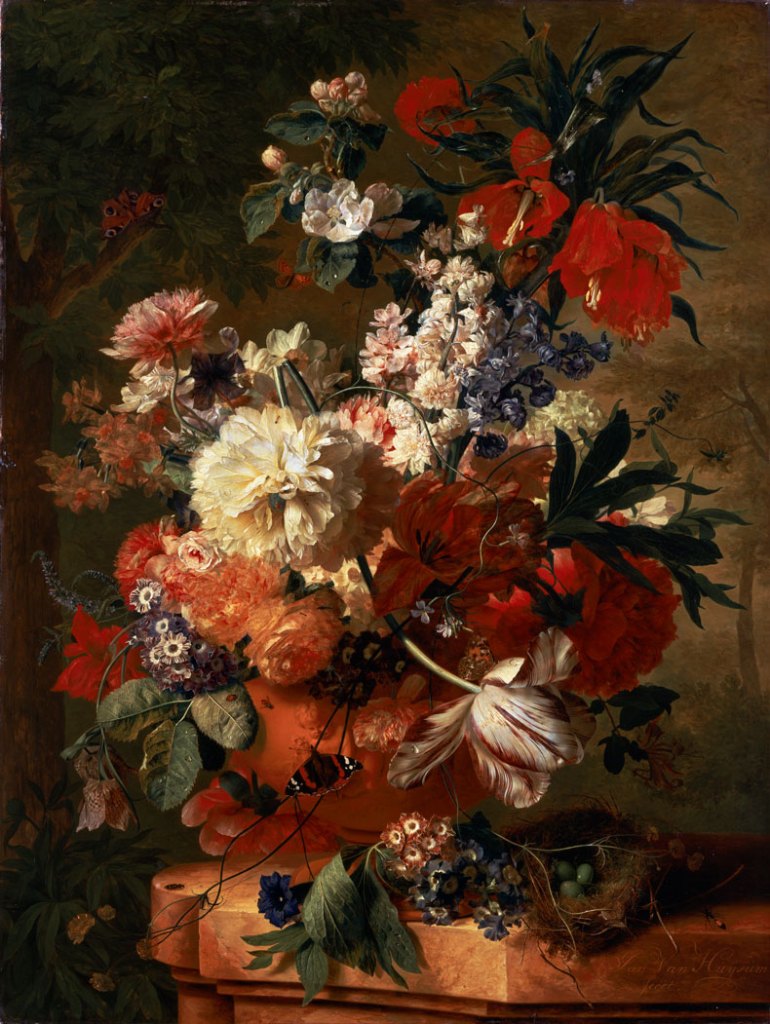
Flowers in a Vase (1726), Jan van Huysum
Wallace Collection, London
Apple blossoms, crown imperials, poppies, tulips and roses cascade over a stone ledge in a characteristically exuberant display, alive with butterflies, flies and beetles rendered in meticulous detail. Van Huysum’s virtuosity extends to transparent water droplets trembling on individual leaves – a feat of illusionism that astonished contemporaries. Though the tulip mania that gripped the Netherlands in the 1630s had long since collapsed by the time van Huysum painted this, a display of this kind of variety and abundance still carried associations of luxury and connoisseurship. Click here to learn more.
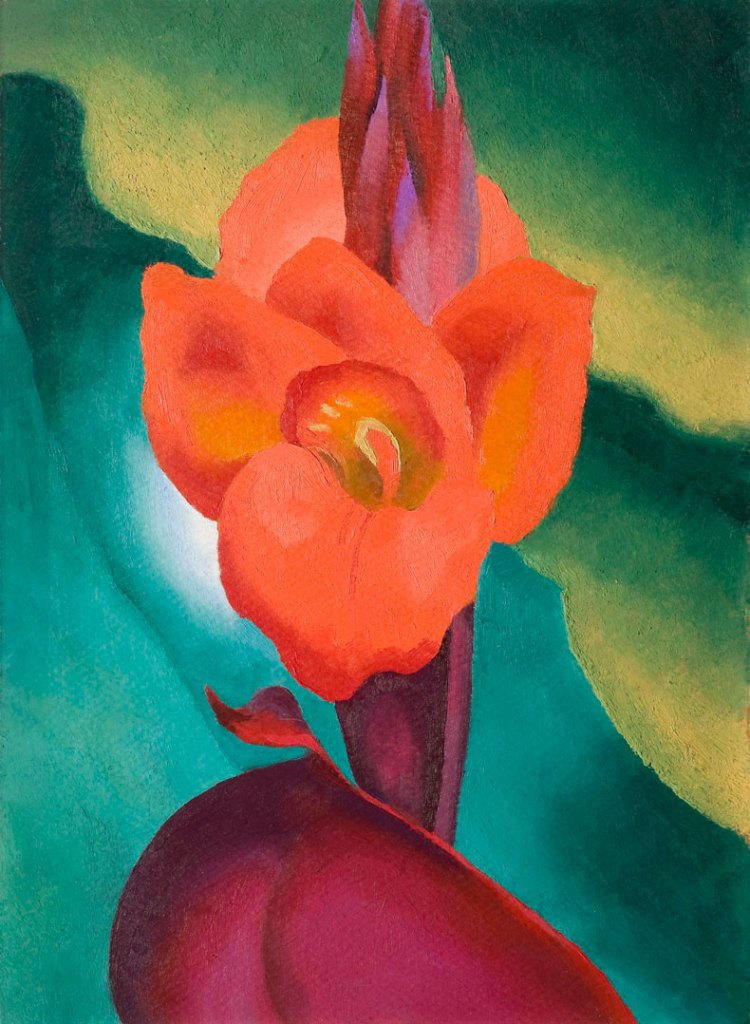
Red Canna (1919), Georgia O’Keeffe
High Museum of Art, Atlanta
A single canna lily – its open bloom a blazing orange-red, its stem and furled lower leaves a deep crimson-purple – rises against a swirling ground of teal and acid yellow-green. O’Keeffe first encountered canna lilies during a visit to Lake George, New York, in 1918 – to the summer home of the parents of the photographer and art dealer Alfred Stieglitz, with whom she had recently begun a romantic relationship. Flowers became a mainstay of her work: an avid gardener as well as a painter, she tended to complete a dozen or more paintings of a single species, attempting to approach each one as though it had never been seen before. Click here to find out more.
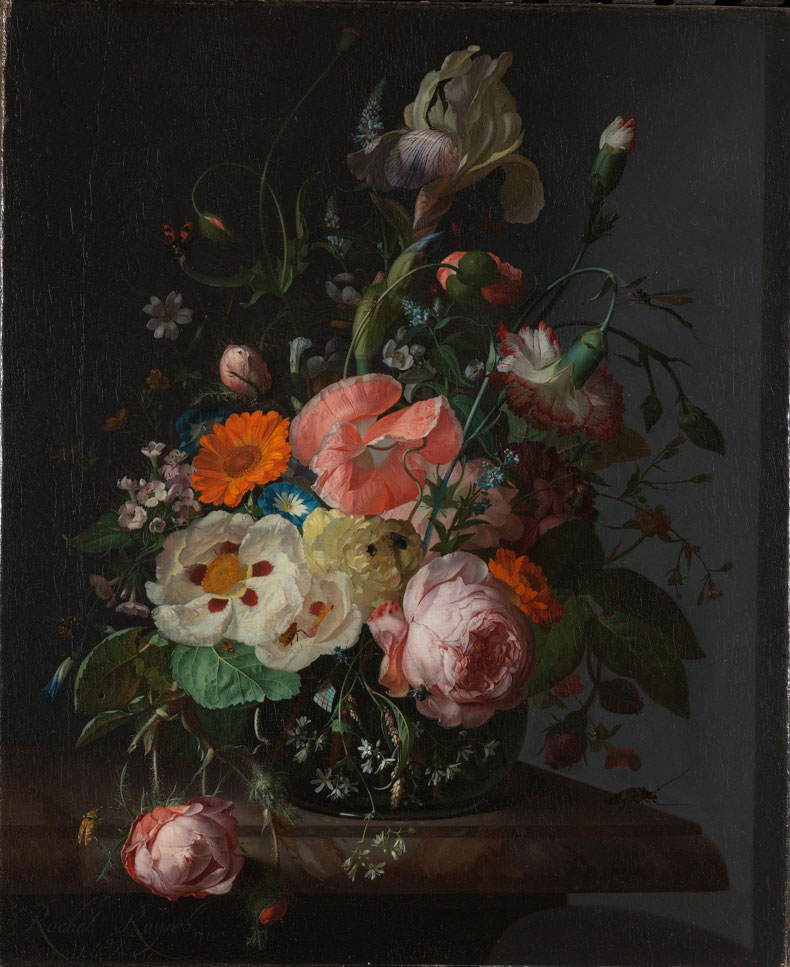
Still Life with Flowers on a Marble Tabletop (1716), Rachel Ruysch
Rijksmuseum, Amsterdam
More than ten species jostle for space in Ruysch’s lavish bouquet, insects nestling among petals that could never have bloomed simultaneously in any real garden. Years of studying living flowers enabled her to make unlikely combinations of species seem entirely convincing. In her lifetime she was among the most celebrated floral painters in Europe: she worked at the court of the Elector Palatine in Düsseldorf and continued to paint well into her eighties, commanding prices that rivalled those of her male contemporaries. Click here to discover more.
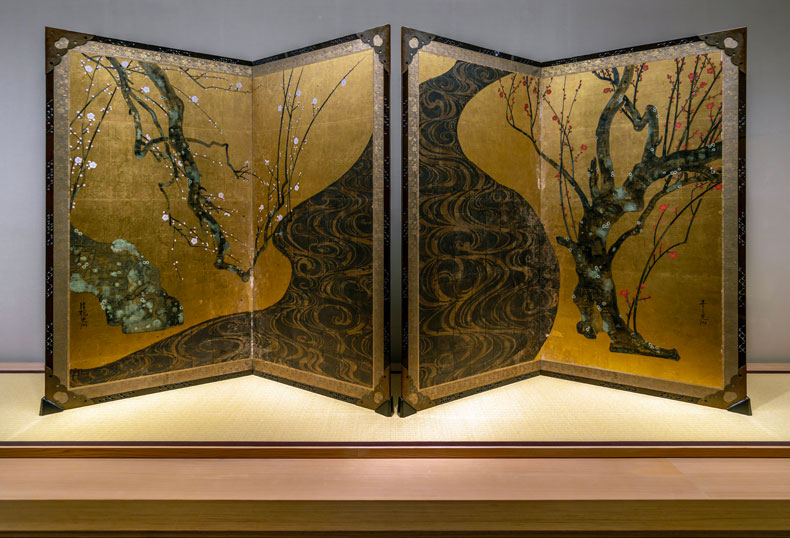
Red and White Plum Blossoms (18th century), Ogata Kōrin
MOA Museum of Art, Atami
Two plum trees – one white, one red – flank a stylised stream across a pair of folding screens, their blossoms depicted in colour without outlines, using a technique that became so associated with Kōrin that it is still known as ‘Kōrin Plum Flowers’. Buds and fully opened flowers seem naturally scattered but are in fact artfully placed. Considered to be masterpieces of Japanese decorative art, the screens suggest that a plant is not a static object to be observed, but a living force in continuous motion. Click here to read more.

‘Four things to see’ is sponsored by Bloomberg Connects, a free arts and culture platform that provides access to museums, galleries and cultural spaces around the world on demand. Explore now.