
Like many of the UK’s most influential bands, the Rolling Stones’ original line-up was made up substantially of art-school alumni. Keith Richards studied at Sidcup Art College; the late Charlie Watts – drummer for the band and fan of this magazine – enrolled at Harrow Art School when he was only 15. Brian Jones won a scholarship to Cheltenham Art College, though this was reportedly withdrawn in short order after someone bad-mouthed him to admissions staff. Mick Jagger, on the other hand, spent nearly two years studying finance and accounting at the London School of Economics. Even after he dropped out, for years it seemed that his ambitions as a visual artist amounted to little more than wanting to paint everything black.
But perhaps he was paying more attention to Malevich than we think? In the intervening years Jagger has become quite the art lover. Your correspondent has written about the singer as a subject for artists before, but we couldn’t resist returning to the subject when the sleeve of the Stones’ upcoming album, Foreign Tongues, was unveiled earlier this week. The two rollicking songs released so far give no indication that the five core members have a combined age of nearly 400. But best of all is the cover art, which in Rakewell’s opinion is the band’s best in decades.
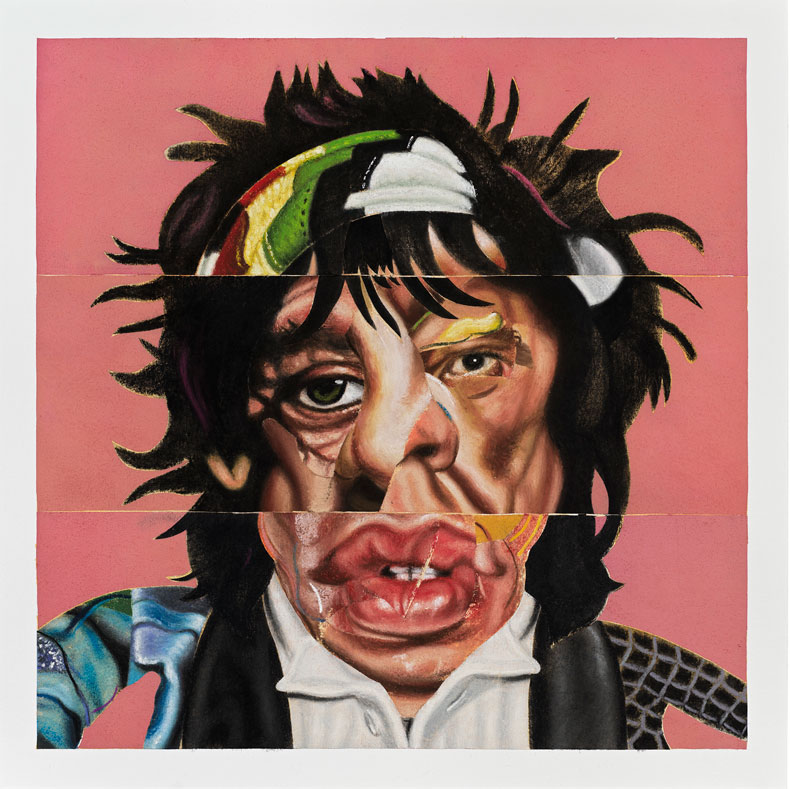
It features Stones Trinity (2025), a pastel painting by Nathaniel Mary Quinn (b. 1977) in which Jagger, Richards and Wood’s faces are hodgepodged together: a frank admission that a band that once traded at least in part on its looks now seems, to paraphrase one of its lyrics, the worse for wear and tear. Gagosian, which represents Quinn, said in a statement that the painting is ‘in a Surrealist style’. The description puzzles Rakewell: if we’re aligning it with movements, surely cubism is nearer the mark, but the style to which it is most indebted is Francis Bacon’s.
Quinn is intrigued by Bacon, just as Bacon was intrigued by Jagger. Last year, as ‘Francis Bacon: Human Presence’ was coming to a close at the National Portrait Gallery in London, Quinn led a workshop in which he walked through the paintings and spoke about Bacon’s influence on him. In 1982 Bacon painted Three Studies for a Portrait (Mick Jagger) – an unusual commission, since he mostly painted people he knew well. He certainly did his homework, stocking his studio with books about Jagger and the Stones, but never made friends with the frontman. Perhaps that lack of familiarity explains why the right-hand panel of the triptych seems to resemble not so much Jagger as former Stones bassist Bill Wyman.
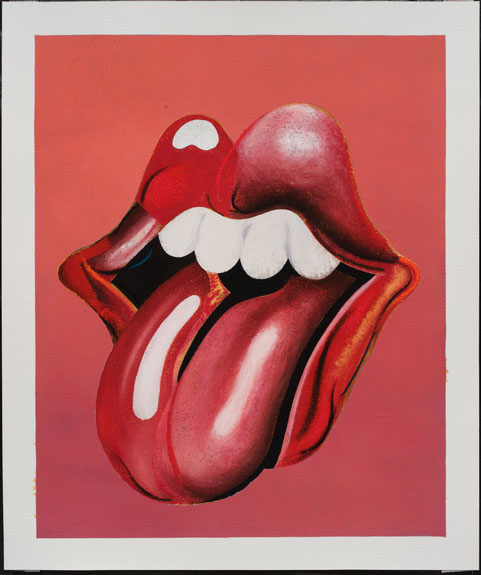
The band also invited Quinn to paint a new version of its famous tongue-and-lips logo, which the art designer John Pasche created in 1970, and which has been synonymous with the band ever since. In Quinn’s reimagining the teeth are in good shape but half the upper lip seems badly bruised; Rakewell hopes this is a veiled reference to the Stones’ outtake ‘Covered in Bruises’, which remains sadly unreleased.
Like the character he played in The Burnt Orange Heresy (2019), Jagger is an art collector himself, though he is wary of shelling out huge sums. After failing to get the rockstar to buy Bacon’s triptych of him, Bacon’s friend Barry Joule described him as ‘penny-pinching’. No doubt that’s why Jagger is now worth hundreds of millions of pounds. Perhaps it’s just as well that he swerved art school for a stint at the LSE.