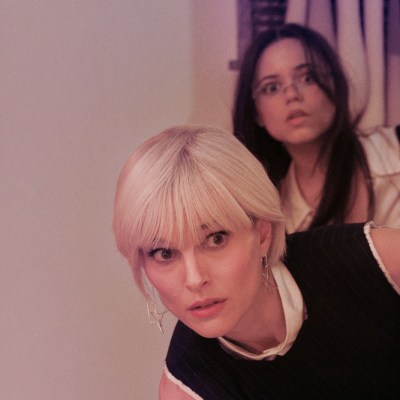
Pity Julian Sklar, the protagonist of Steven Soderbergh’s latest film. Once a fixture of the British art world, an enfant terrible who made his name pushing the envelope of figurative painting, he has fallen on hard times. First came a bid for attention on Art Fight, a TV game show in which he dished out put-downs of young artists like a painterly Simon Cowell. Then changes in artistic fashion consigned him to irrelevance. Now he rarely leaves his Fitzrovia townhouse and records Cameos on demand. His grasping heirs have hired an art restorer named Lori Butler to pose as a personal assistant, but her real task is to secretly finish off the unfinished third series of his masterpieces, the ‘Christophers’ – never exhibited and therefore the only works likely to bring in serious money after Sklar’s death.
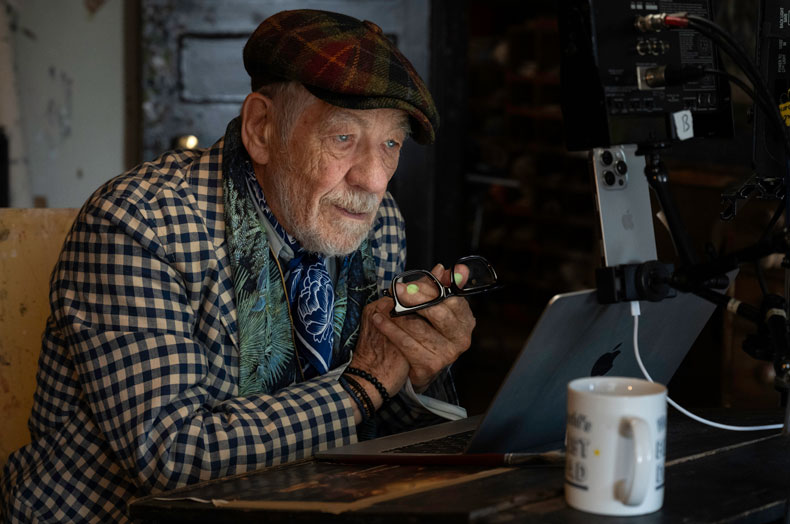
The plot is only one of the pleasures of The Christophers, Soderbergh’s 11th feature in nine years. Ian McKellen plays Sklar as both acid-tongued and watery-eyed; wily and vulnerable. Ed Solomon’s script gives him plenty of good lines and, though Butler is given less to say, Michaela Coel brings out her wariness, guile and talent for thinking on her feet. But what catches my eye when I watch the film is the obvious care and attention that has gone into creating Sklar’s studio. In the absence of any artistic activity, it has become a sort of bunker. In this first-floor space, the size of a small living room, the blinds are permanently drawn, an easel stands neglected in a corner and, where you might expect a drawing board, there’s a small table with a laptop and a ring light, for Sklar to make videos for his remaining fans.
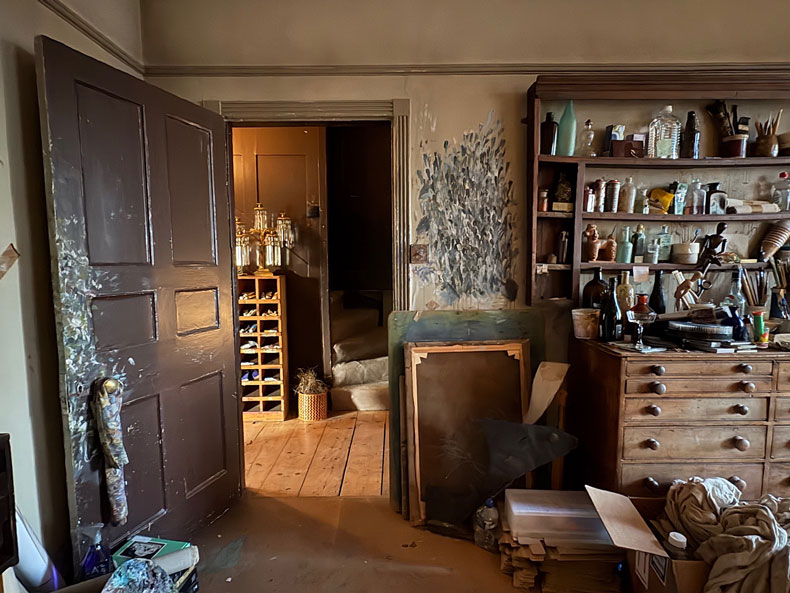
‘I’ve done nothing but shit in 30 years,’ he tells Butler during the job interview. ‘Nothing at all in 20.’ Yet the room is full of used brushes, tubs of turpentine, models of body parts and reference images of Renaissance paintings. Swatches of blue cover the walls and have even invaded the outside of the door, as if the paint has a life of its own. It feels entirely, even unhealthily lived in. When I speak to the film’s production designer, Antonia Lowe, about how she created such a convincing set, it comes as no surprise that she was raised by artists.
‘I knew that world and thought it would be a really exciting one for me to explore, having kind of grown up in studios,’ she tells me on a video call. Lowe’s father, Jeff Lowe, is a sculptor; her mother, Biddy Bunzl, is an abstract painter. But Lowe also looked to photos of a wide range of artists’ studios for inspiration, including Francis Bacon’s for how he used the walls. Part of the fun of the film is in puzzling out where exactly its fictional protagonist fits into British art history: McKellen was born in 1939, eight years after Frank Auerbach and two years after David Hockney, so we might just about group Sklar with the School of London painters. But his punkishness and media savvy – at least until sometime in the 21st century, when he ran afoul of what he would probably describe as ‘cancel culture’ – align him in spirit with the Young British Artists. He is to blame for his own meteoric fall, but if we’re looking for wider reasons, perhaps he was born too early and too late.
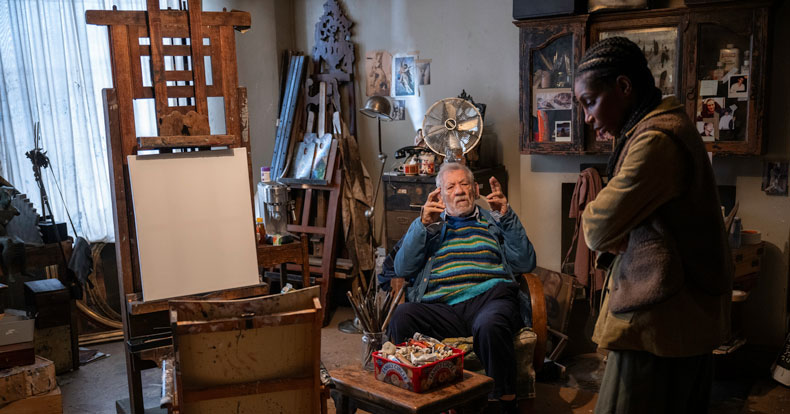
It’s hard to imagine Sklar, with his patrician airs, having much time for the art of his real-life contemporary Rose Wylie, but she was a major influence on Lowe’s conception of Sklar’s studio. ‘She’s fascinating because she’s just everywhere with her stuff,’ Lowe tells me, flinging her arms open. ‘Some of her paintings have a certain amount of space and clarity. But then when you see her workspace, there’s obviously so much work that goes into them.’ Lowe, whose father is a friend of Wylie’s, spent time in Wylie’s studio. But it wasn’t just painters who provided inspiration. Alexander Calder is also a reference point. ‘He was a sculptor, but there was still that sense of a lived-in space and the way he used storage and space. His response to shape, including the shapes that were in his studio, were obviously translated into his work, which I think was very much the same with Freud and Bacon.’
We can glean a lot about Sklar’s state of mind from the state of his studio, which is largely in disarray. ‘The important thing with Julian was that not only did the space have to feel lived-in, but there also had to be a sense of loss,’ Lowe explains. ‘There are things around him – mannequins, models of body parts, signage – that had at one point been inspiring to him, or part of his process or materials, but which he is no longer using. It was important to have that sense of history.’
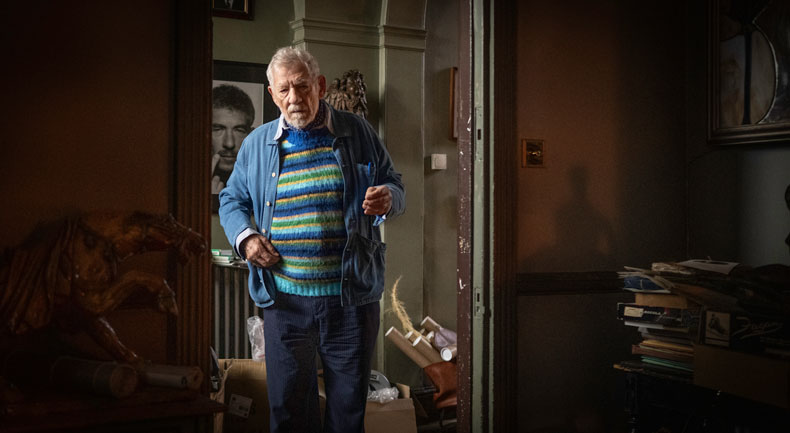
Some of that history is conveyed quite straightforwardly, through photos of a younger Sklar that crowd one of the walls of the house’s entranceway. Getting images of McKellen cleared by the legal team was one of Lowe’s biggest challenges; one black-and-white image of the actor slyly flipping the bird, taken by Trevor Leighton in 1989, had to be licensed from the National Portrait Gallery at great expense. McKellen gave Lowe the run of his own photo collection, handing her an enormous leather case of shots he’d amassed over the years. ‘They were incredible to look through – a life in hard-copy photos, which is not something you get any more. But they were incredibly hard to clear: there were pictures of him with royals and other famous people, which we couldn’t use. We had to get creative with his entranceway to give an idea of this lived life, this famous artist, without using tonnes of photographs.’
The Christophers is more interested in the artist than the art, but Lowe and the production team also manage to give us a sense of Sklar’s painterly style. We catch glimpses of the ‘Christophers’ themselves, delicately sketched portraits of a young man Sklar had been in love with. Barnaby Gorton, who has made artworks designed to appear in films, including most of the Harry Potter series, created these in a Freud-like style. ‘We were looking at other artists as well, but a Francis Bacon style would have been too recognisable,’ Lowe tells me. ‘There was a way of doing Lucian Freud where it felt like we could make it our own a bit more, but still have echoes of that moment in painting that was so specific to London at that time.’
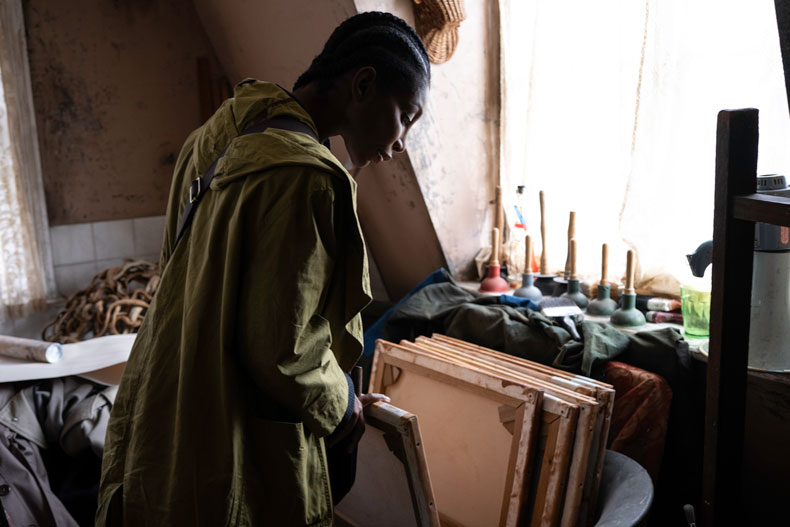
Gorton was an indispensable member of the production team. Not only did he lend his own easel to stand in as Sklar’s – a heavy-duty H-frame specimen that looks as much like a guillotine as a canvas-holder – he was also quick to create the artworks, open to feedback from Soderbergh and Lowe, and attentive to details that only expert viewers will catch. ‘We were thinking about the types of canvases, what the fixings were – would Sklar have used staples or pins? – the time period in which he would have stretched them, and also how they would have aged while being stuck in an attic for so many years,’ Lowe says. ‘Barnaby did all of that, and we just gave him reference points.’
He wasn’t the only person who brought the art to life. One painting, Boy Under Cloud, which in the film’s narrative left a mark on 12-year-old Butler and dates from when Sklar was six, was created by Sarah Bell and loosely inspired by Picasso’s Little Yellow Picador (1889). ‘We were looking at painters who’d done paintings as children and Picasso had done an incredible painting of a matador when he was eight,’ Lowe tells me. ‘We thought, “Let’s not make it quite as achieved as that, because it’s almost not believable.”’ Still, Bell’s painting neatly conveys the sense of a precocious, saturnine child.
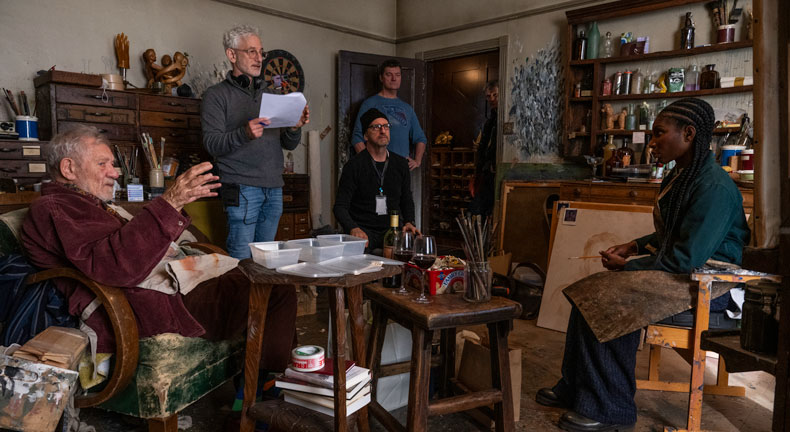
When we think of dramas we often think of major performances or memorable dialogue, but none of it would get under our skin without the little things that tell us just as much about a character. ‘Wherever I go I’m always really interested by the details,’ Lowe says. ‘It might be the mouldings of a particular period house, or how a building is dressed if the owner is a hairdresser or a builder or a cleaner or an artist. What’s their daily business? What are their daily activities? I call it “life crap”. In The Christophers there’s the easel, the shelves, the paints, but actually you need all the other stuff on top: a ball of elastic bands, a pile of envelopes that haven’t been opened, a blister pack of Paracetamol.’
However convincing McKellen and Coel are in their roles, it’s the ‘life crap’ that makes The Christophers feel real.
The Christophers is in UK cinemas from 15 May.