From the June 2026 issue of Apollo.
Anyone with a passing interest in cricket will know about the 1981 Ashes series, remembered chiefly for the third test at Headingley, in which Ian Botham dragged England from the brink of annihilation to a glorious, preposterous victory. A less familiar story is that of the previous test at Lord’s, which ended in a draw. Botham, who was captain of the England side, had a bad time with the bat and, after being bowled out for no runs in the second innings, took the walk that every player at Lord’s has had to do since the 19th century: into the pavilion, through the Long Room, where Lord’s members gather to watch the game, and up the stairs to the dressing room. ‘It was a walk that I’ll probably never forget,’ Botham said in an interview afterwards. The members ‘could not even look at me: they all had their heads in the papers, as if I wasn’t there, just the ghost of a former player going through’. As soon as the match ended, Botham resigned as captain. Mike Brearley stepped in and in the next test Botham, freed from the pressure of leadership, put in one of the greatest solo cricketing performances of all time.
Almost half a century on from Botham’s lonely walk, his portrait hangs in that same pavilion in St John’s Wood, rubbing shoulders with the many paintings – ghosts of former players – that line the walls of the Long Room, the staircases and the members’ bar. Many players have tried to describe what it is like to play at Lord’s, and all seem to agree that it has a different feel to other grounds. Lord’s, the self-styled Home of Cricket, owned by Marylebone Cricket Club (MCC) and home to Middlesex County Cricket Club since the 19th century, may not be quite the powerhouse that it once was: Middlesex has suffered a slow decline into mediocrity in recent years, England is no longer the undisputed centre of world cricket and there are, by my count, more than 30 grounds in India and Australia alone with a bigger capacity than the 31,000 spectators that Lord’s can hold. Nevertheless, there is a sense, as we might infer from Botham’s vivid recollection of his experience there, that it has always been a place of consequence – a place where history happens.
Lord’s aura is due in large part to its status as a centre of cricketing history – not just as a place where that history is made, but one where it is preserved. Many sporting venues have museums – few, it must be said, with as large and prestigious a collection as the MCC Museum, which counts among its exhibits the original Ashes urn from the 1880s and a stuffed sparrow killed by a flying cricket ball in 1936 – but almost none have an equivalent to the Long Room, a place where the players are directly confronted by art.
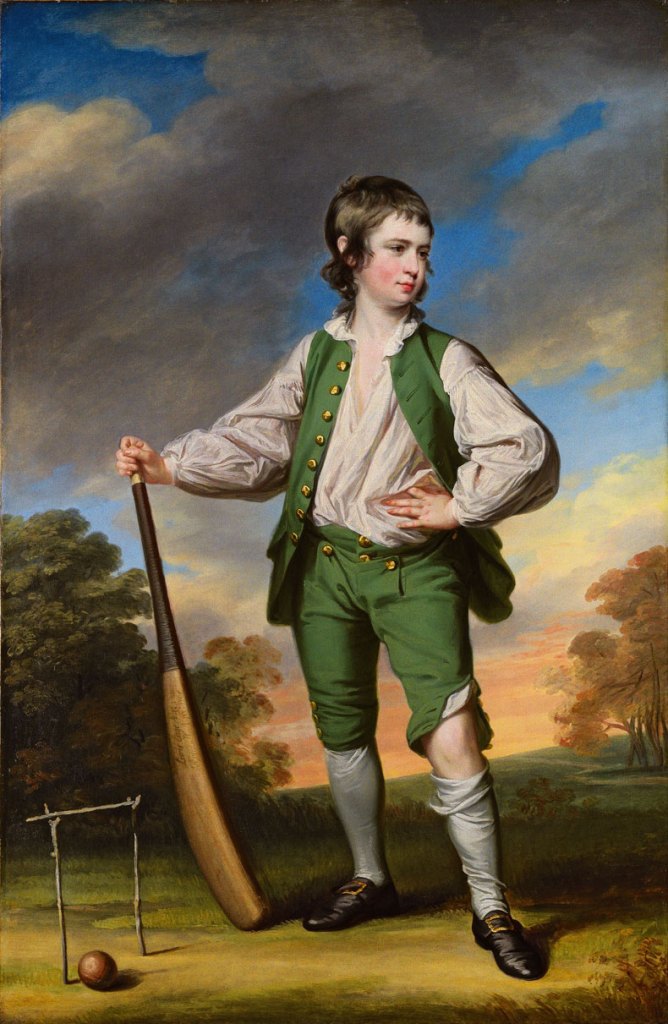
When I visit in late April, it is six weeks before the first test of the summer begins, and preparations are underway. The Long Room, designed in 1889–90 by the theatre architect Thomas Verity, has just been rehung by Charlotte Goodhew, the MCC collections manager since 2008. Until a few years ago the room was filled with 18th- and 19th-century depictions of cricket matches and portraits of significant figures, such as Spencer Ponsonby-Fane, the club’s treasurer in the late 19th century, who first began soliciting items from members and buying artworks to decorate the pavilion. Things are different now. There is still a painting of the hirsute Victorian man-mountain W.G. Grace wielding a bat with simultaneous heroism and insouciance, and there is room too for one of the earliest paintings in the collection: Francis Cotes’s depiction from 1768 of a young boy posing with a bat. But Lord’s also holds more recent paintings of more recent cricketers: former England captain Alec Stewart looking blank in a portrait from 2000 by Andy Pankhurst; the Australian bowler Glenn McGrath looking downcast in a work of 2010 by Justin Mortimer; the great Barbadian all-rounder Garfield Sobers looking angry in a rather good, Lucian Freud-ish portrait of 1992 by the late Sarah Raphael.
Many of the late 20th- and 21st-century greats on the walls are here because of the Lord’s Portrait Project, which began in earnest in 2005 and commissions new portraits of cricketers to decorate the pavilion. Eight new works will be unveiled over the course of the summer, though Goodhew is understandably tight-lipped about the subjects. She keeps a running list of artists she admires and makes clear that liking or knowing about cricket isn’t necessary to bag a commission (‘or to work here’, she jokes). For Goodhew, whose background is in art history and curation, artistic merit is the main criterion for commissions, rather than completism or sporting history.
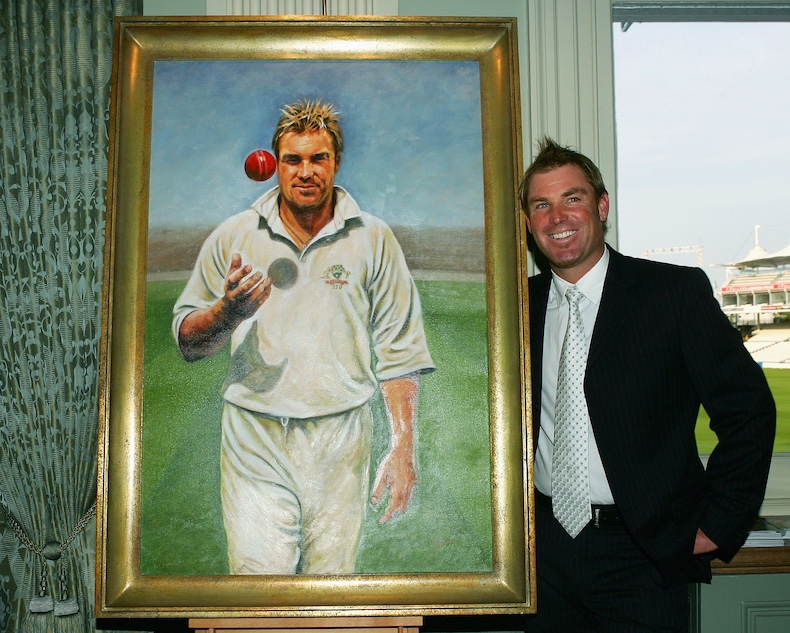
Choosing the subjects is a tricky business. The main rule is that players have to be retired, although that was broken in 2005, when a portrait by Fanny Rush of the leg-spinner Shane Warne, tossing a ball up with a smirk, was unveiled in the Long Room, prompting concerns from some members about breaking precedent. (Warne said he was just worried that one of his teammates would draw a moustache on the painting while they were walking past.) The vast majority of the portraits are done from life: Goodhew says that she wants to foster a personal relationship between artist and sitter. These marriages are not always happy ones, however. Dilip Vengsarkar was one of three Indian former cricketers to sit for Stuart Pearson Wright in 2008, who apparently found him a difficult customer. The artist responded by painting the batter having just been bowled out, looking glum with the bails strewn behind him. It’s a more prosaic form of artistic revenge than Michelangelo painting his critic Biagio da Cesena into The Last Judgement as a donkey-eared Minos, but a biting one nonetheless.
Is this the finest group of portraits ever produced? Probably not. But the more time I spend here, the more I come to appreciate the sketchier works – an uncomfortable-looking Alastair Cook, a lopsided Graham Gooch – and the paintings of groups of blazered patrician men in top hats. These oddball paintings capture something that po-faced cricket fans (I count myself among them) often fail to acknowledge: cricket, which is plagued by labyrinthine rules, outdated traditions and a whole vernacular incomprehensible to the uninitiated, is a fundamentally silly game.
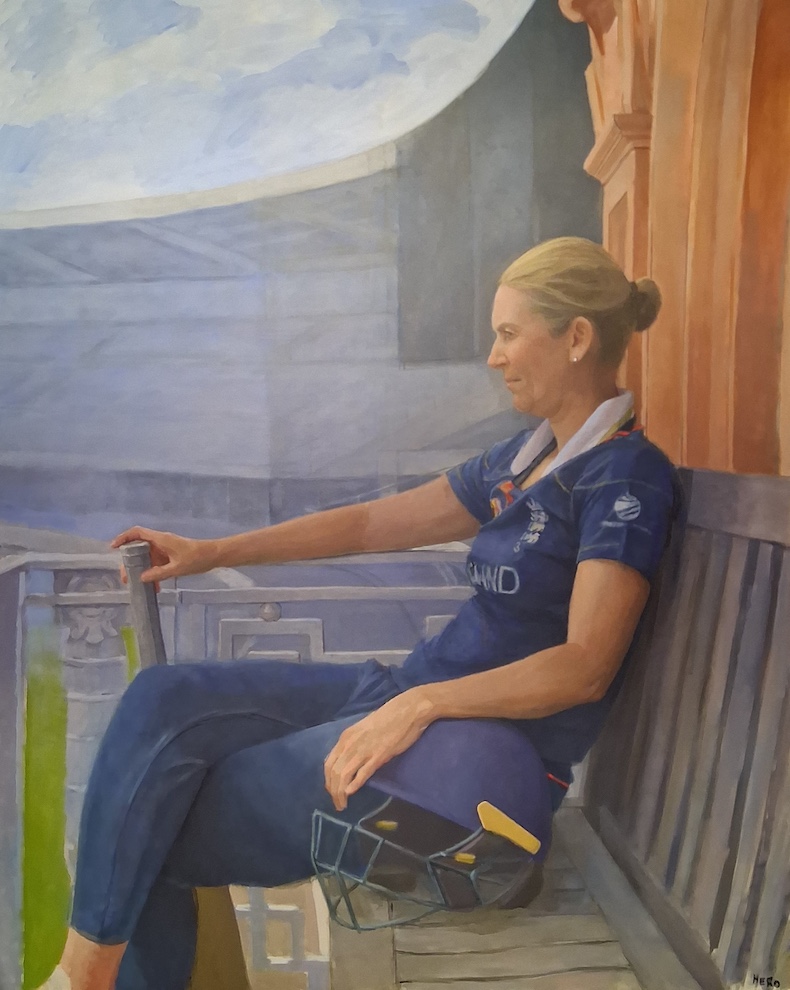
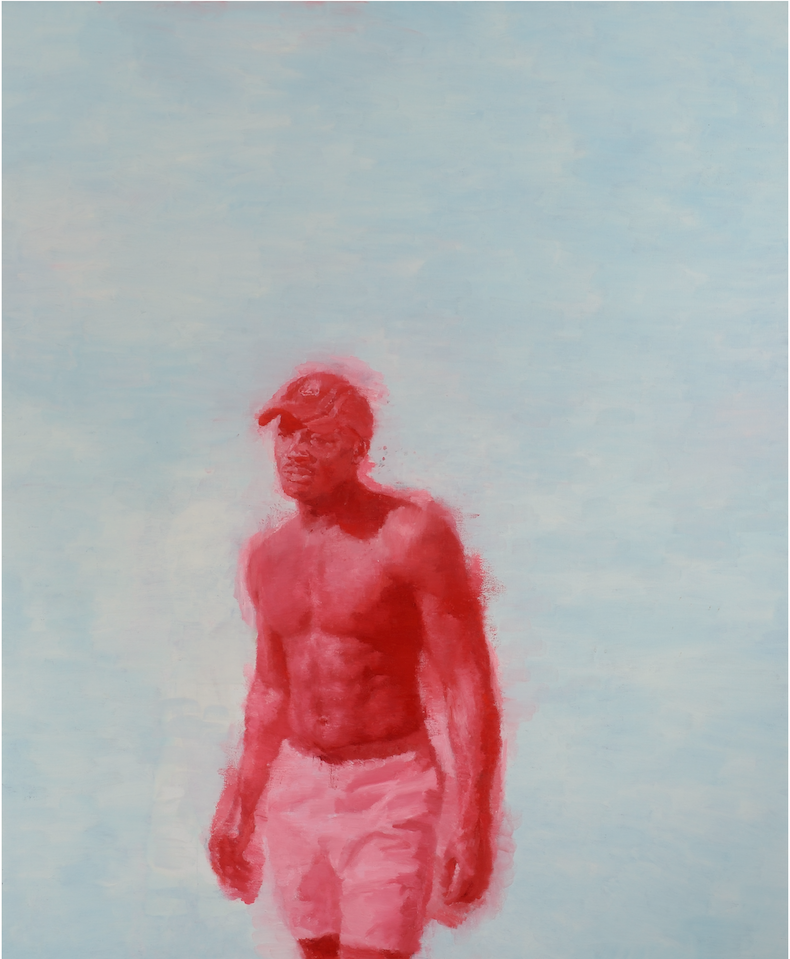
Lord’s is still one of the most evocative places in world cricket, but it is also the nucleus of English cricket’s old-fashioned, insiderish tendencies. To take just two revealing statistics: 97 per cent of full MCC members are men and the waiting time for membership is around 29 years. Goodhew and her team cannot change that, but the art that hangs in the pavilion may be able to nudge things slowly into the 21st century. It is striking to see, in a room that until 1998 refused to admit women during play (the late Queen was the only exception), a large portrait by Hero Johnson of the former England batter Charlotte Edwards, unveiled in 2025. One of the best works in the Long Room, Justin Mortimer’s brooding red-hued painting of Brian Lara, shirtless and sporting a West Indies cap, is another piece of gentle iconoclasm in a place where tailored jackets or blazers are mandatory on match days. What if, I ask naively, an artist wanted to do an abstract portrait? ‘The rule is that it has to be a likeness,’ Goodhew tells me. Change is slow at Lord’s – but that’s part of its charm. Let’s see where we are in 29 years.
From the June 2026 issue of Apollo.