From the June 2026 issue of Apollo.
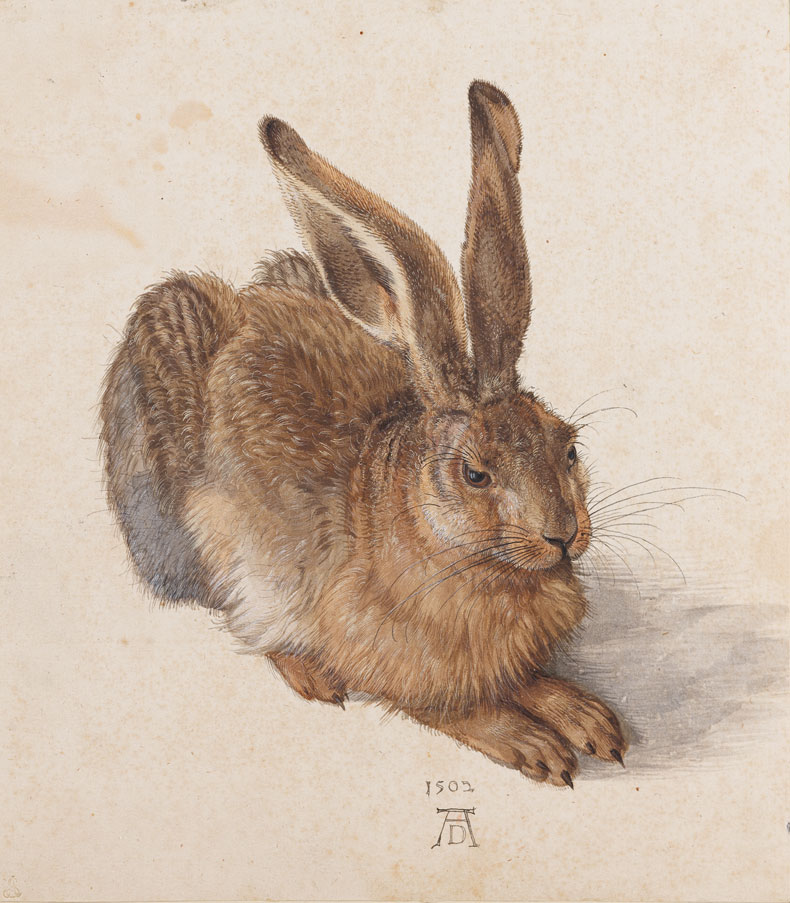
The Albertina, the great Viennese treasure house of works on paper and home of Dürer’s celebrated watercolour of a hare, celebrates its 250th anniversary this year. However, long before the peerless foundational collection owned by Prince Albert Casimir of Saxony, Duke of Teschen, arrived in Austria it had already criss-crossed Europe, and not without peril.
The origins of the collection lay in Venice, where the duke, with the aid of Giacomo Durazzo, the Austrian ambassador and a committed print collector, started to amass works. In 1776 Durazzo gave 1,000 pieces to Albert and his wife Maria Christina, the Empress Maria Theresa’s favourite daughter. This influx joined the couple’s own collection at Bratislava Castle, where Albert was based as governor of Hungary, and then moved with them to Brussels when he was made governor of the Austrian Netherlands. It was in 1793, amid the upheavals of the French Revolution, that the works finally headed to Vienna. The collection was loaded on to three ships sailing for Hamburg to shorten the land crossing in a Europe upended by war, but one vessel foundered on an outcrop of rocks and sank. It was said to have taken some of the best works in the collection with it to the bottom of the Wadden Sea.
Quite what those were will never be known, but the denuded collection that Albert and Maria Christina unpacked at their new home, the Palais Tarouca, sitting high on one of the remaining bastions on Vienna’s ancient city walls, was still of extraordinary quality. There were, among a host of others, drawings by Pisanello and Antonello da Messina, Michelangelo and Leonardo, Pieter Bruegel the Elder and Hieronymus Bosch, Dürer and Tintoretto, Rubens and Rembrandt, as well as sheaves of prints, many of which had been specially commissioned by Durazzo.
The building itself – renamed the Albertina in the duke’s honour only in 1921 – is a work of art. Albert was a Freemason and the journey through the classically inspired city palace from street level to the upper reception rooms represents the masonic idea of the passage from darkness to enlightenment. Freemasonry was a prominent force in 18th-century Vienna, with Mozart’s last opera, The Magic Flute, a work filled with masonic themes, receiving its premiere in the city in 1791. Perhaps it is no coincidence that the date of the initiation of the collection, which was meant by both Albert and Durazzo to serve an educative and moral purpose, took place on the same day – 4 July 1776 – that the United States declared independence. The timing suggests some form of collaboration with the Founding Fathers, several of whom were masons, including George Washington and Benjamin Franklin, an acquaintance of Albert’s.
Both the building and the collection were extended by the heirs of Albert and Maria Christina but they nevertheless remained subject to the vicissitudes of fate. One assassination attempt on Emperor Franz Joseph took place right outside the Albertina, and a second, on his nephew in Sarajevo, initiated the First World War. In the peace that eventually followed, a new republican government took charge of Austria and confiscated both the building and its contents. The palace was at that point occupied by the military branch of the Habsburgs and, having refused to submit to the new regime, they went into exile in Hungary. Unfortunately they stripped the building before they went – decorative panelling, overmantels, mirrors. Over the following century many of these fixtures have been bought piecemeal at auctions and private sales and returned to the Albertina. After the museum passed into state ownership in 1920, rumours abounded that the collection of works on paper would be sold to London, or to the United States – the resulting hue and cry put paid to any such idea.
Towards the end of the Second World War, the building was badly damaged during an American air raid and needed substantial rebuilding. A programme of further refurbishment took place from 1998 to 2003 to repair decades of neglect and underinvestment, and it was only then that the Albertina as we now know it took shape. It took longer still to become established as one of the world’s pre-eminent museums: in the early years of the millennium its visitor numbers were low considering the quality of its collection; now, together with its two outposts – Albertina Modern (post-1945 art) and Albertina Klosterneuburg (mostly contemporary art) – the Albertina attracts some 1.3 million visitors each year.
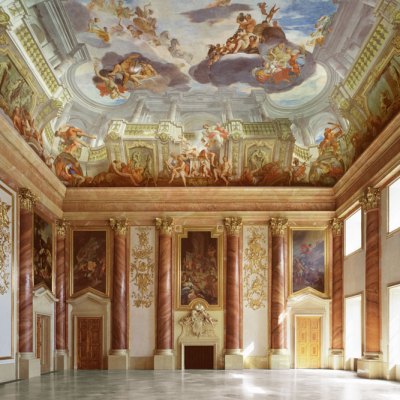
Although the institution’s exhibition galleries are largely modern, many of the palace’s original state rooms have been returned to their full 19th-century glamour, all silk-covered walls and Biedermeier furniture. It pays to look down as well as up since the marquetry floors are themselves spectacular creations. They struck the Hollywood actress Sharon Stone so forcefully during a visit that she asked if she could be left alone in the building for two hours so she could walk barefoot over them in order to restore her inner harmony. The museum is far too discreet to confirm or deny whether her request was granted.
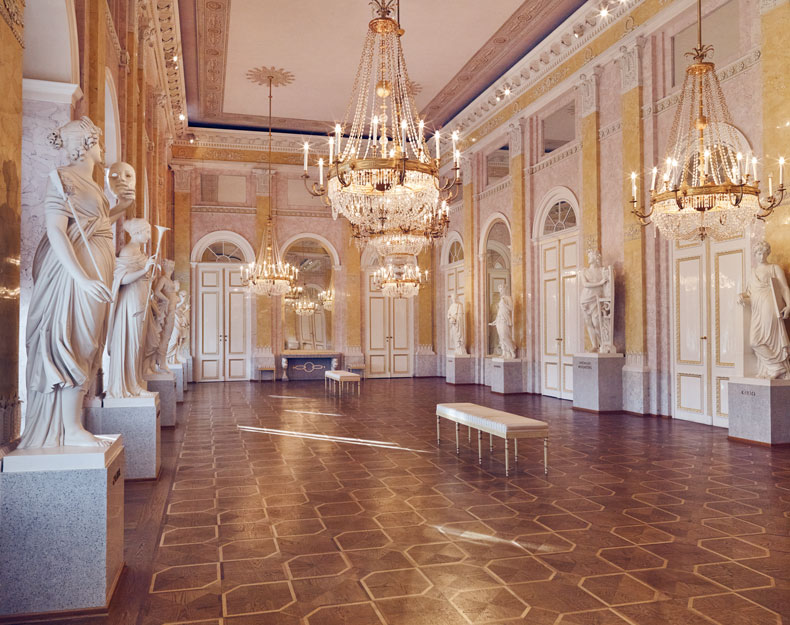
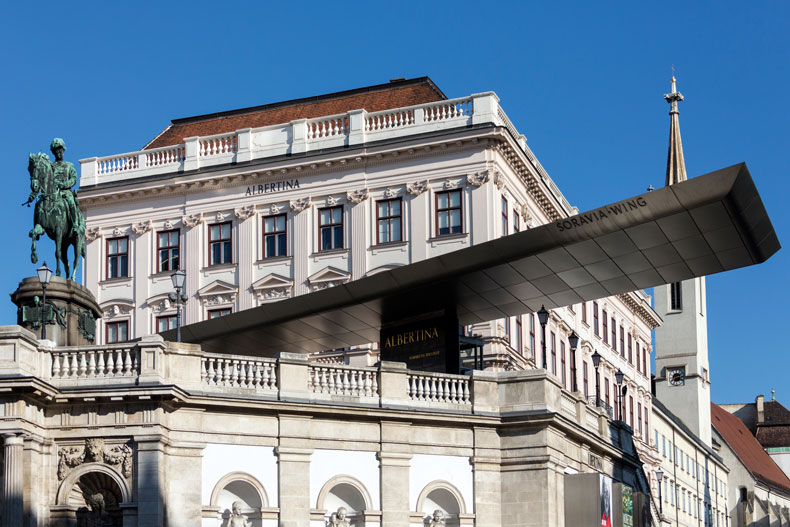
By way of contrast, the historic interiors belie the fact that, during a turn-of-the-millennium refurbishment, three basement floors were excavated that now hold some 1m pieces, complete with a robotic retrieval system. This dual aspect is apparent throughout the building. Ascend from the street via either wide staircase or a tunnelled escalator and the visitor arrives at the high entrance level guarded by Kaspar von Zumbusch’s equestrian statue of Archduke Albrecht, eldest son of Archduke Charles of Austria, who defeated Napoleon at Aspern-Essling in 1809, and part-covered by a flying wedge canopy – one signalling the museum’s antiquity, the other its modernity. The old carriage forecourt is now a glass-covered atrium and an enfilade of passages and stairs funnels the visitor upwards – past a Franz Xaver Messerschmidt bust of the museum’s founder, Albert, Habsburg jaw jutting prominently – into the state rooms. These contain an assortment of sculptures, facsimiles of some of the Albertina’s master drawings – the originals kept out of the light – and Habsburg portraits and battle scenes.
Take a lift either up or down and the rest of the building is given over to a series of adaptable exhibition spaces, allowing for up to five shows to run concurrently. The rooms are distinctly modern and designed in universal gallery language – white walls, partitions to hold single images (Modigliani’s Young Woman in a Shirt from 1918, for example), hidden lighting and with little or no hint of the original architecture of the rooms they inhabit.
Although the collection of more than a million prints and drawings – one of the largest in the world alongside the British Museum, the Louvre and the Met – remains the heartbeat of the Albertina, it has been supplemented by substantial gifts of 20th-century paintings and permanent loans, such as the Batliner Collection of classical modernist works that was given in 2007, so it now has an enviable permanent collection of paintings too: pictures by Picasso and Matisse, Modigliani and Monet, Cézanne and Chagall, Klimt and Munch, and a strong group of Blue Rider artists are among those on display. Today’s Albertina spans 600 years of Western art.
This, then, was the institution that Ralph Gleis inherited when he became director in January 2025. Gleis’s career includes spells as a research assistant at the Royal Museum of Fine Arts Antwerp and as curator of painting and graphics until 1900 and then curator of sculpture at the Wien Museum, before becoming director of the Alte Nationalgalerie in Berlin in 2017. He was, in his own words, ‘a curator in all media’, having also worked in a commercial gallery and as a guide at Cologne cathedral. It all helps at the Albertina, he says, ‘because we collect all kinds of artworks’. Indeed, his own spacious white office is decorated with a series of large abstract paintings by the contemporary British-American artist Sarah Morris rather than with historic works from the Albertina’s collection.
Gleis was ‘a bit afraid of the 250th anniversary. I’m not the only person who doesn’t know everything about the Albertina.’ Some of the preparatory work had already been done by the former director, Klaus Albrecht Schröder, who led the museum for 25 years. What has emerged to mark the event is a roster of 16 exhibitions throughout the year, held across its three venues and designed to show not just the breadth of its interests but something of the Albertina’s past and future too. The shows range from an exploration of works on paper to early photographs of ballet and dance, from modern donated works by the likes of Roy Lichtenstein and Julie Mehretu to a Picasso-Francis Bacon pairing, and from the Pop artist KAWS to a survey of Australian art.
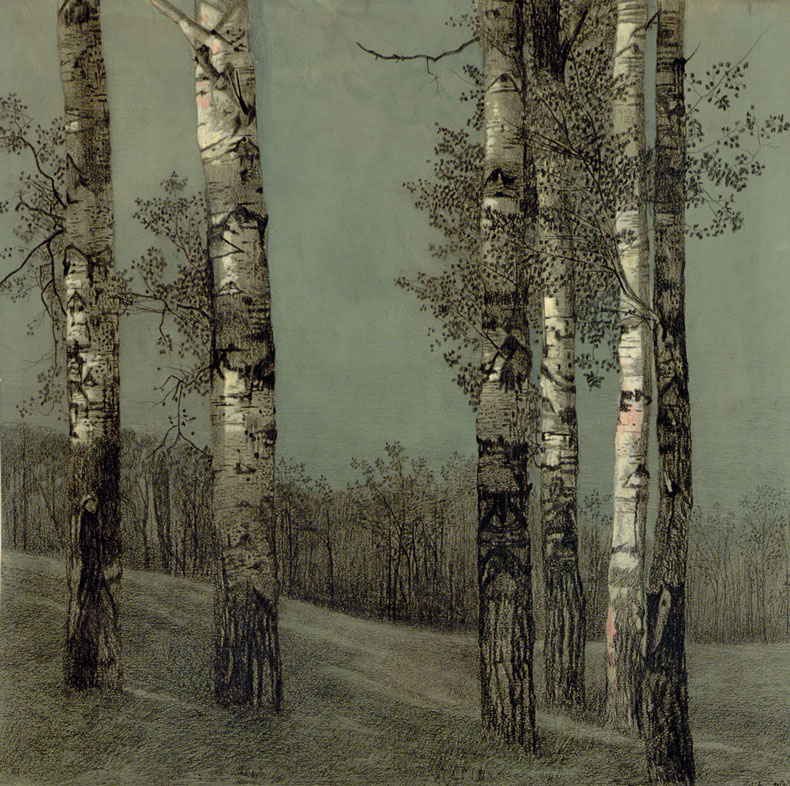
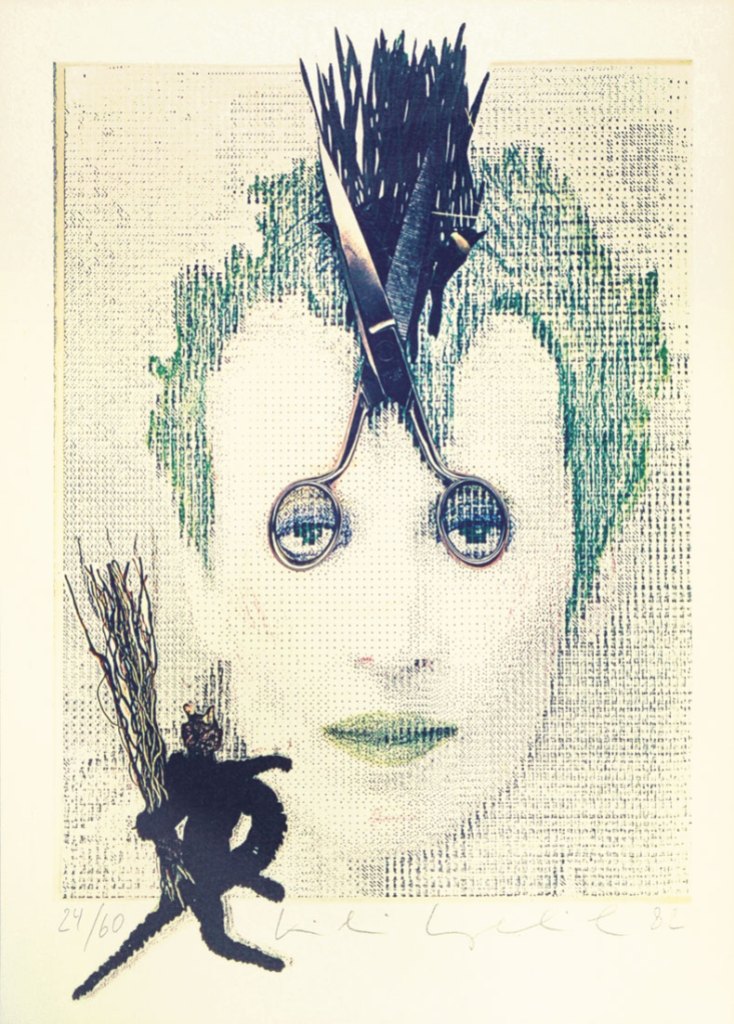
One of the exhibitions Gleis is most proud of is ‘Women Artists of the Albertina’, opening in October, the museum’s first display dedicated to the female practitioners represented in the collection and also a nod to the co-founder Maria Christina, herself an accomplished painter. In the course of general catalogue research, the museum discovered that it had more than 5,000 works by women dating from the 15th century to the 1970s, most of which had rarely, if ever, been displayed before. Many of these are by Austrian painters with limited name recognition internationally, such as the Symbolist Emilie Mediz-Pelikan (1861–1908) and the Pop artist Kiki Kogelnik (1935–97).
Providing a platform for Austrian art, especially of the 20th century, is, says Gleis, an important part of his role and the Albertina’s future. ‘Everyone knows Klimt and Schiele,’ he says, but there are many other names still to be introduced. Artists such as Arnulf Rainer, painter of vigorously gestural works and overdrawn photographs, deserve to be better known outside their homeland.
The Albertina is nevertheless a local museum: some 40 per cent of visitors are Austrian, which makes it less reliant on tourists than many others. ‘We are at the centre of Vienna’s art world,’ Gleis says. It is unusual, too, in that a high proportion of the Albertina’s income – around 67 per cent – comes from its own efforts, whether ticket sales or merchandising, rather than from state subsidies.
Although Gleis doubled attendance at the Alte Nationalgalerie in Berlin during his tenure, his primary consideration here is not growth, but strengthening what the Albertina offers. ‘After one and a half years you get a good feeling of what the museum is about,’ he says. Albertina Modern (which opened in 2020), a 10-minute walk from the mother institution, is well established in Gleis’s estimation but Albertina Klosterneuburg, 13km north of Vienna, is ‘still searching for a specific profile […] you won’t find it as a tourist unless you want to go there’. The building, formerly the Essl Museum containing a collection of post-1945 Austrian art, sits near the Danube and there are plans to add a sculpture garden and make the most of the riverside site.
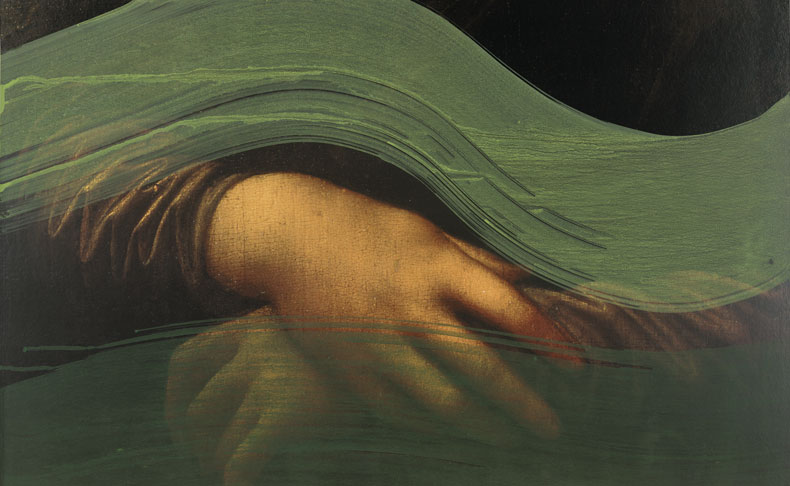
Meanwhile, the three branches are between them hosting around 18 exhibitions a year – ‘not enough’, says Gleis – and, although the diary is full until 2030, his team are always suggesting more. ‘Curating is about making a choice,’ he says. ‘It is about what you leave out as well as what you put in.’ There is, for example, the photography collection of some 120,000 works, the largest in Austria, and although a Richard Prince show (until 16 August) is part of the anniversary celebrations, there are innumerable other photography exhibitions yet to be conceived. Meanwhile, the museum is continuing to acquire works across various media. As Gleis points out, the museum has collected contemporary work from the start: ‘It is in our DNA.’
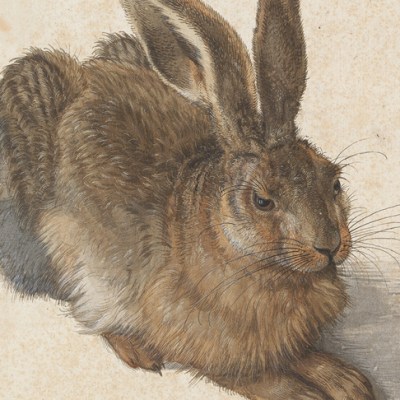
And the Albertina is, of course, a major lending institution. Dürer’s Young Hare (1502) – ‘our Mona Lisa’ as Gleis put it – might never be loaned but some of the other choicest items frequently are: several of its Raphael drawings, for example (the museum owns more than 60), are currently on display in ‘Raphael: Sublime Poetry’ at the Met in New York. And loan requests are regularly received, hoping to draw on, say, the museum’s 12 Michelangelo drawings or its 1,100 Oskar Kokoschkas or its 42,000 architectural drawings (with works by Bernini, Adolf Loos and Frank Lloyd Wright among them) or its holdings of Dürer and Schiele works on paper – the largest collections of both in the world. ‘You learn so much from other institutions,’ Gleis says, ‘among other things about what is interesting in making a show.’
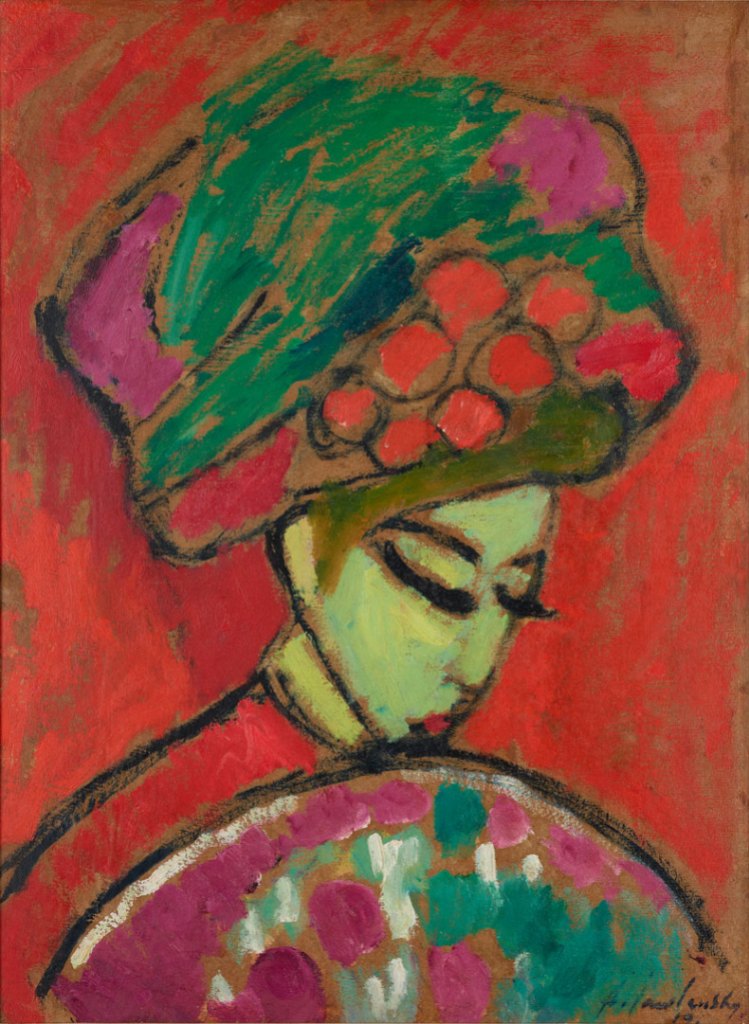
While the hare may not be allowed to roam free and Dürer’s three other most celebrated graphic works – The Large Piece of Turf (1503), Wing of a Blue Roller (c. 1500/12) and Praying Hands (1508) – are granted only limited outings, there are alternatives. Rembrandt’s rapid drawing of a celebrity elephant named Hansken who enraptured the artist when she visited Amsterdam in 1637 – where she performed tricks such as fighting with a sword and shooting a pistol – is a visitor favourite, as is Klimt’s Standing Couple, a late study for The Kiss (1907–08). Among the paintings, Gerhard Richter’s green and orange Abstract Image (1986) makes a fine contrast with Monet’s Water Lily Pond (1917–19), as does Picasso’s Woman in a Green Hat (1947) with Alexej von Jawlensky’s Young Girl in a Flowered Hat (1910) and Alex Katz’s Black Hat 2 (2010). With a collection as rich as the Albertina’s, the pleasurable problem, as Gleis puts it, is that there are ‘so many possibilities’.
‘Collecting for the Future: 250 Years of the Albertina Museum’ is at the Albertina, Vienna, from 19 June to 11 October.
From the June 2026 issue of Apollo.