
Backrooms, released by the independent American distributor A24, takes a timeless spooky premise – the discovery of a hidden warren of rooms – and gives it a modern overhaul. And it’s not just modern in terms of what happens on the screen. The whole origin of the story, directed by newcomer Kane Parsons, is an interesting example of contemporary myth-making.
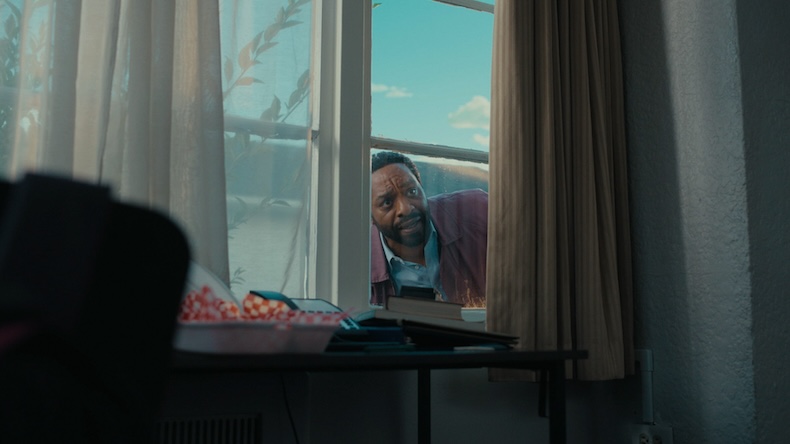
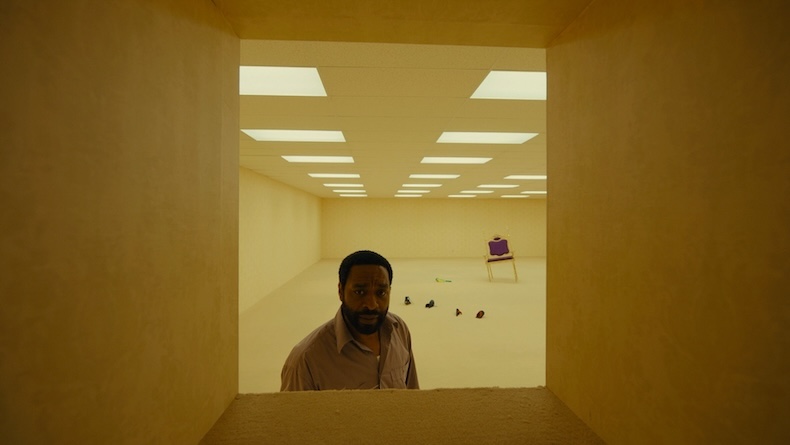
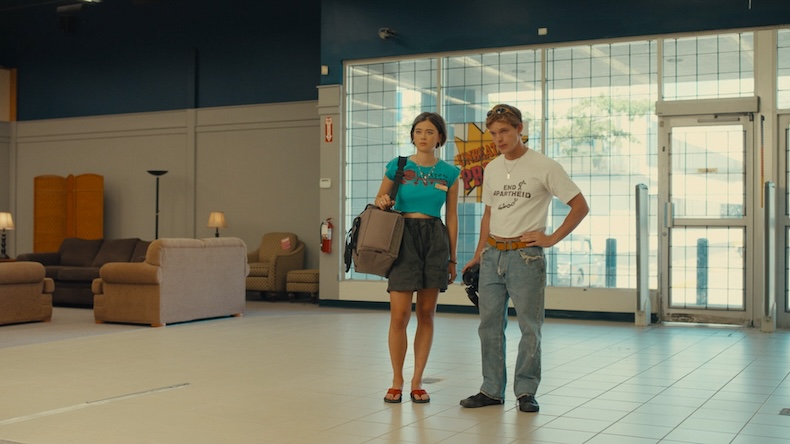
In the basement of his failing big-box furniture store, Clark (Chiwetel Ejiofor) discovers that an apparently solid wall is in fact porous and that he can slip through it. What lies beyond is both mundane and bizarre: a limitless labyrinth of grey carpet tiles and partitions covered in sickly yellow wallpaper, lit with headachy, buzzing fluorescents. Clark, in reliable doomed-protagonist fashion, becomes obsessed with this discovery. He babbles about it to his therapist (Renate Reinsve) and ropes his junior staff members (Lukita Maxwell and Finn Bennett) into his explorations. But a labyrinth must have a minotaur.
I say ‘partitions’ rather than ‘walls’ because it is not quite right to say ‘rooms’. One of the destabilising qualities of the backrooms – the environment, that is, because that is where we have arrived – is the lack of enclosure. Spaces don’t quite resolve. Some of the partitions are waist height; sometimes there are clerestory gaps, or ramps, or blocked doorways, or arches, or narrow slits only just wide enough to squeeze through. You may loop back to where you came from, but there’s always the suggestion of somewhere beyond.
The atmosphere is deeply unnerving, but in a familiar way. We have taken a wrong turn and found ourselves in an untenanted part of the shopping mall, or a floor of the exhibition centre that is not hosting an exhibition, or hotel function rooms that are slowly losing their function. Human activity has vacated. Whatever relics are left behind, such as signs and oddments of furniture, have become strangely unmoored, taking on enigmatic, de Chirico significance. As in de Chirico’s work, the perspective lines seem to lead nowhere good.
Backrooms began life as an anonymous post on an internet message board in 2019. The (real) photograph accompanying the post laid out the essential components: the ceiling tiles and fluorescent light, the sickly yellow tinge, the dreary wallpaper, the obscured view suggesting a continuation of the space far beyond what can be seen. In 2022, Parsons began uploading short films based on the concept to his YouTube channel, made using the 3D graphics program Blender and taking the form of ‘found footage’ from expeditions into the backrooms. These shorts were a viral success and other creators emulated and added to them, making the backrooms an exercise in spontaneous collaborative storytelling, resembling the oral tradition. In his remarks before the screening I attended, Parsons acknowledged the ‘publicly owned’ character of the material.
The ‘open source’ nature of the backrooms is part of what gives them strength as a contemporary myth – the sense that they were not created, but already exist in the collective subconscious. I became aware of Parsons’s shorts as they were repeatedly sent to me by people who felt they resembled my novel The Way Inn (2014), in which an out-of-town chain hotel is the entry to an endlessly replicating series of corridors and courtyards. A terrible entity lurks therein, but the really terrifying entity is the environment itself. I don’t believe for a moment that I had anything to do with the backrooms – what’s much more interesting is the thought of separate creators thirstily drawing on an innate quality of modern space. For me, the inspiration had come from architect Rem Koolhaas’s essay ‘Junkspace’ (2000), a professional’s lament for the proliferating substandard semi-commercial spaces that accompanied airports, hotels, convention centres, shopping malls and so on – not an aberration from 21st-century space but ‘the main thing’, which had replaced architecture and was metastasising across the surface of the earth. The nightmare of junkspace, Koolhaas writes, is its lack of edges, a ‘fuzzy’ or blurred quality. It has no beginning or end. This was already horror, I just made it into a work of fiction.
What Backrooms adds is an unexpected layer of nostalgia. Flickering CRT screens and flurries of VHS snow are the newest texture of yesteryear, as clear an indicator of era as Kodachrome, Super 8 or sepia tinting. Rattan couches, stained pine and answering machines put us firmly before the turn of the century. It’s the way everything looked before IKEA opened in town. The camera lingers fondly on 3.5-inch floppy discs. All this takes on an extra layer of significance when you consider that Parsons is only 20 years old. It may be (I insist) the fairly recent past for this reviewer, but for the young creators making these online shorts, it’s a lost world, less turn of the century and more fin de siècle. This sharpens our view of the backrooms as a 21st-century answer to the classic ‘haunted house’ of the early 20th century, the unheatable Second Empire money-pit painted by Edward Hopper in House by the Railroad (1925). A hundred years later the same gothic atmosphere clings to the tiles and vinyl of dead malls and similar acres of extruded, offline postmodern space, sterilised of function by the global financial crisis of 2008. It’s a place made from the leftover fabric of the last century.
Computer games are another strong influence on Backrooms, and the backrooms in general. Parsons’s film sometimes has the feel of a game, with its mazes, loops, scale shifts, hidden troves and puzzles solved under the terror of pursuit. But although these are all filmic as much as ludic, the backrooms myth also quotes some deeper elements of spending time in the landscape of games. The earliest web versions of the story talk about ‘no-clipping’ out of our reality, referring to a type of glitch (or cheat) in games where a player is able to pass through a surface or obstacle that ought to be ‘solid’. This can mean accessing a space that was made by the developers but not intended to be seen by the player – a vast wilderness of partially textured, undesigned virtual space, or a sort of junk room filled with test objects. Sometimes it can result in ‘falling’ into an endless void, or causing the whole game to freeze or crash. Backrooms shows us some of these mysterious virtual corners bleeding through into the popular imagination.
The virtual world has a more direct relationship to another recent film, Exit 8, directed by Genki Kawamura and based on a computer game made by Kotake Create in 2023. A man – portrayed in the film by Kazunari Ninomiya – is trying to find the titular exit of a sprawling subway station. He becomes trapped in a loop of white-tiled corridor. Every time he notices something amiss in his surroundings – an ‘anomaly’, which can be as subtle as a doorknob out of place – he must turn around and go the other way, or he will get no closer to his goal. This made an excellent basis for a short, unsettling game; it transfers a little shakily to 95 minutes of linear storytelling, but the result is distinctive and memorable. Just as in Backrooms, the overt horrors that emerge are a little extra to the subtle nightmare of a mundane, in-between location closing like a trap around the characters. The underlying fear in both films is not violent death but loss of self, and endless looping undeath. Both use architecture to express this fear – or rather it is not architecture, but a kind of thoughtless spatial extrusion, which is weaving its way to becoming the defining nightmare of the century.


