The Finish of the 1827 Gold Cup (1827; detail), John Frederick Herring, Sr. Danum Gallery, Library and Museum, Doncaster. Photo: Heritage Doncaster

‘Four things to see’ is sponsored by Bloomberg Connects, a free arts and culture platform that provides access to museums, galleries and cultural spaces around the world on demand. Explore now.
Each week we bring you four of the most interesting objects from the world’s museums, galleries and art institutions, hand-picked to mark significant moments in the calendar.
Royal Ascot, which attracted hundreds of thousands of visitors this week, is one of the oldest and most celebrated fixtures in the racing calendar. The hats are imaginative, the dress code fiercely defended and the racing world-class.
The event was founded by Queen Anne in 1711 but horse racing itself is considerably older. Chariot races featured in the ancient Olympic Games and competitive riding took place in ancient Persia, China and the Middle East long before it became an organised sport in Europe. In Britain, horse racing received patronage from the Stuart monarchs and grew rapidly through the 18th century.
It’s not hard to see why racing has always attracted artists: the raw athletic power of the horse, the split-second drama of the finish, the noise and spectacle of the crowd. Betting and social display, danger and glamour, aristocratic patronage and popular entertainment – the racetrack brought all of it together. This week we explore four works that capture the excitement of horse racing.
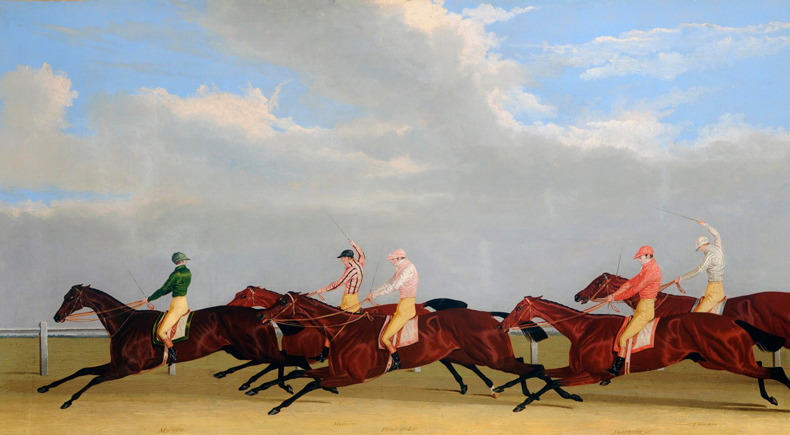
The Finish of the 1827 Gold Cup (1827), John Frederick Herring, Sr
Danum Gallery, Library and Museum, Doncaster
Horses and jockeys surge across the canvas, the grandstands of Doncaster receding to near-invisibility as the race reaches its climax. The painting records the fight for second place between Memnon and Fleur de Lis, which was so close that the judges were unable to separate them. Herring painted the horses in the characteristic rocking-horse pose of the period – legs fully extended fore and aft, which reflected the limits of our vision before photography revealed how a horse really galloped. Click here to find out more.
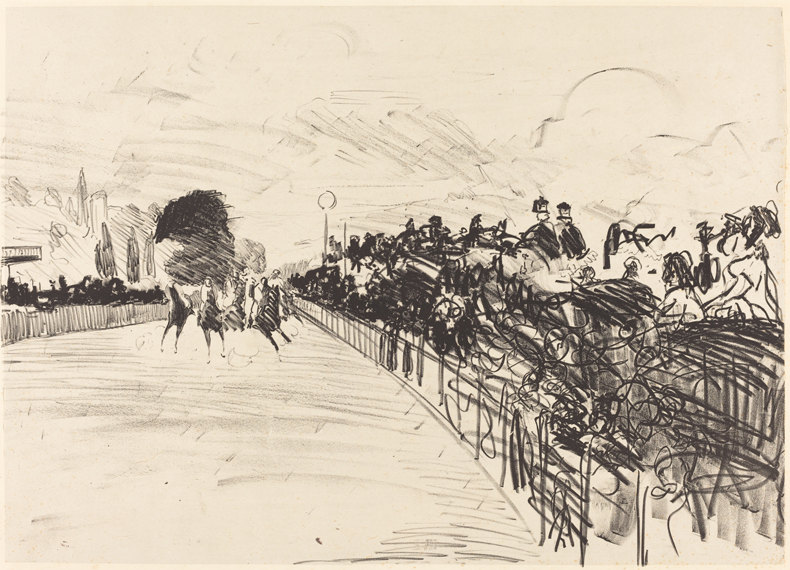
The Races (1865–72), Édouard Manet
Van Gogh Museum, Amsterdam
Scrawled in energetic black marks, this lithograph abandons the orderly panoramic tradition: rather than the conventional side-on perspective, the horses appear to be galloping directly towards the viewer. To the right, the crowd is made up of frantic hatching and looping lines that suggest noise, movement and excitement. The Longchamp racecourse on the western edge of Paris had become the gathering point for fashionable society, where aristocrats and wealthy demi-mondaines mingled with bookmakers and bettors. Manet, who was interested in the textures of Parisian life, recognised the racetrack as ideal subject matter, and this lithograph captures it at its most exciting. Click here to find out more.
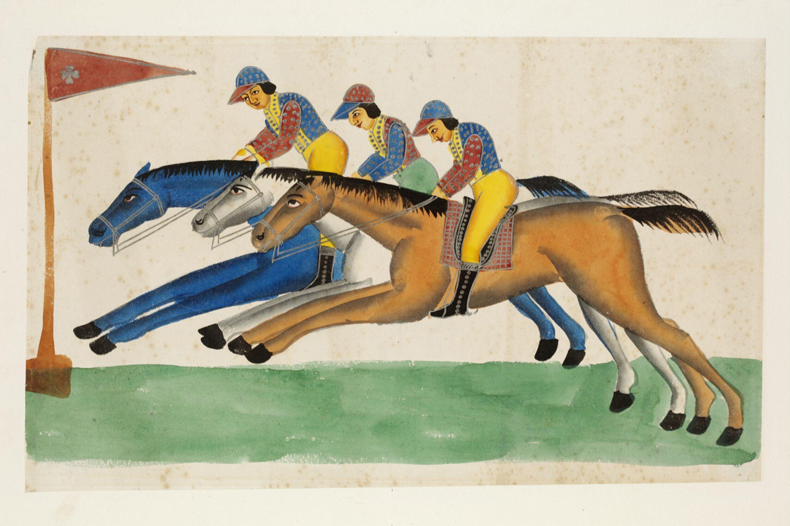
Watercolour of jockeys racing (c. 1830), Kalighat painter
Victoria and Albert Museum, London
Three jockeys on horseback lean forward as their mounts gallop towards a red finishing flag. In the 19th century, Calcutta was the capital of British India, and horse racing, imported by the colonial administration, had become one of its most visible social rituals. Kalighat painters – artists from rural Bengal who settled in Kolkata and began producing work that reflected the rapidly changing world around them – responded with characteristic boldness, putting a local spin on a British sporting import. Click here to find out more.
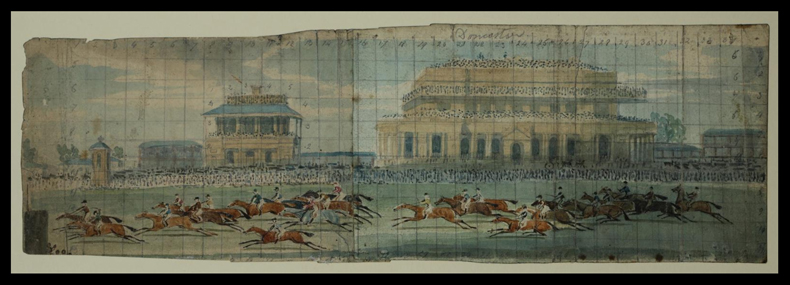
Watercolour of a race at Doncaster (19th century, before 1867), James Pollard
British Museum, London
In this vivid painting, horses and jockeys race from right to left, past packed stands and a dense crowd of spectators. Numbers and grid lines pencilled across the surface suggest that the image was used as the basis for an engraving. Pollard trained as an engraver and became the foremost specialist of his era in painting horse-drawn coach and sporting scenes. The panoramic format, which here is crammed with incident, suited a subject that was as much social spectacle as athletic contest. Click here to find out more.

‘Four things to see’ is sponsored by Bloomberg Connects, a free arts and culture platform that provides access to museums, galleries and cultural spaces around the world on demand. Explore now.