From the July/August 2026 issue of Apollo.
Hannele Klemettilä’s book The Medieval Kitchen is at once a culinary history of medieval Europe and a recipe book for those who want to recreate popular dishes from the period. One of the most cited visual sources in the book is the Luttrell Psalter, a prayer book commissioned in the early 14th century by Geoffrey Luttrell, a wealthy Lincolnshire knight, and filled with illuminations by a series of anonymous artists. One page from the Psalter in particular catches the eye: a depiction of two kitchen helpers turning a spit to roast pigs for a feast. Created around the time of the Little Ice Age, when storms and freezing weather struck the country, the image depicts a kind of plenty that could be intended as ironic. Many images of medieval banqueting seek to look enviable; some are even tinged with the divine. A miniature in the Lancelot du Lac manuscript (1300–25) in the collection of the British Library shows a feast at the court of King Arthur, with a gilded wall behind the banqueting table and, with 13 diners, a visual echo of the Last Supper. In a world where it was possible to eat your God, albeit in the form of a thin white wafer, the mouth was often seen as the seat of the soul and gustatory pleasure was proof of the divine. At the same time, medieval Christianity endorsed fasting as the acme of holiness; many of the greatest medieval saints starved themselves to death.
Those servants in the Luttrell Psalter are not eating but cooking, however, and the manuscript offers a number of examples of what must be done to flesh in order to turn it into food. Such sights are bound to lead to eater’s remorse: in order to eat at all, we have to pretend that our food was never alive. Men turn over pieces of meat with pincers, a sight that recalls the hellscapes in which human flesh is pulled off as a punishment, or depictions of the flaying of Saint Bartholomew, of which there is one in the psalter. The piglets being roasted on a spit remind us of the more frequently encountered spectacle of the bodies of sinners being turned in the flames. In Giotto’s fresco of the Last Judgement in the Scrovegni Chapel in Padua, a sinner is turned on a spit that pierces his mouth and anus, representing his physical sins. In medieval Venice and elsewhere, the bodies of those convicted of sodomy were burned, to cleanse the city: the fire that crisps the pig’s fat could also become an instrument of human and divine justice.
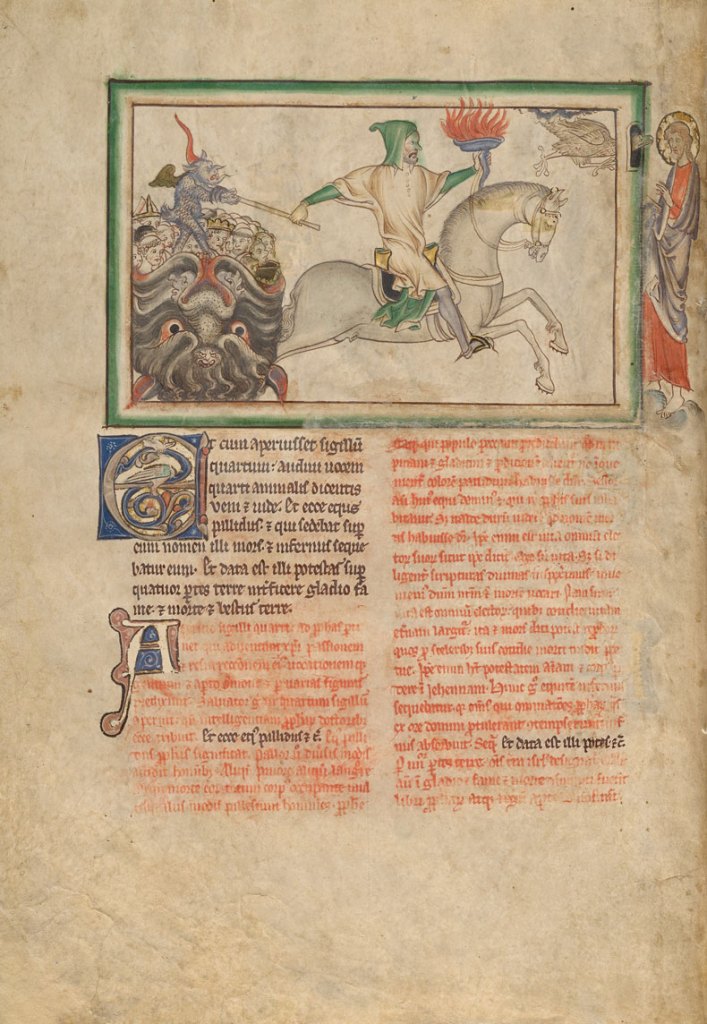
Feasting in the Middle Ages could be at once celebrated and linked to damnation. Elias Canetti once said that having dinner with someone creates social bonding because neither of you eats the other. But hell is different: in hell, everybody is food. That is only fair, because during their lives they have been devouring others, even if metaphorically. In the old English funeral chant the ‘Lyke-Wake Dirge’, we are told that those who did not give meat and drink to others will themselves be burned ‘to the bare bone’ in the fires of Purgatory.
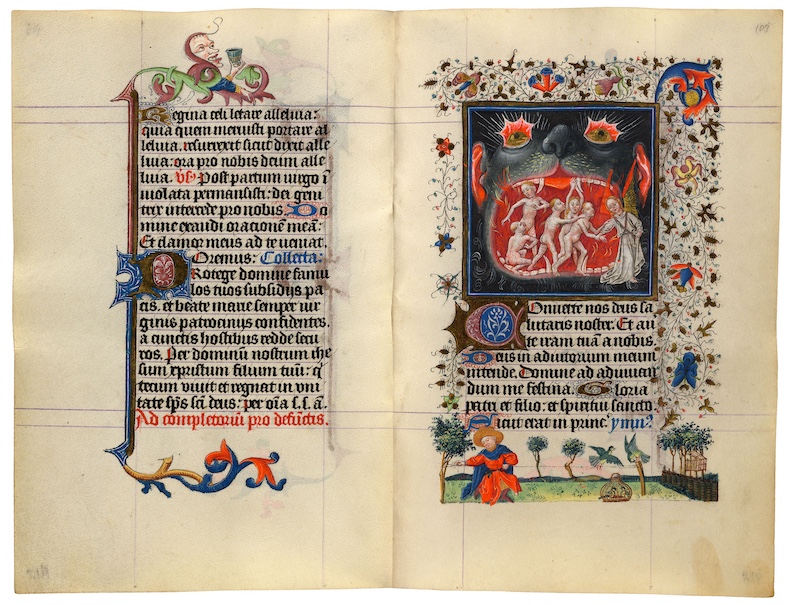
This idea reaches its apex in medieval depictions of hell as a mouth that eats the bodies of those who fall into it. One of the best-preserved medieval stained-glass windows in the UK, at St Mary’s Church in Fairford, features a spectacular image of the gaping jaws of Satan devouring the damned. Medieval and early modern theatre sets often incorporated a hellmouth, in the form of a papier-mâché prop, that could swallow up the damned and remind audiences to stay virtuous.
When we turn back to the banqueting table after such reflections, we might find ourselves hesitating before cramming piles of roasted flesh into our mouths. On one page of the Luttrell Psalter, we see Geoffrey Luttrell at a table surrounded by his family and two Dominican friars, in a scene of serene social order. Yet that serenity masks the body’s hellscape and its eventual fate. One day, we might pass from eating to being eaten, not once but repeatedly, moving through the guts of the underworld and re-emerging only to be swallowed once more.
The Medieval Kitchen: A Social History with Recipes by Hannele Klemettilä is out in paperback in August (Reaktion).
From the July/August 2026 issue of Apollo.