From the July/August 2026 issue of Apollo.
If you find yourself in Jungmannovo náměstí, a small square in central Prague, you’ll see a curious lamp post. It looks a little like a Brâncuși column. It was erected in 1913, five years before the Romanian artist made his first Endless Column. At its base is a seat and on its crown a lantern with faceted panes contained in a cage of ironwork. This streetlight was designed by Emil Králíček. It is not the original: that was moved to a museum because this is, perhaps unsurprisingly, the world’s only cubist lamp post.
It is one of the smallest but most elegant encapsulations of an artistic movement that lasted no longer than a few years in the period immediately before the First World War; one which was unique to what is now the Czech Republic, and mostly centred on Prague, which was then still part of the Austro-Hungarian Empire. It was a style characterised by oblique surfaces, angular planes, fragmentation, facets and folds. It anticipated much that came later, from Expressionism through brutalism to deconstructivism; exemplars such as Josef Chochol’s Hodek Apartments (1913–14) on Vyšehrad are among the most charismatic monuments of early modernism, buildings that we don’t seem to have quite caught up with yet.
When we think of cubism we probably think about paintings on canvas. We might understand it as an attempt to embody the three-dimensional world in the painted plane for an age when photography had radically undermined traditional representation and realism. Cubism was a way of capturing instead the experience of a world in its full dimensional complexity.
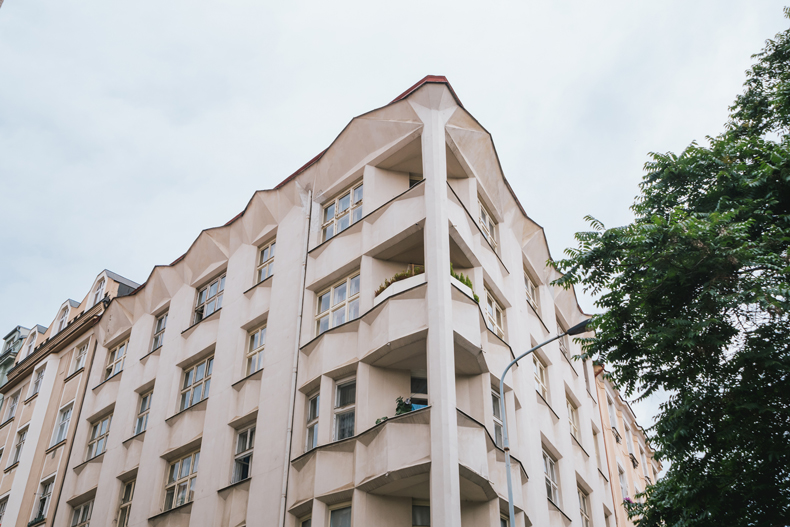
Buildings and objects, however, already exist in three dimensions. The Czech cubists, who began to formulate their ideas in salons, magazines and manifestos in around 1911, had a vision to unite all the arts in a single movement inspired by new understandings of space, time, form and the underlying structure of the cosmos and everyday matter. Einstein, whose theory of special relativity had been published in 1905, had upturned the understanding of time and space and, critically, of mass and energy. The cubists were looking to express that shift in art and design, to express that energy embodied in matter through static media.
At the heart of the movement was a surprisingly large group of architects, artists and writers including Josef Gočár, Josef Chochol, Vlastislav Hofman, Pavel Janák, Otto Gutfreund, Bohumil Kubišta (yes, really) and Karel and Josef Čapek. The Čapek brothers were writers; it was Karel who created our idea of robots (or rather androids) in his play R.U.R.: Rossumovi Univerzální Roboti (1920), while Josef was also a fine cubist painter.
In a manifesto of 1911 Pavel Janák wrote: ‘All shapes that occur in inanimate nature are geometrically complex evolved with the collaboration of a third force. The oblique fall of rain is caused by the additional element of wind; similarly, snowdrifts, washouts, ravines, caves, sinkholes, and volcanos, are […] positively or negatively created forms made out of inanimate matter by another invading force […] Crystallisation offers the most beautiful example […] it is so powerful that it transforms itself, under all circumstances, into a concentrated, self-contained world.’
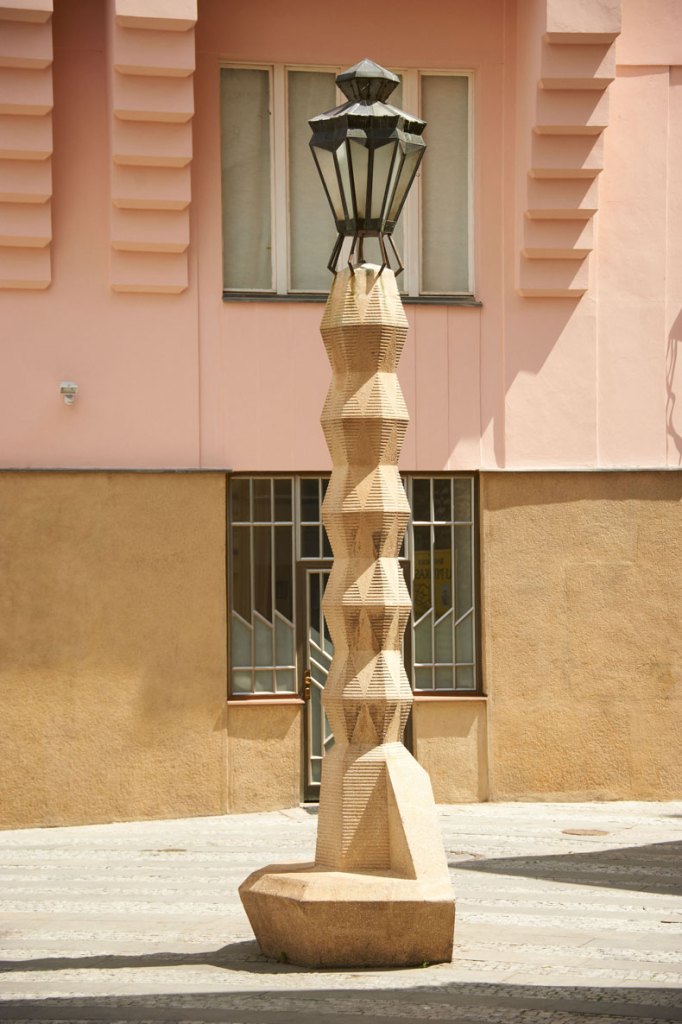
It was that concentration that they were trying to achieve in a single work; the effect of compressing the force, whether of nature, creativity, energy or motion, into an architecture capable of fully reflecting the dynamism of the cosmos. Janák goes on to describe the origins of the physical forms they employed: ‘A beautiful parallel between the means of human creativity and the means of artistic creation offers itself here: wedges, arrows, posts, knives, levers, all of which overcome matter physically, are generally oblique planes.’
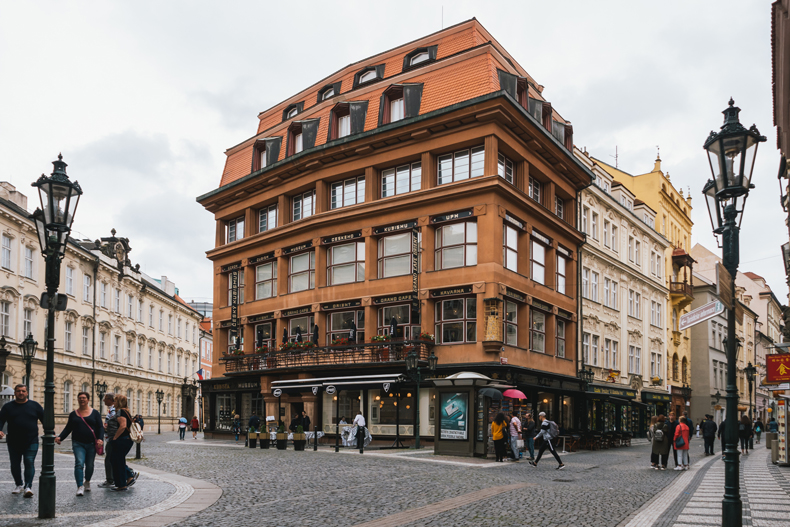
The results can be spectacular, and spectacularly eccentric. Largely ignored as an artistic dead end for most of the 20th century, Czech cubism was rediscovered in the eclectic enthusiasm of postmodernism and the attempt to redefine modernism as a more diverse movement than its MoMA-promoted International Style image. The centre of the movement – now recast as a tourist curiosity and social-media sensation – has become the House of the Black Madonna (1912), the first major realised work in the style in Prague. Named for the baroque sculpture of a black Madonna on its corner – salvaged from an earlier building on the site – it was designed as a small department store by Josef Gočár and looks, at first glance, fairly conventional. But when contrasted with its neighbours it seems astonishing. With curious columns with wedge capitals, faceted mansard windows and, inside, a looping spiral stair, it is completely original. Now boasting a cafe, design shop and museum, it has become a place of cubist pilgrimage.
There are a number of these structures scattered throughout the city, some more extravagant than others. Chochol’s villas Kovarovic (1912–13) and Bauer (1912–14) are both symmetrical reinterpretations of the classical bourgeois villa. The furniture he designed for these houses remains remarkable, much of it presaging the forms of art deco and 1920s Expressionism, the bookcases and vitrines often being the most exuberant – mini-urban structures in their own right.
The war almost killed Czech cubism; it emerged on the other side, in a newly independent Czechoslovakia, as rondo cubism. Facets and angles were replaced by scallops, arches and circles, stripped classical motifs and echoes of the baroque, that enduring influence of Prague’s haunting churches, which had always somehow been latent in the style’s examples. Those works in their turn were reinterpreted by an increasing interest in folk and vernacular forms; a brief, strange moment in which those ideas informed by relativity and distortions in time and space were applied to log cabins and wooden houses painted in brilliant colours. Then the white walls, strip windows and straight lines of modernism arrived.
Yet even if Czech cubism was later derided as an architectural cul-de-sac, it left an important legacy. It is there in German Expressionism, in the early work of Walter Gropius, and then the Bauhaus. You can see its influence in the brutalist work of Gottfried Böhm (notably the pilgrimage church of Neviges), and in Claude Parent’s architecture of slopes and ramps. And you can see it reflected in the work of Zaha Hadid, Frank Gehry and beyond.
Key to its enduring success is that, for all its revolutionary angularity and obliqueness, Czech cubism remained contextual. These architects managed to work within the tectonic language of a medieval and baroque city centre, acknowledging the advances in our understanding of the universe and yet creating designs that fitted into a continuum. Eccentric they may be, but these buildings remain enigmatic and beautiful.
From the July/August 2026 issue of Apollo.