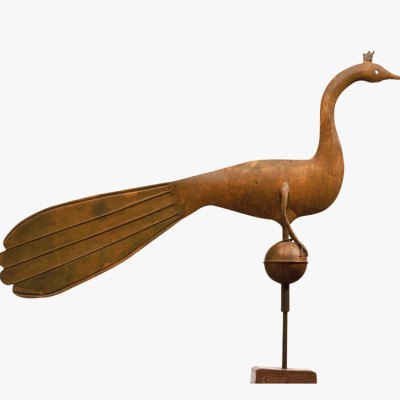
Who gets to be an artist? Or rather: who gets to be called one? These and other questions are present but unarticulated in ‘American Folk Art’ at the Museum of Modern Art in New York. Drawing from the collection of MoMA co-founder Abby Aldrich Rockefeller, this mid-size, two-room exhibition provides a decent overview of the diverse forms that, in the first decades of the 20th century, were alternately known as vernacular, primitive or folk art. There are a number of portraits painted by the itinerant artists known as ‘limners’, as well as social scenes, memorial watercolours and product advertisements. There are carved figures, wooden toys, cast metal weathervanes and a hunting decoy in the form of a slipstreamed crow.
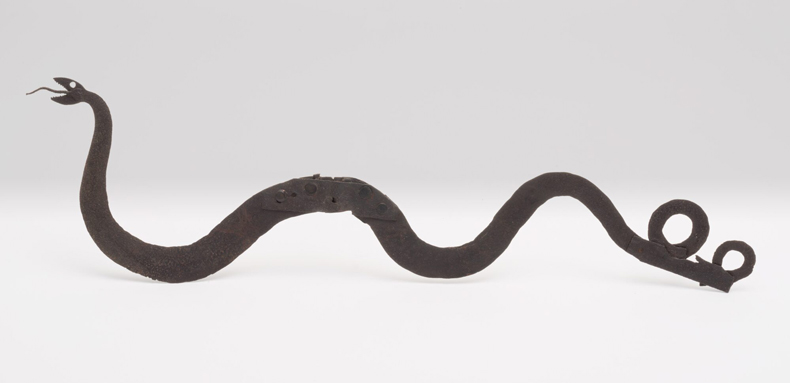
The pieces range from the decorative to the practical – or somewhere in the middle in the case of stoneware jug with pursed lips and bulging eyes. Almost all could be described as applied arts, works ‘of a type’, executed for a purpose yet carrying still the mark of their makers. I was most struck by a collection of weathervanes, sinuous and striking, cast by industrial artisans for widespread use. Towards the midpoint of the exhibition there is a group of vivid watercolour and pencil depictions of fruit bowls, all made by young women then enrolled in boarding school. The actual shape of each fruit was set by stencil but their arrangement was entirely up to the girl. One painting is orderly, another wily and chaotic. The artist pushes her personality through the form and across the gap of the centuries.
Rockefeller’s collection was purchased in the 1930s and ’40s at the Downtown Gallery in New York’s Greenwich Village, which specialised in modern and vernacular art. It privileges works from New England and the Eastern Seaboard but there are also pieces here from Tennessee, Michigan and Indiana. They were chosen for the distinctly ‘American’ qualities, representing key national traits or depicting important scenes of national mythology, such as the founding of Pennsylvania. Yet many of these objects betray the immigrant character of the country some 150 years after its founding. A prominently placed wooden sculpture of a preacher was long assumed to represent some puritan demagogue; it is most likely an image of Martin Luther. There are hand-painted certificates and religious objects, created by Pennsylvania Dutch refugees and written in German. The term ‘folk art’ most likely comes from the artist and collector Elie Nadelman, who was born in Warsaw in 1882 and came to the United States only in 1914.
Many pieces were made by itinerants – artists such as Wilhelm Schimmel (1817–90), who drifted from town to town, paying off his bills with large-scale wooden pieces he would sculpt with his pocket knife. Others, such as a large-scale painting of Pennsylvania’s Manchester Valley executed by Joseph Pickett (1848–1918), convey a deep familiarity with their subject matter. I found myself drawn in once and again by the way that Pickett painted his trees, building them sculpturally out of the canvas using a mixture of oil paint and sand. This was a man who knew not only how those trees appeared but also how they stood, how they felt.
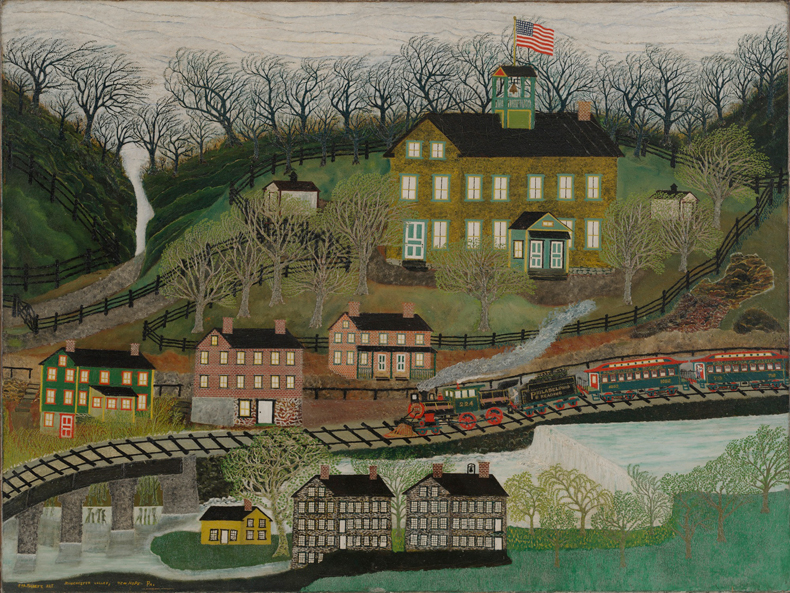
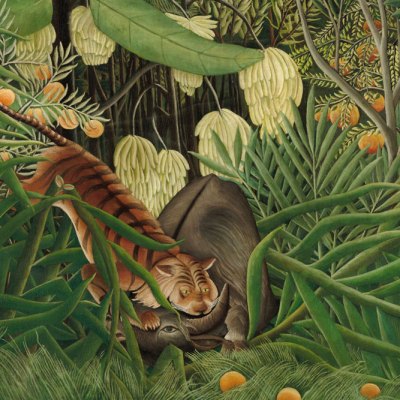
Though not quite so technically perfect as the paintings of fellow Pennsylvanian Andrew Wyeth, Pickett’s work depicts the same landscape with similar familiarity. So why is he down in this special exhibition, while Wyeth’s Christina’s World gets pride of place in the permanent collection? This, as ever, is the tricky question when it comes to folk art. In the 1940s, MoMA hung many of these pieces alongside paintings by Henri Rousseau and John Kane in an exhibition called ‘Modern Primitives’; Kane is included in ‘American Folk Art’, alongside the folk-influenced artists Yasuo Kuniyoshi and Marguerite Zorach. Yet these pieces are still clearly segmented from the rest of the collection, the issue of individual artists with an individual perspective rather than semi-anonymous figures collected for how well they represent a particular tradition. Occasionally a Kane or a Rousseau will break through and is separated immediately from the folkloric mass. Derek Hill considered the painters of Donegal’s Tory Island every bit his equal, yet it took his backing to get them shown outside of their own homes. There is always a problem of credentialling, of categorisation (often ghettoisation) by self-appointed experts.
Yet throughout the exhibition you sense the urge that so many people have towards beauty, whatever the limits of their training or their resources. They remind me of my friend’s father, a railroad engineer who lives in a house of his own design, and of my family back in Ireland, who decorate their homes with petrified wood dug up during peat cutting. They are artists, all of them. Don’t expect MoMA to come calling.
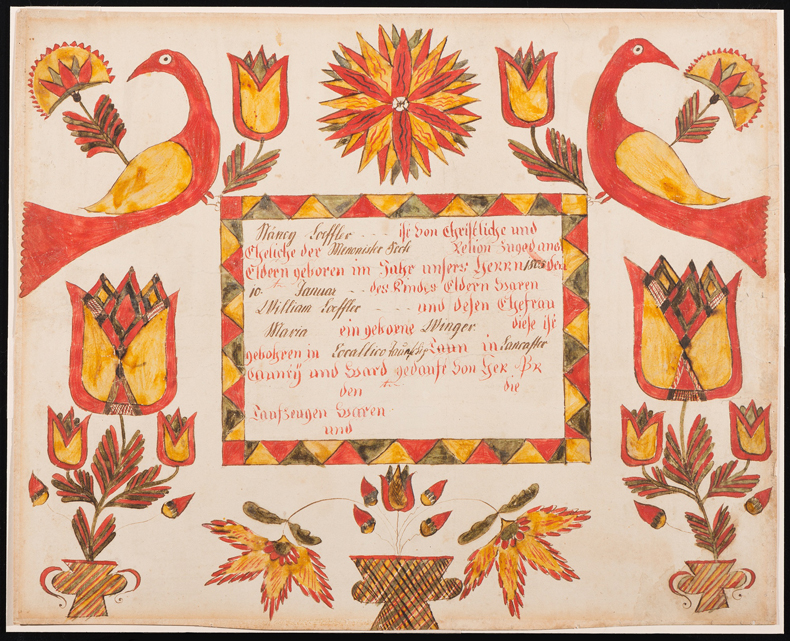
‘American Folk Art: Revisiting the Collection of Abby Aldrich Rockefeller’ is at the Museum of Modern Art, New York, until 9 August.