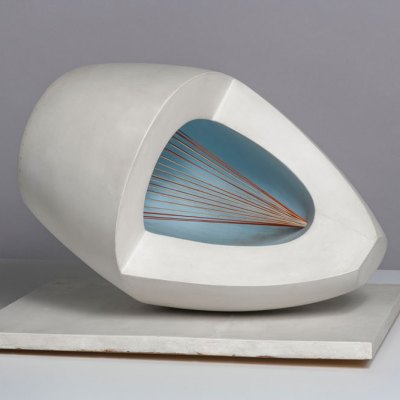
Home to some of the best known and most sensually appealing European artworks of the last thousand years, the Courtauld is also a global centre of academic art history. An exhibition of work by Barbara Hepworth (until 6 September) exemplifies both strengths. The show is built around one piece: Sculpture with Colour (Oval Form) Pale Blue and Red (1943), acquired for the nation by the Hepworth Wakefield in 2025 after a £3.8m fundraising campaign. The acquisition inspired new scholarship on this piece and others, focusing on the role of colour in Hepworth’s sculpture – a strand of her practice that she found to be distressingly misunderstood in her lifetime. The result is an exhibition of clarity and beauty, disposed over two rooms. It brings together drawings and sculptures spanning three decades, all illustrating some aspect of the question asked as long ago as 1970 by her son-in-law, the art historian Alan Bowness: ‘Why do you introduce painted colour into stone and wood carvings?’
Her early work, from the 1930s, revels in the beauty of natural materials – different woods and coloured marbles. But this show makes clear that from 1936 Barbara Hepworth was also intrigued by the idea of applying an artificial surface of paint to her work. She later recalled that when she made the sudden journey from London to St Ives with her young family at the outbreak of war in 1939, the only artwork she took with her was a maquette for ‘the first sculpture with colour’ (since destroyed), complete with white and blue colour and red strings. Although unable once in Cornwall to work at scale, lacking space and materials, and with triplet toddlers underfoot, she started work on a striking series of plaster maquettes, on view here: three-dimensional ovoid forms cut into at abrupt angles, the interior cavities painted a deep blue, with red strings across the mouth, and the exterior a startling white. As the curators point out, while many have noted the influence of the vivid light and colours of the Cornish landscape on Hepworth’s later sculptures, the blue and white used on these maquettes owe little to nature. Hepworth had more probably been inspired by her visit to Mondrian’s studio in Paris on 1 January 1935; she was struck, she later wrote, by the ‘different-sized rectangles of primary colours – red, yellow, and blue’ on the white walls. Another inspiration may have been the circle of modernist architects in London who introduced Hepworth to Le Corbusier’s ideas about colour, space and architecture.
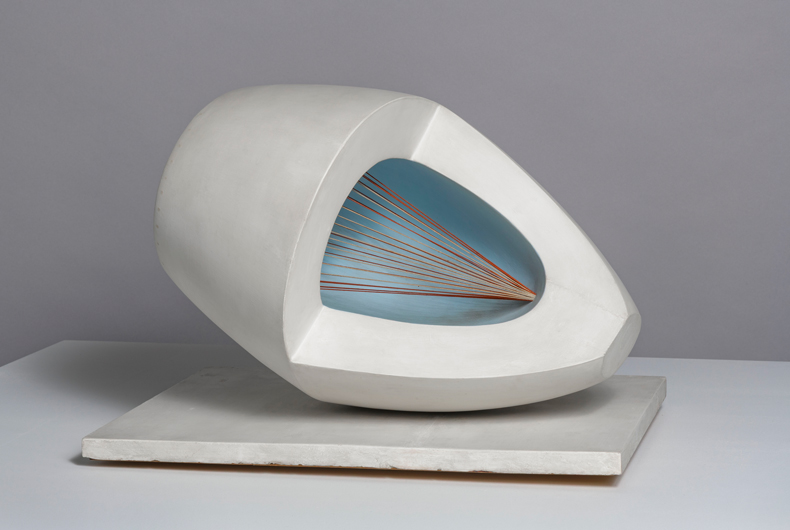
Around the maquettes are some of the many geometric drawings Hepworth created at this time, in pencil and gouache, on board or paper, with sharp accents of colour, exploring the ways in which colour could create space within two-dimensional abstract images. By 1943, when Hepworth was granted a permit to use wood for sculpting and moved into a larger studio, the Cornish coastline had worked its way deep into her imagination. While Oval Form retains a constructivist purity of conception, with the mind responding to each very different point of view, the paler blue colour inside evokes what Hepworth would later call ‘depth of water, caves, or shadows deeper than the carved concavities themselves’, prompting one also to hear and almost smell the sea and sky. Meanwhile the red and white strings, she suggested, express ‘the tension I felt between myself and the sea, the wind or the hills’.
The second room brings together a tightly curated group of drawings and painted sculptures in wood, stone and bronze from the following decades, showing how a concern for colour continued to run through her work. The connection between the immediate environment and Hepworth’s art is never figurative or decorative. The colour serves not in opposition or in addition to form, but rather as part of the artist’s enquiry into space and structure, enhancing the impact of Hepworth’s pierced forms and giving spatial depth to her intensively constructed, sometimes almost carved drawings. Highlights include Wave (1943–44), which is held in tension by tawny strings between the peak of a curve and a folding collapse, and Pelagos (1946), with its ethereal blue inner skin enhancing the effect of Hepworth’s intended comparison with ‘the arms or bosom of a goddess’.
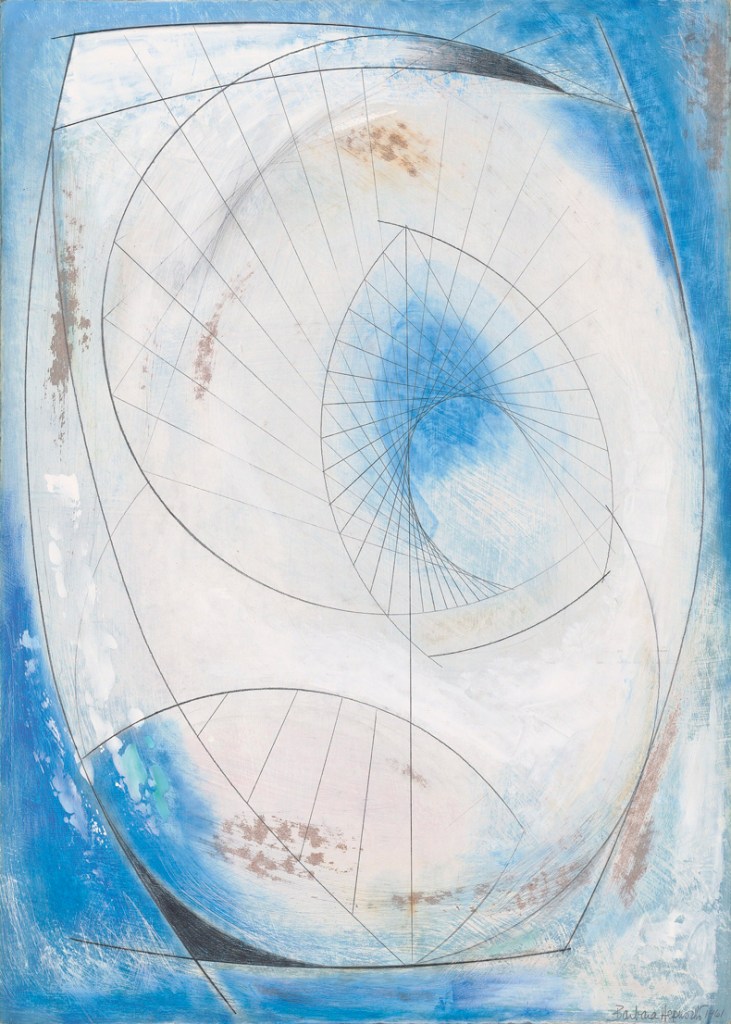
The drawing Turning Form (Atlantic) (1961) shows a freer use of colour and pencil, with blue, white and green paint evoking the splash and spray of seawater, the vortex of wind and sky, overlaid by a structure of geometric pencil lines. It shows off the brightness of phthalocyanine blue, or Monastral Blue, one of the organic synthetic colours Hepworth had embraced since the 1940s. Not only does the exploration of Hepworth’s use of colour in this tightly focused exhibition offer a new way of thinking about her entire oeuvre, it also leaves us wondering how this element of her work ever escaped our notice.
‘Hepworth in Colour’ is at the Courtauld, London, until 6 September.