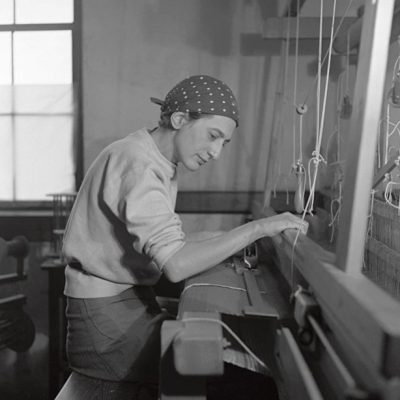
Weaving balances thousands of thread-lines which, in their close proximity, move suddenly between orderly and disorderly layers, knots and twists. The great weaver Anni Albers never stopped considering this coming together of pattern and snarl; she turned to another medium, drawing, to study the knot itself. ‘Anni Albers: Constructing Textiles’, a landmark show of her work, which I saw at the Lower Belvedere in Vienna (it had an earlier run at the Zentrum Paul Klee in Bern), has a large room in which the walls are lined with Albers’ reflections on paper about both knots and tangles. A knot is a potentially permanent overlay of threads pulled tight enough that the space has been eliminated and the thread intertwines with itself. One of Albers’ main interests was in restoring the space around the thread-lines so that the eye could follow the pathways of the strands. ‘I am less interested in areas,’ she said in an interview with Sevim Fesci in 1968, ‘and more interested in the voice of the single thread.’
Knots bear a deep relation to mathematics and to the abstract, symbolic work of culture. Early in her career, Albers studied the knot in German collections. She may well have known that Albrecht Dürer was fascinated by the knot and by certain geometric loop works of the Ottoman empire; perhaps she saw his beautiful black-and-white renderings of these abstract patterns from c. 1506–07. Before she and her husband, Josef, left Germany in 1933 (to teach at Black Mountain College in North Carolina), Anni used to go to what is now the Ethnological Museum in Berlin, which is probably where she first encountered the khipu system of the Incas. Khipu are like small, thick hanging curtains of knotted threads suspended from a horizontal, and were used for documentation, and perhaps also for ceremony and storytelling, throughout the empire. The knots on the individual threads were the writing, their number and placement making a record of population, tributes and trade that is also an economic history. About 360 khipus, the largest collection in the world, are held in Berlin.
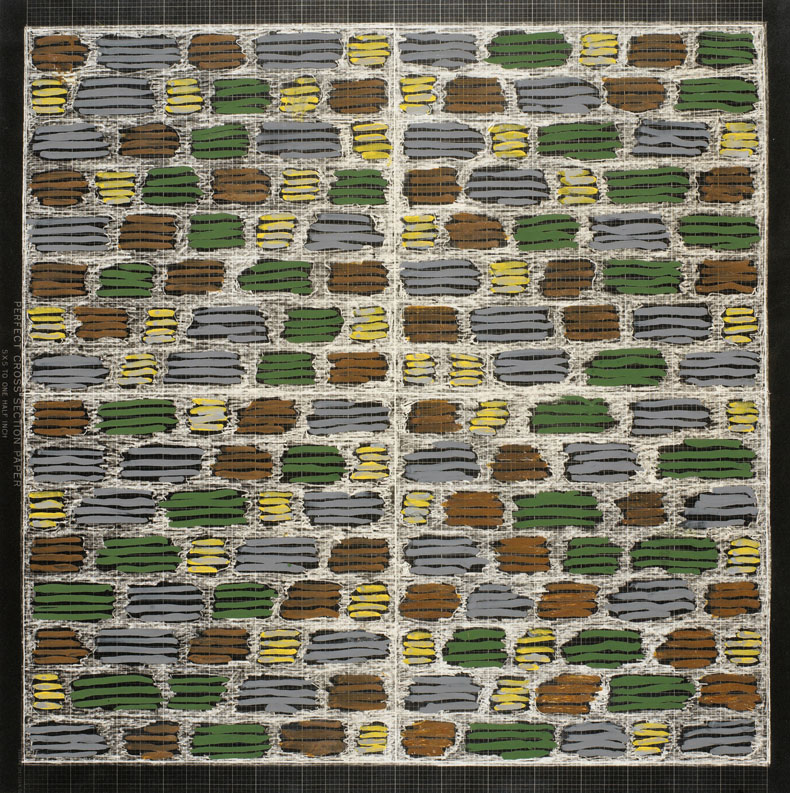
In the Albers exhibition, the curators Brenda Danilowitz and Fabienne Eggelhöfer point out that Albers was fascinated by the idea that sometimes weaving is writing. This is made explicit in Ancient Writing (1936), in which the subtle, closely woven black, white and grey shapes look like passages of text. In other works, such as Open Letter (1958), Code (1962) and Epitaph (1968) as well as in the deliberately scribbled drawings of her last years, the wandering lines are full of symbolic, scriptlike, even digital intent. Albers’ own prose style is compact and judicious. She wrote several books that are foundational texts in the field. In On Weaving (1965) her dedication reads, ‘To my great teachers, the ancient weavers of Peru.’
A thread is a line; in mathematics and in painting it is considered to have two dimensions. A knot is still a thread, but three-dimensional, approaching the condition of sculpture and architecture. One can imagine interesting conversations at Black Mountain College between Albers and the German mathematician and knot theorist Max Dehn after he arrived at Black Mountain in 1945. Dehn worked to understand how one could modify what in topology are called 3-manifolds, closely related to three-dimensional spaces. A knot is an action that creates three-dimensional structure and strength out of two dimensions.
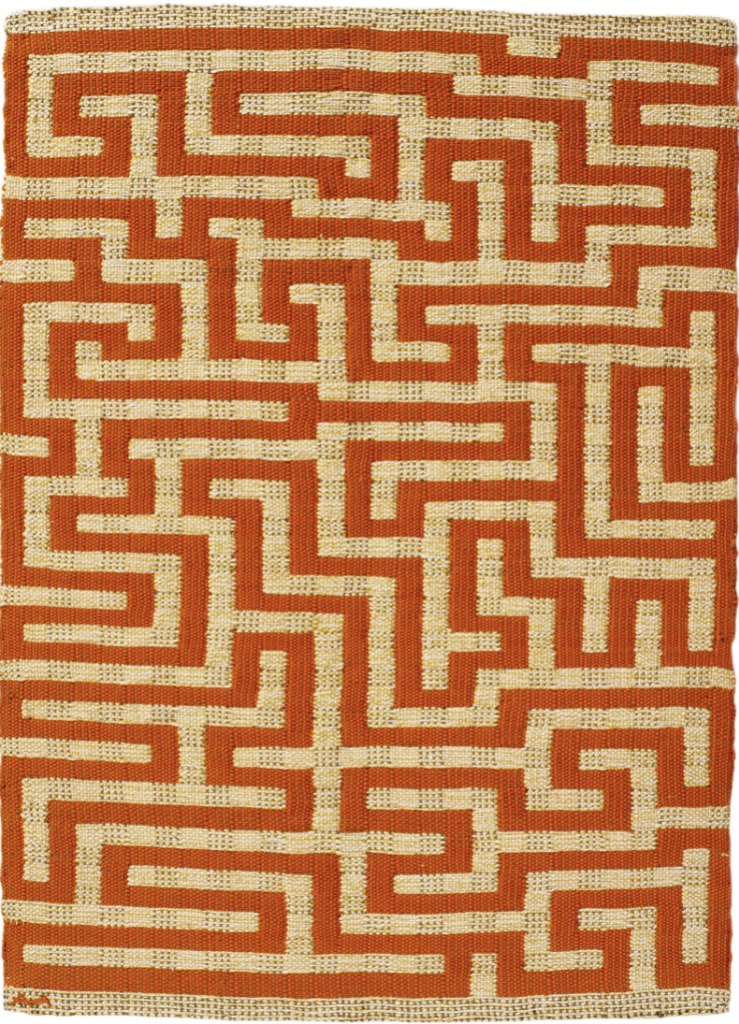
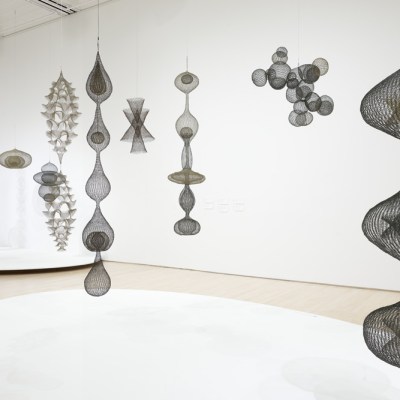
Anni and Josef Albers were interested in building structure from simple materials (as in Josef Albers’ monumental series of more than 1,000 iterations of Homage to a Square.) This was a preoccupation of the Bauhaus in Germany where the Alberses met as students, married and taught, and they carried this enquiry with them to Black Mountain College, where the students and faculty built up the campus and the life of the place using the simplest materials. Albers and her student Alexander Reed made beautiful necklaces from paper clips and bottle tops. One of the Albers’ closest associates from Black Mountain was student and fellow artist Ruth Asawa, the subject of a major retrospective currently at the Guggenheim Bilbao. (Asawa also studied with Dehn at Black Mountain.) There is a photograph of the Alberses in their home in Connecticut with the delicate knotted wires of an Asawa sculpture hanging on the wall behind them. Albers used to keep her letters in a basket made by Asawa, who described her sculptural method as making a single cursive ‘e’ over and over; it was looped from the lettered conversation of the wire with itself. Anni Albers said that weaving was ‘closest to architecture because it is building-up out of a single element’.
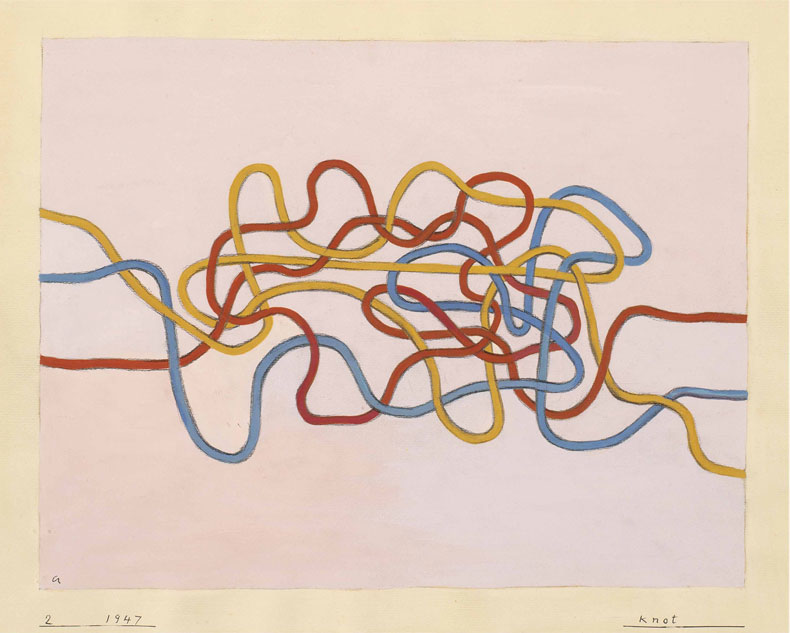
Because Albers rooted herself in weaving, a medium often shuttled to the ‘decorative’ side of museums, and because she was interested in making art that could be widely and democratically available beyond the world of collectors, it has sometimes been overlooked how successful, influential and cerebral her work was. It is not only that she was the first textile artist to have a retrospective at MoMA (in 1949) but also that she invented certain kinds of artistic conceptualisation. As Lynne Cooke, curator of the important show ‘Woven Histories: Textiles and Modern Abstraction’ at MoMA in 2025, points out in the catalogue, ‘textile is not a medium-specific art form’. One can work in the mode of textiles, in a way that is related conceptually or by method or material. The way in which Albers encoded process in her weavings, designs and drawings still offers powerful tools to artists today who wish to move away from blue-chip work and into media that are harder to contain in the old frames. She experimented continually with ways of conceiving and tracking movement in space and, through the air that makes her textiles move, she created special interactions between her works and their viewers. Her ideas and designs are still a part of the lives of ordinary people when they move fabric around in their rooms to create and affect space. Considering Albers’ careful work on semi-transparent ‘room dividers’, Darby English wrote in an essay for ‘Woven Histories’ that her work ‘insists on itself and the many transitions it brings about’.
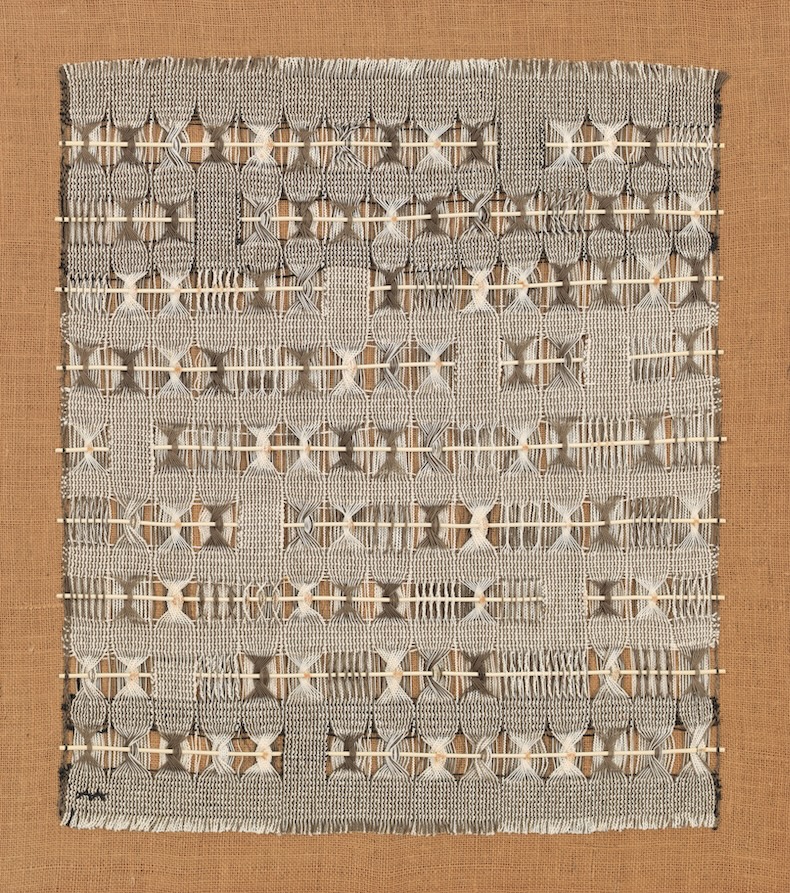
A work I keep returning to in my photographs of the exhibition was in the last room. Variations on a Theme (1958) juxtaposes two colours, a brown and a light beige, which may have faded from an original black and white, but the form and the superb technique still make the contrasts pronounced. The weaving is two-ply, following separate planes of activity, using in the upper layer a pre-Columbian weaving technique called leno to create an open weave of twisted warp yarns. The threads arise, intersect and continue. Dowels (made of plastic tubing) are left in as a horizontal pattern around which the curving threads turn; your eye can trace the falling colours as if following the bends of a river. There are knots of course, to structure and hold the frame and threads, but what Variations on a Theme considers and makes manifest is not a knot, an object, but rather the movement to which Albers devoted her life and work, the activity of threads: knotting, entangling, running next to and through.
‘Anni Albers: Constructing Textiles’ is at the Lower Belvedere, Vienna, until 16 August.