In 1957, Gillian Ayres was offered an unusual commission: to create a mural for the dining hall of South Hampstead High School. The ‘Hampstead Murals’ – four panels more than eight metres wide – were installed that same year, though they didn’t remain on display for long. Made of sturdy stuff – hardboard topped with Ripolin, a household enamel paint – the murals were soon covered by wallpaper; it wasn’t until 1983, so school legend goes, that students took to the murals with buckets of water, soaking and peeling away layers of paper to reveal what lay beneath. ‘Gillian Ayres: A Life in Colour’ at the Box in Plymouth – the first institutional exhibition of her paintings in a decade and the first since the artist’s death in 2018 – is not unlike those eager students, bringing Ayres’s seven-decade career back into focus.
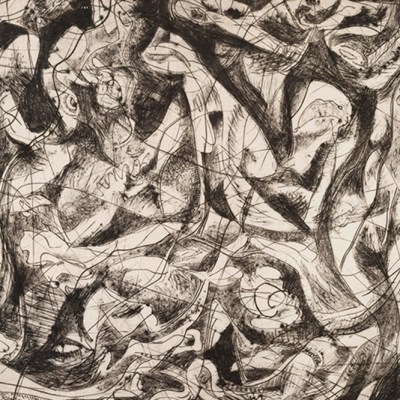
Born in Barnes in 1930, Ayres was a precocious teenager – Harlyn Bay (1945), a roiling seascape painted when she was just 15, puts her beyond her years. Accepted to the Slade at 16 but too young to take up her spot, Ayres studied at Camberwell School of Art instead. After graduating in 1950, she split her time between painting and a part-time job at AIA Gallery in London – a role she shared with her husband at the time, the artist Henry Mundy. In 1956, Ayres came across photos of Jackson Pollock working in his studio, folded at the hips as he flicked paint on to a canvas on the floor. His influence is obvious in the murals Ayres made the next year – globs and streaks of colour splash across their surface; rings remain where tins of paint were set down without a wipe around their base.

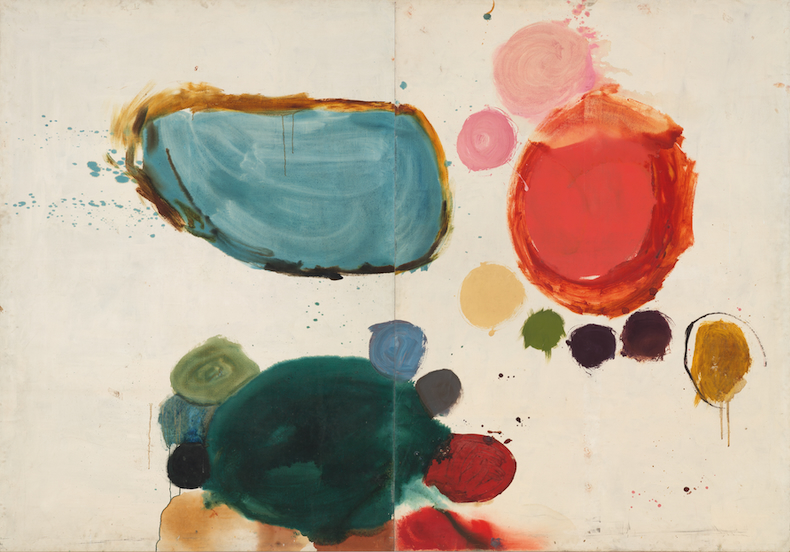
The murals caught the attention of the critic Lawrence Alloway, who included three works by Ayres in ‘Situation’ at the Royal Society of British Artists in 1960, an exhibition exploring home-grown interpretations of Abstract Expressionism. But Ayres soon changed tack, settling into a style more removed from that of her peers across the pond. In Brood (1962), Ayres worked with restraint: paint pools but isn’t forced to fill the canvas. A constellation of coloured orbs – a motif carried through Ayres’s work – float against a cream background; a pale blue lozenge lined with brown has room beside a terracotta circle orbited by small spheres. Break-off (1961) and Untitled (1962), placed on a perpendicular wall, also gesture towards a shifting focus on shapes and how their boundaries could be blurred, edges made fuzzy by a dousing of turps.
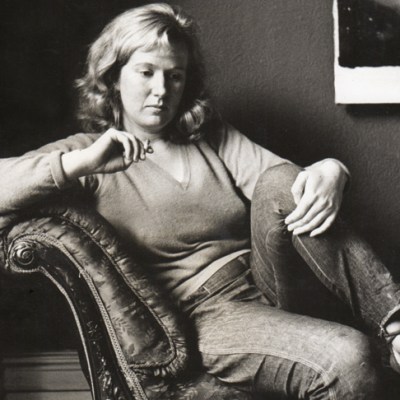
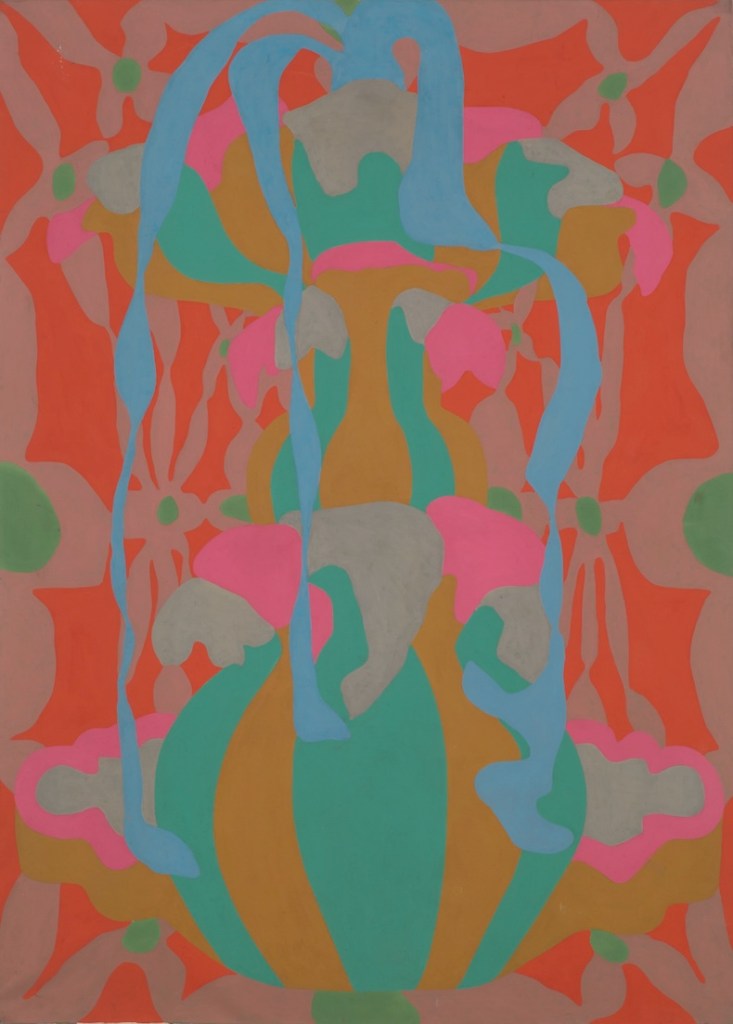
By the early ’60s, Ayres had begun her career in arts education and was working in Corsham at the Bath Academy of Art, a small school modelled on the Bauhaus. Despite the demands of teaching, the unflappable Ayres, perpetually clutching a cigarette – one of the 60 she was said to smoke a day – still made time for painting. Through the 1960 and ’70s, she kept trying new styles. Untitled (Green Pools) (1968) lays a pointillist grid over four emeralds orbs – a glance back at the circular forms present in Break-off and Brood. Fountain (1967) sits somewhere between a figurative painting and a Rorschach test, Ayres’s play with contrasting colours part-concealing the familiar form.
Ayres liked to paint on a large scale. Untitled (Cerise) (1972), her largest single-canvas work, stretches almost six metres wide. Painted in Ayres’s garden (there wasn’t room for it indoors), it’s a cheerful pink, streaked with ochre and yellow. The spaced-out curation of the show is a clever antidote to the joyful cacophony of Ayres’s painting, bringing a lightness that prevents works such as Cerise from becoming visually overwhelming. This becomes even more apparent when taking in works made between the 1980s and ’90s, where the paintings burst with colour and their surfaces thicken, impasto pilled on like layers of meringue.
In 1981, Ayres – then head of painting at Winchester School of Art – stopped teaching. The decision paid off: the ’80s was perhaps the most important decade of her career. She had solo shows at the Serpentine Gallery and the Museum of Modern Art in Oxford and was nominated for the Turner Prize in 1989. Works from this period are some of Ayres’s most arresting: Astrophil and Stella (1982–83) is a clash of lines and curves and colours, while Helios (1990)– inspired by Ayres’s travels to Jaipur – sings with heat, a sun peeking out behind a white flash that cuts a horizon across the canvas. Arching above these paintings – as in a few other spots in the show – a quotation from Ayres curves across the wall: ‘Painting is a visual thing and that’s it. People like to understand, and I wish they wouldn’t! I wish they’d just look.’ An argument could be made for these didactic decals as going slightly against the message they promote; at the same time, it’s easy to imagine the long-term teacher being happy to share a lesson in looking.
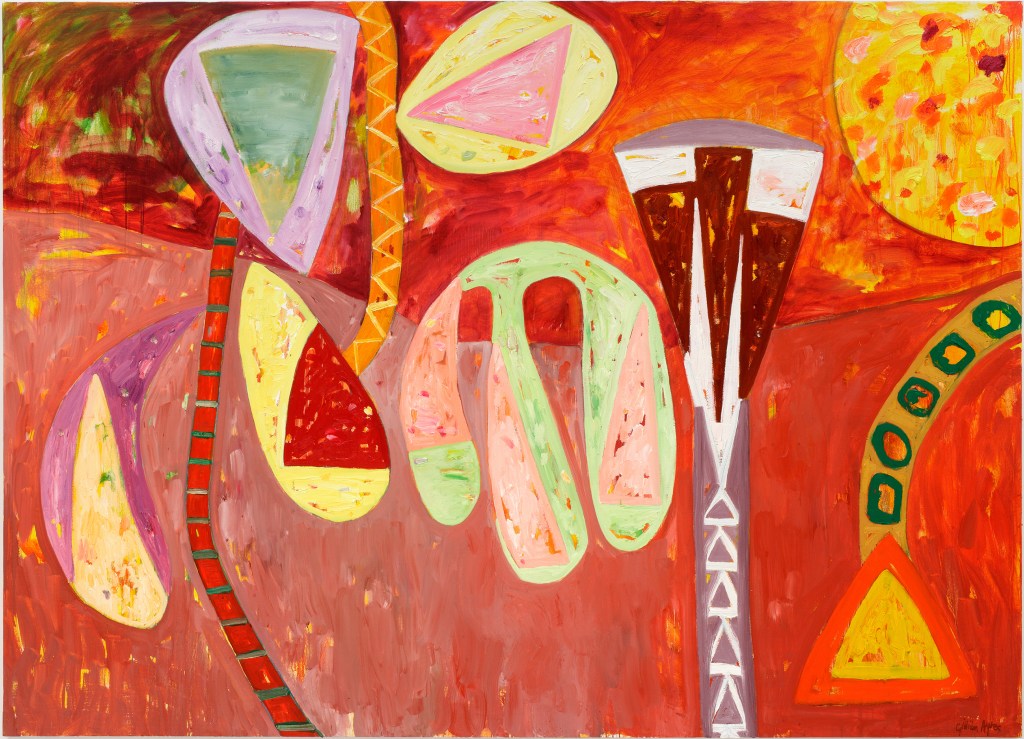
The show winds down with paintings made in the final two decades of Ayres’s life – quiet years spent on the Devon-Cornwall border. Paintings from this period are a little tighter than their predecessors, each form more defined, more angular. Triangles converge with bulbous fronds in Sang the Sun in Flight (2009), an orange painting redolent of a garden scorched by summer; Dark Carnival (2003) shows a rare use of black, a liquorice background crammed with contrasting segments of colour. While the later work lacks some of the charmed fluidity of Ayres’s earlier pieces, they show an artist bent on experimentation, paintbrush – and, no doubt, cigarette – in hand, right up until the end.
‘Gillian Ayres: A Life in Colour’ is at the Box, Plymouth, until 4 October.