From the September 2026 issue of Apollo.
Eric Symes Abbott was dean of Westminster Abbey for 15 years. After his death in 1983 he was buried in the abbey’s nave and an annual lecture was established in his name. This gives the Eric Symes Abbott Memorial Lecture a curious distinction: it is delivered almost on top of the remains of its dedicatee. This year, its 40th, the lecture was given by the writer Francis Spufford and its subject was a thorny question: why aren’t there more beautiful places?
Spufford sensibly steered wide of architectural prescriptions, sticking instead to topology and sociology. Beautiful human places tended to arise in interesting settings, from lower Manhattan to Italian hilltops. And beautiful places are often in the care of institutions – such as universities – that represent a sense of agreement over time, a continuing shared purpose.
So it’s not easy, which lets us off the hook a bit. Nevertheless there must be ways to improve the quality of everyday places so they can be reliably agreeable, enticing and pleasant, if not beautiful. This was what Gordon Cullen set out to do in his book Townscape, first published in 1961. A few days after Spufford’s lecture, Townscape’s 65th anniversary was celebrated by a one-day conference at the University of Westminster, home of the Cullen archive. Sixty-five isn’t a terribly resonant anniversary, but Cullen has enough lasting influence to draw an eager crowd. And he deserves more.
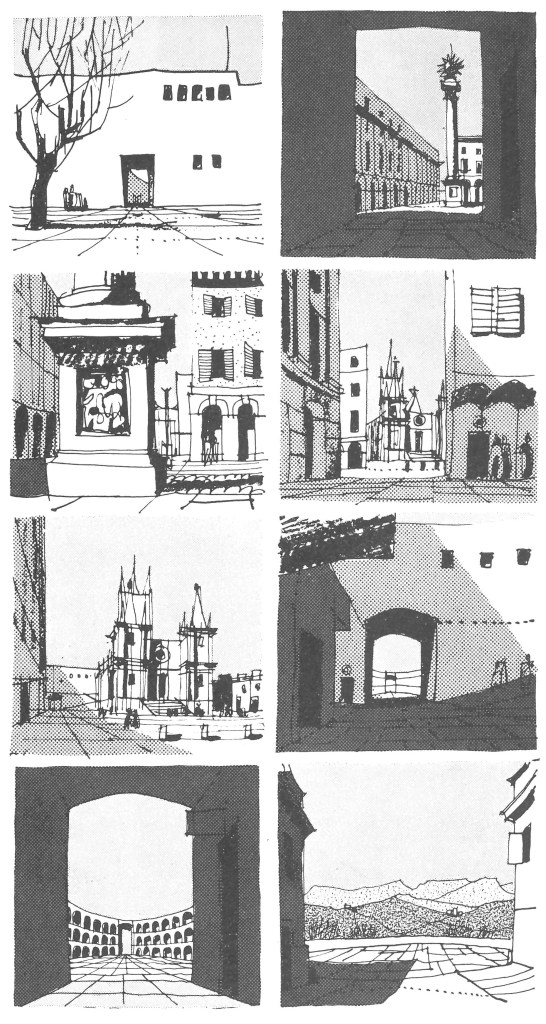
Cullen was assistant editor of the Architectural Review in the post-war period when the journal was working to expand the vocabulary of environmental design. ‘Townscape’, the word, has the strength of needing very little definition; it speaks for itself. As Cullen put it, ‘one building is architecture but two buildings is townscape.’ Townscape, the book, comprises a collection of pictures, captioned by Cullen, showing the art in action: mostly positive examples of pleasing corners, alleys and arches, beach huts and balustrades, rendered into lessons and concepts. Some of these are practical, such as ways of separating a sheltered area from circulation. Others can be a little opaque, even Zen-like, such as those grouped under the heading of ‘thisness’, or ‘a thing being itself’: ‘Nostalgia: The wind blows and the luxuriant creeper on the wall tosses and surges, but behind the glass in the dimly lit and silent room the solitary plant grows alone.’
The most enduring legacy of Townscape is the concept of ‘serial vision’, a series of images that recreates a walk through a place: the sight of a spire or dome in the distance, the sense of enclosure caused by an arch, the way a building intrudes on the view ahead but creates an impression of space beyond. Crucially, ‘serial vision’ shows how lively and mobile Cullen’s idea of place is, compared to static orthogonal elevations and plans, and how great and powerful effects can hang on quite modest touches rather than major interventions. (It is also, I suspect, a way in which comic strips have influenced the wider world.)
Rather than offering strict prescriptions, Townscape was about establishing a vocabulary of what worked, and the quicksilver touches that make the difference between the barren and the enriching. It gave planners and designers ways of seeing and thinking, from which they could intuit their own solutions. The lay reader could also play this ‘environment game’, as Cullen called it, improving the overall quality of the public discussion.
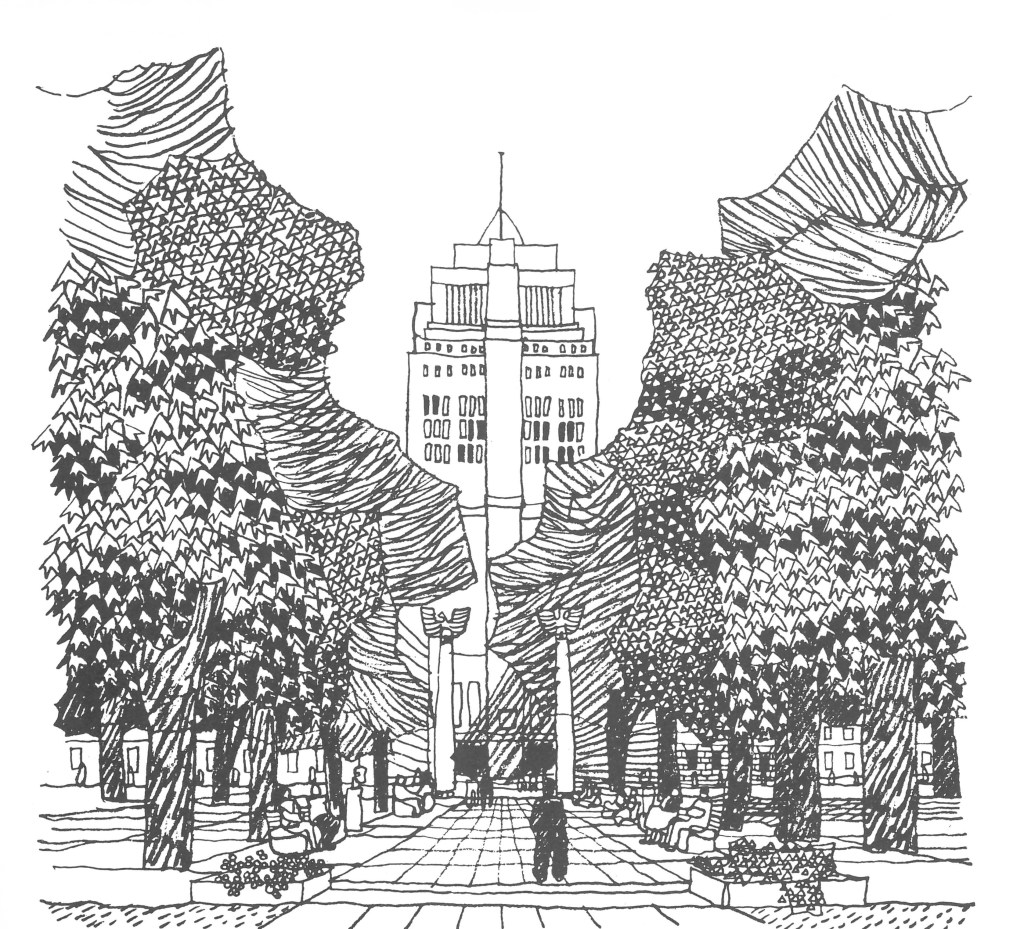
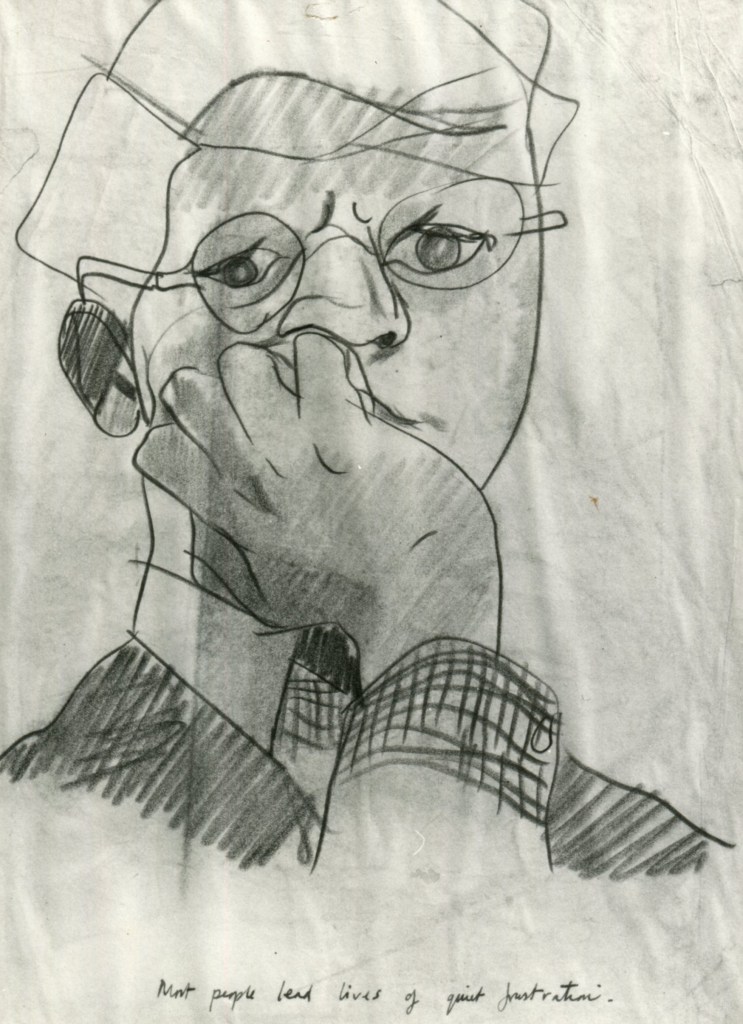
This vocabulary extended beyond words. Townscape’s scores of photographs are punctuated by Cullen’s beguiling illustrations. He was a trained architect and a draughtsman of immense skill, who evolved a style of confident looseness – whole shapes formed in single meandering lines, background figures only a tweak away from the squiggle, strong blocks of heavy pencil shading. He had a particular ability to convey variety in texture, an essential Townscape tool – different types of trees, with foliage of plain hatching or dozens of scribbled triangles, and the switch between paving slabs, cobbles and grass verge. The work has the gregarious informality of the doodle, but there is nothing thoughtless or idle about it.
A self-portrait, exhibited by the Cullen archive during the conference, shows these strengths in full: a hand and an expression wrought in a few deftly wobbly lines, the difference between cotton shirt-cuff and jacket collar evoked in bold hatching. But the expression is troubled and the caption reads: ‘Most people lead lives of quiet frustration.’ The frustration sometimes shows in the work. In the preface to the 1971 edition Cullen is frankly annoyed that the message of Townscape has not been received. ‘Superficials’ such as bollards, cobbles and pedestrian precincts have been applied, but ‘the spirit, the Environment Game itself, is still locked away in its little red and gilt box.’
One problem was that the language of Townscape – serial vision and those beguiling drawings – was easier to pick up than the underlying wisdom. Even Cullen was guilty of this. In Boom Cities: Architect-Planners and the Politics of Radical Urban Renewal in 1960s Britain (2019), Otto Saumarez Smith includes Cullen’s illustrations accompanying Graeme Shankland’s plan to push elevated motorways through central Liverpool. In Cullen’s drawing, the underside of one of these roads becomes a gently curving vaulted arcade in which informal figures blithely stroll. In Saumarez Smith’s measured judgement, it ‘shows an astonishing lack of foresight as to how these spaces would be experienced’.
This isn’t meant to condemn Cullen – a person must eat and, if such undercrofts had to exist, it was worth thinking about ways to make them as habitable as possible. In the 1971 introduction Cullen likens the problem to indigestion: cities had been forced to swallow great lumps of redevelopment and the ‘gastric juices’ – that is, the planners – had not had time to break them down into ‘emotional nutriment’. And so, as Spufford said, it comes down to human institutions, and time. But the positive legacy of Townscape is found in all sorts of unexpected places. Take the amusing and useful first-floor walkway above Villiers Street in central London, part of Terry Farrell’s Embankment Place development of 1991. This could have been utilitarian and dingy – as a pre-existing stretch of it is. But the Farrell stretch is enchanting and my children insist on detours through it. As Alistair Barr, the project architect responsible for the walkway, revealed at the conference, this was Townscape in action; thus a vast development was given a touch of joy.
From the September 2026 issue of Apollo.