From the September 2026 issue of Apollo.
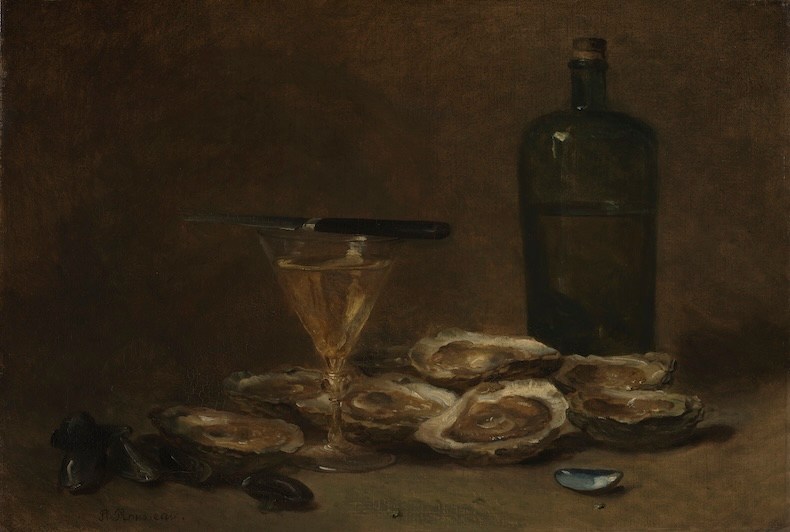
I am fascinated by oysters, but I’m not sure I like them. I know that I do not dislike them. I know that I quite like the sensation of swallowing them whole (cold slurp) and that I do not like to chew them (alarming burst). I often order them, but never more than three. I rarely partake alone. I like paintings of oysters. I have found myself, on a number of occasions, staring lustily at Philippe Rousseau’s Still Life with Oysters (probably 1875–87), thinking how much I’d like to pull up a chair at that particular table. I have considered the oyster for many hours and come to this conclusion: an oyster is an event. To shuck one is an event; to arrange it among other oysters is an event; to dress an oyster and gulp it down is an event. This is, after all, its death. And death is an event. Death is the event for which we must have the utmost respect.
I found it galling, then, working in a ‘top’ London restaurant that had made zero provision for the event of the oyster. They were served on side plates, balanced on the lids of their shells, with a teaspoon (a teaspoon) to assist their eating. Oysters would wobble precariously in the hands of waiters as they made their way across the dining hall – many did not make the passage and would invariably return to the pass, their contents spilled across their sad little plate, to be re-dressed, and the perilous crossing attempted again. This was made more irksome still by gastronomic history, which has provided us with multiple elegant approaches to the oyster’s fate. The first is ice, which cradles and cools, offering the oyster a sedate and dignified end, and the eater (the swallower) heightened sensation in the throat. Then the ice melts. Condensation gathers on the edges of its aluminium tray. Puddles proliferate. Empty shells are upturned, spilling the last of their liquor into water from whence they came. For a moment the table is a fine, watery grave.
I like this method of presentation. I like its neat symbolism and how cheaply and easily the host, chef or shucker, can create a sense of occasion. But I am a woman of ornate and indulgent tastes. What I really want is an oyster plate.
An oyster plate, for the uninitiated, is just that: a plate in which there are divots, most often six, sometimes five, for the explicit purpose of keeping the oyster safe. They are commonly painted, often with a nautical, seashell theme. There was a time when the oyster plate was a regular feature of a formal dinner set. That time was the Victorian era. But homes have got smaller since then and cupboards have diminished in size. The middle classes have fewer staff (I, for instance, keep none) and have done away with many of the specialised tools that made Victorian dining so fiddly, and elegant, and great. Modern man wants to eat all sorts of things off his crockery, not just oysters (or, at a push, devilled eggs).
It’s truly a shame, as there are some really fantastic oyster plates. There are the majolica patterns, where the oysters are fanned around a central well in oceanic greens and blues. The artist Louie Isaaman-Jones’s recent set of oyster plates (2023) are squares of poured aluminium that cradle the oysters in impressions of other oysters’ shells. I find them quite devastating in their beauty: quiet and serene and achingly modern. Isaaman-Jones uses the textures of an ice tray and the solidity of a plate to create an object that is both things at once – and a standalone art object besides. I have fantasies of owning one and freezing it, so I can present it to my guests, glistening.
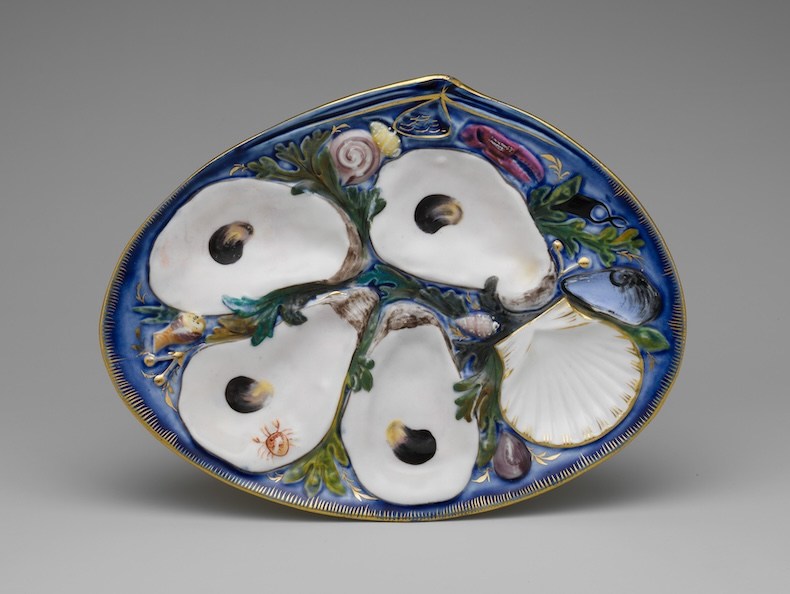
A set of oyster plates made for the US president Rutherford B. Hayes (1880) have also been subject to my coveting. They have space for five oysters, nestled in porcelain oyster shells that are arranged as if having opened themselves on a rock, surrounded by their closed compatriots and strands of seaweed, all picked out with gilded edge. I love the impulse to return the oyster to the roiling waves, paired with the reality of its gold-plated destruction. The plates remind us that we are human beings of culture, and that we are monsters.
At the dinner table, it is the oyster who forces us to meet with our most monstrous nature, a point that Lewis Carroll made famously well. The best of them are raw and pulsing; our gulp is their death. It is for this reason that they are so asking to be considered, and we have, as a culture, spent so much time doing so.
To ignore one’s most monstrous nature is to live a lie. Instead, consider the rocky bed from which the oyster was pulled, the blade that prized it apart, the gullet that seals its fate. It is only the respect, the dignity, the carefully painted plate, that separates us from these animals on which we graze.
From the September 2026 issue of Apollo.